The Old Spedling Castle's Ghost's Dance
MiniCribs
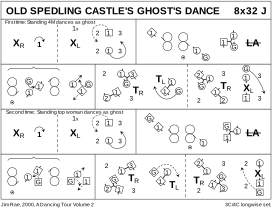
1-8
1s cross RH & cast down to 2nd place, cross LH & 1L casts up while 1M casts down
9-16
1s dance reels of 3 across RSh to 1st corners (1M followed by Ghost) & 1/2 turn LH in middle to face 3rd corners
17-24
1s dance RSh reels of 3 across (Man with 2s & Lady with 3s) & pass RSh to face 1st corners
25-32
1s turn 1st corners RH, partner LH, 2nd corner RH & partner LH back to 2nd place own side
1st Ghost (1st 32 bars)
1-8
4M stands for 8 bars
9-16
4M ‘ghosts’ 1M in reel with 3s & joins in with LH turn
17-24
4M ‘ghosts’ 1L reeling with 3s & changes to ‘ghost’ 1M who faces 1st corner
25-32
4M joins in with 1M turning 1st corner & dances long way round to lead 1M into 2nd corner, joins in RH turn & crosses back to place
2nd Ghost (2nd 32 bars)
1-8
Original 2nd Lady (now in 1st place) stands for 8 bars
9-16
Lady ‘ghosts’ 1L in reel with 3rd couple & joins in with LH turn
17-24
Lady ‘ghosts’ 1M reeling with 3rd couple & changes to ‘ghost’ 1L who faces Ladies 1st corner
25-32
Lady joins in with 1L turning 1st corner & dances long way round to lead 1L into her 2nd corner, joins in RH turn & crosses back to place
Deviser’s note: this jig may be danced with or without “The Ghost”

Заметки
The Old Spedling Castle´s Ghost´s Dance is a dance where the ‘standing’ bottom man or top lady takes the part of the ghost to enter the dance. Thus, it is somehow a dance for 3 couples and a ghost in a 4 couple longwise set.
It was first tried at a dance workshop in 2000 led by Jim Rae at the Kuckucksnest (=cuckoo’s nest) in Schlüchtern, Germany. After a few more changes it was then published in his “A Dancing Tour Volume 2” in 2004.
The recording of the tune by Green Ginger named “
The Old Spedling Castle's Ghost's Dance
” (also mentioned by Jim Rae in “A Dancing Tour Volume 2”) is only four times through. Thus, this recording might not be well suitable, if one wants to perform the dance the full eight times through in one go.
Although the name of the dance has “Spedling” (with a G) the notes refer to “Spedlins Tower” (without a G).
Spedling Castle and its Ghost
The Old Spedling Castle's Ghost's Dance
is the title of a jig tune in the collection of
James Porteous
(1762–1847), a fiddler who learned his craft under the Gows in Edinburgh and was known as
The Musical Miller of Annandale
(his day job was that of a miller and farmer). This piece of music must have fascinated
Jim Rae
to a point where he wondered what an eponymous dance might look like. In fact, at the 2000 Easter Workshop in the
Kuckucksnest
I was part of a set of guinea pigs who went through a series of iterations of the dance before Jim arrived at the final version which is published in
A Dancing Tour Volume 2
.
Of course, no ancient Scottish edifice is complete without at least one ghost – whether it is that of a dastardly-slain knight or a maiden who perished pitifully from a broken heart –, and many have served as the inspiration for dances. The Scots’ predilection for the supernatural is so well-known that many years ago during a visit to the tourist information centre in the French town of Blois, we noted a leaflet which at the bottom contained a boldface remark which dispelled all hopes concerning the famous Loire
châteaux
very succinctly: “Sorry for Scots, but our castles are
NOT
haunted!”
Spedling Castle, situated on the south bank of the Annan river in Dumfriesshire, dates from the 15th century and is the traditional seat of the Jardines of Applegarth. The ghost, James “Dunty” Porteous and indeed the great-grandfather of the composer, was also a miller and, we’re told, of an irascible disposition. He ended up in a vehement disagreement with the local landowner, Sir Alexander Jardine, and was promptly incarcerated in the castle dungeon. Soon afterwards Sir Alexander was called to Edinburgh on urgent business and departed, inadvertently forgetting to leave the keys to the dungeon and indeed any instructions for the welfare of his prisoner. Poor Dunty eventually perished from starvation and, as one does under the circumstances, promptly started haunting the castle as a ghost. Thus for some time the Jardines lived a life of nightly terror, until the family priest banished the ghost back to its dungeon – a measure which was said to be effective as long as the family bible, which had been used in the proceedings, remained on the premises. Many years later the bible was so dilapidated that it had to be sent to Edinburgh to be re-bound, and for Dunty the ghost this was the signal to raise an almighty racket in the dungeon, to a point where it was feared he might break out and wreak late revenge on his tormentor’s descendants. Eventually the bible came back and things went back to their usual quiet state. The landlady, however, declared that if the bible was ever to be removed again, she would spend not a single night in the castle.
In the 19th century the family built Jardine Hall, a manor on the other side of the river Annan (and presumably uninfested by spectral millers). Spedling Castle fell into dereliction and was only restored to serve as a residence in the 1960s (Dunty the ghost seems to leave the current inhabitants in peace), while Jardine Hall was demolished in 1964.
James Porteous, the hapless Dunty’s fiddler great-grandson, doesn’t seem to have borne a grudge towards the Jardines: His collection of tunes, which appeared around 1820 and contained, among other tunes,
The Old Spedling Castle’s Ghost’s Dance
, is dedicated to Lady Jardine of Applegarth. Jardine Hall was finished in 1818, so perhaps we can reasonably say that by the time the Jardines had decamped to the other side of the Annan, their previous abode was the
Old Spedling Castle
(haunted by a ghost) – or
Spedling Castle
(haunted by an old ghost)? You decide.
From “Anselm's Notes on Dances”, by Anselm Lingnau
(Used by permission.)
It was first tried at a dance workshop in 2000 led by Jim Rae at the Kuckucksnest (=cuckoo’s nest) in Schlüchtern, Germany. After a few more changes it was then published in his “A Dancing Tour Volume 2” in 2004.
The recording of the tune by Green Ginger named “
The Old Spedling Castle's Ghost's Dance
” (also mentioned by Jim Rae in “A Dancing Tour Volume 2”) is only four times through. Thus, this recording might not be well suitable, if one wants to perform the dance the full eight times through in one go.
Although the name of the dance has “Spedling” (with a G) the notes refer to “Spedlins Tower” (without a G).
Spedling Castle and its Ghost
The Old Spedling Castle's Ghost's Dance
is the title of a jig tune in the collection of
James Porteous
(1762–1847), a fiddler who learned his craft under the Gows in Edinburgh and was known as
The Musical Miller of Annandale
(his day job was that of a miller and farmer). This piece of music must have fascinated
Jim Rae
to a point where he wondered what an eponymous dance might look like. In fact, at the 2000 Easter Workshop in the
Kuckucksnest
I was part of a set of guinea pigs who went through a series of iterations of the dance before Jim arrived at the final version which is published in
A Dancing Tour Volume 2
.
Of course, no ancient Scottish edifice is complete without at least one ghost – whether it is that of a dastardly-slain knight or a maiden who perished pitifully from a broken heart –, and many have served as the inspiration for dances. The Scots’ predilection for the supernatural is so well-known that many years ago during a visit to the tourist information centre in the French town of Blois, we noted a leaflet which at the bottom contained a boldface remark which dispelled all hopes concerning the famous Loire
châteaux
very succinctly: “Sorry for Scots, but our castles are
NOT
haunted!”
Spedling Castle, situated on the south bank of the Annan river in Dumfriesshire, dates from the 15th century and is the traditional seat of the Jardines of Applegarth. The ghost, James “Dunty” Porteous and indeed the great-grandfather of the composer, was also a miller and, we’re told, of an irascible disposition. He ended up in a vehement disagreement with the local landowner, Sir Alexander Jardine, and was promptly incarcerated in the castle dungeon. Soon afterwards Sir Alexander was called to Edinburgh on urgent business and departed, inadvertently forgetting to leave the keys to the dungeon and indeed any instructions for the welfare of his prisoner. Poor Dunty eventually perished from starvation and, as one does under the circumstances, promptly started haunting the castle as a ghost. Thus for some time the Jardines lived a life of nightly terror, until the family priest banished the ghost back to its dungeon – a measure which was said to be effective as long as the family bible, which had been used in the proceedings, remained on the premises. Many years later the bible was so dilapidated that it had to be sent to Edinburgh to be re-bound, and for Dunty the ghost this was the signal to raise an almighty racket in the dungeon, to a point where it was feared he might break out and wreak late revenge on his tormentor’s descendants. Eventually the bible came back and things went back to their usual quiet state. The landlady, however, declared that if the bible was ever to be removed again, she would spend not a single night in the castle.
In the 19th century the family built Jardine Hall, a manor on the other side of the river Annan (and presumably uninfested by spectral millers). Spedling Castle fell into dereliction and was only restored to serve as a residence in the 1960s (Dunty the ghost seems to leave the current inhabitants in peace), while Jardine Hall was demolished in 1964.
James Porteous, the hapless Dunty’s fiddler great-grandson, doesn’t seem to have borne a grudge towards the Jardines: His collection of tunes, which appeared around 1820 and contained, among other tunes,
The Old Spedling Castle’s Ghost’s Dance
, is dedicated to Lady Jardine of Applegarth. Jardine Hall was finished in 1818, so perhaps we can reasonably say that by the time the Jardines had decamped to the other side of the Annan, their previous abode was the
Old Spedling Castle
(haunted by a ghost) – or
Spedling Castle
(haunted by an old ghost)? You decide.
From “Anselm's Notes on Dances”, by Anselm Lingnau
(Used by permission.)
Видео 1
Good

Видео 2
Good