Alyth Burn
Основная информация
| Автор: | W R Webster |
|---|---|
| RSCDS: |
 RSCDS HQ publication
|
| Сочинен в России: | Нет |
| Публикация: |
|
| Рекомендуемая музыка: | Alyth Burn |
Параметры
| Тип танца: | Jig |
|---|---|
| Тип сета: | Longwise set |
| Размер: | 8x48 |
| Формат сета: | 4 couples |
| Танцующие пары: | 3 |
Источник:
https://my.strathspey.org/dd/dance/116/
MiniCribs
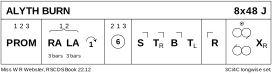
1-8
1s+2s+3s dance Promenade
9-16
1s+2s dance RH across for 3 steps, LH across & 1s cast 1 place, 2s dancing to top
17-24
2s+1s+3s circle 6H round & back 1s end facing 1st corners
25-32
1s set to 1st corners, turn corners RH & retaining hands Bal-in-Line, 1s turn LH to face 2nd corners
33-40
1s set to 2nd corners, turn RH & retaining hands Bal-in-Line; 1s turn LH to face 1st corners again
41-48
1s dance reels of 3 on opposite sides giving LSh to 1st corner, 1s cross to 2nd places
E-Cribs
1-8
1c+2c+3c Promenade
9-16
1c+2c RHA {3}, LHA {3} | 1c cast off on as 2c dance to top.
17-24
2c+1c+3c circle6 and back, 1c finish facing 1cnr
25-32
1c set to and turn 1cnr RH to join P LH ; BiL | 1c turn LH to face 2cnr
33-40
1c set to and turn 2cnr RH to join P LH ; BiL | 1c turn LH to face 1cnr
41-48
Reels3{6} with cnrs, Lsh to 1cnr | cross to 2pl (2,1,3)

Заметки
Alyth Burn
Alyth Burn is the brook that runs through the burgh of Alyth in Perthshire. A market and manufacturing
town set on the slopes of the Grampians, it is also a resort area.
About a mile from Alyth is Barry Hill and its Pictish fort where Queen Guinevere of the Arthurian legends
was purported to have been held captive by the Picts and the Scots.
Nearer to town are the ruins of Bamff Castle, once the home of the Ramsays of Bamff. The family
began with the 13th century Baron Adam de Ramsay and very nearly ended with Sir George Ramsay
who was killed in a duel in 1790 by Captain James Macrae of Holmains, a clansman of the “wild
Macraes”.
About four miles north of Alyth, on the River Isla, are two spectacular waterfalls, the Reekie Linn and
the Slug of Auchrannie.
Where the Isla meets Melgam Water, five miles from Alyth, is Airlie Castle, the ancient seat of the
Ogilvy chiefs. The old castle, built about 1432, was burned by the covenanting Campbells under
Archibald, Marquess of Argyll, who had been issued a commission by the Marquess of Montrose
of “Fire and Sword”. James Ogilvy, created Earl of Airlie by Charles I for his loyalty to the Royalist
cause was in England at the time of the attack. Tradition has it that Lady Ogilvie, wife of Lord James,
was present at Airlie and poetic license has created the ten or so children. However, it makes an
excellent story out of a fairly routine castle-burning to picture the earl’s daughter-in-law defying
Argyll and escaping across the Isla to Dundee where she gave immediate birth to a daughter.
It fell on a day, and a bonny simmer day,
When green grew aits and barley,
That there fell out a great dispute
Between Argyll and Airlie.
Argyll has raised an hunder men,
An hunder harnessed rarely,
And he’s awa by the back of Dunkell
To plunder the castle of Airlie.
Lady Ogilvy looks o’er her bower-window,
And oh, but she looks weary!
And there she spy’d the great Argyll,
Come to plunder the bonny house of Airlie.
“Come down, come down, my Lady Ogilvie,
Come down, and kiss me fairly.”
“O I winna kiss the fause Argyll,
If he should na leave a standing stane in Airlie.”
He hath taken her by the left shoulder,
Says, “Dame where lies thy dowry?”
“O it’s east and west yon wan water side,
And it’s down by the banks of the Airlie.”
They hae sought it up, they hae sought it down,
They hae sought it maist severely,
Till they fand it in the fair plumb-tree
That shines on the bowling-green of Airlie.
He hath taken her by the middle sae small,
And O, but she grat sairly!
And laid her down by the bonny burn-side,
Till they plundered the castle of Airlie.
“Gif my gude lord war here this night,
As he is with King Charlie,
Neither you, nor ony ither Scottish lord,
Durst avow to the plundering of Airlie.
“Gif my gude lord war now at hame,
As he is with his king,
There durst nae a Campbell in a’ Argyll
Set fit on Airlie green.
“Ten bony sons I have born unto him,
The eleventh ne’er saw his daddy;
But though I had an hundred mair,
I’d gie them a’ to King Charlie.”
Five years later, in 1645, the Royalists evened the score by burning Castle Campbell, near Dollar
in Clackmannanshire, otherwise known as Castle of Gloom, between the Water of Care and the
Burn of Sorrow. Montrose had, by this time, changed his political colours and crushed Argyll
and the Campbells at Inverlochy in the name of “King Charlie”.
From “Scotland Dances”, by Eugenia (Jeannie) Callander Sharp
(Used by permission.)
Alyth Burn is the brook that runs through the burgh of Alyth in Perthshire. A market and manufacturing
town set on the slopes of the Grampians, it is also a resort area.
About a mile from Alyth is Barry Hill and its Pictish fort where Queen Guinevere of the Arthurian legends
was purported to have been held captive by the Picts and the Scots.
Nearer to town are the ruins of Bamff Castle, once the home of the Ramsays of Bamff. The family
began with the 13th century Baron Adam de Ramsay and very nearly ended with Sir George Ramsay
who was killed in a duel in 1790 by Captain James Macrae of Holmains, a clansman of the “wild
Macraes”.
About four miles north of Alyth, on the River Isla, are two spectacular waterfalls, the Reekie Linn and
the Slug of Auchrannie.
Where the Isla meets Melgam Water, five miles from Alyth, is Airlie Castle, the ancient seat of the
Ogilvy chiefs. The old castle, built about 1432, was burned by the covenanting Campbells under
Archibald, Marquess of Argyll, who had been issued a commission by the Marquess of Montrose
of “Fire and Sword”. James Ogilvy, created Earl of Airlie by Charles I for his loyalty to the Royalist
cause was in England at the time of the attack. Tradition has it that Lady Ogilvie, wife of Lord James,
was present at Airlie and poetic license has created the ten or so children. However, it makes an
excellent story out of a fairly routine castle-burning to picture the earl’s daughter-in-law defying
Argyll and escaping across the Isla to Dundee where she gave immediate birth to a daughter.
It fell on a day, and a bonny simmer day,
When green grew aits and barley,
That there fell out a great dispute
Between Argyll and Airlie.
Argyll has raised an hunder men,
An hunder harnessed rarely,
And he’s awa by the back of Dunkell
To plunder the castle of Airlie.
Lady Ogilvy looks o’er her bower-window,
And oh, but she looks weary!
And there she spy’d the great Argyll,
Come to plunder the bonny house of Airlie.
“Come down, come down, my Lady Ogilvie,
Come down, and kiss me fairly.”
“O I winna kiss the fause Argyll,
If he should na leave a standing stane in Airlie.”
He hath taken her by the left shoulder,
Says, “Dame where lies thy dowry?”
“O it’s east and west yon wan water side,
And it’s down by the banks of the Airlie.”
They hae sought it up, they hae sought it down,
They hae sought it maist severely,
Till they fand it in the fair plumb-tree
That shines on the bowling-green of Airlie.
He hath taken her by the middle sae small,
And O, but she grat sairly!
And laid her down by the bonny burn-side,
Till they plundered the castle of Airlie.
“Gif my gude lord war here this night,
As he is with King Charlie,
Neither you, nor ony ither Scottish lord,
Durst avow to the plundering of Airlie.
“Gif my gude lord war now at hame,
As he is with his king,
There durst nae a Campbell in a’ Argyll
Set fit on Airlie green.
“Ten bony sons I have born unto him,
The eleventh ne’er saw his daddy;
But though I had an hundred mair,
I’d gie them a’ to King Charlie.”
Five years later, in 1645, the Royalists evened the score by burning Castle Campbell, near Dollar
in Clackmannanshire, otherwise known as Castle of Gloom, between the Water of Care and the
Burn of Sorrow. Montrose had, by this time, changed his political colours and crushed Argyll
and the Campbells at Inverlochy in the name of “King Charlie”.
From “Scotland Dances”, by Eugenia (Jeannie) Callander Sharp
(Used by permission.)
Видео 1
Demonstration quality

Видео 2
Good