Phase Rule
Основная информация
| Автор: | Robert Gregg |
|---|---|
| RSCDS: | Не RSCDS |
| Сочинен в России: | Нет |
| Публикация: | The Arches of MacGregor and other Scottish Country Dances |
| Рекомендуемая музыка: | - |
Параметры
| Тип танца: | Reel |
|---|---|
| Тип сета: | Longwise set |
| Размер: | 8x32 |
| Формат сета: | 4 couples |
| Танцующие пары: | 3 |
E-Cribs
1-8
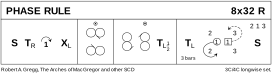
1c set | turn RH ; cast (2c up) | cross LH to 2plx (2,1x,3)
9-16
Reels3 on sides, 1c LSh to 2cnrs (2,1x,3)
17-24
Reels3{6} across, 1c RSh to 1cnrs | 1c turn P LH ½
25-32
1c turn{3} P LH, dance{3} LSh round 3cnrs to 2pl | all set (2,1,3)

Заметки
Notes:
Bars 17-20 1st couple must take measured steps to be in the middle (halfway) on bar 19
Bars 25-30 1st couple should make the tum in 3 bars leaving 3 bars to dance out the end and cast to 2nd place
The New Haven Scottish Country Dance class since its founding has danced within a few blocks of the spot on Wall Street where J. Willard Gibbs spent his life (1839-1903). Educated at Hopkins Grammar School and Yale, he received the first doctorate in engineering ever given in the U.S.A. in 1863. He taught Latin for two years and Natural Philosophy for one year at Yale before spending three years in Paris, Berlin and Heidelberg. He returned to Yale in 1869 and in 1871 became Professor of Mathematical Physics.
In 1878, he published the second part of his “Equilibrium of Heterogeneous Substances”, one of the most important works in the history of chemistry. To quote Prof Frank H. MacDougall, M.f. (Queen’s), Ph.D. (Leipzig) “Where F is the number of degrees of freedom of a system of C components in P phases in equilibrium F = C + 2 - P. This is the famous Phase Rule enunciated by Willard Gibbs”. The phase rule is especially useful in the study of heterogeneous equilibria that are the bases of many important industrial processes. The Gibbs Medal of the American Chemical Society has been a yearly award to outstanding chemists starting with Svante A. Arrhenius in 1911.
Gibb’s work in vector analysis is of import in pure mathematics. He applied it to find the orbit of a comet from just three observations. He made advancements in the electromagnetic theory of light, in statistical mechanics and in thermodynamics. He was greatly admired by such as Kirchoff, Helmholtz and James C. Maxwell. He was awarded the Copley Medal of the Royal Society, the most prestigious science prize of his day.
Bars 17-20 1st couple must take measured steps to be in the middle (halfway) on bar 19
Bars 25-30 1st couple should make the tum in 3 bars leaving 3 bars to dance out the end and cast to 2nd place
The New Haven Scottish Country Dance class since its founding has danced within a few blocks of the spot on Wall Street where J. Willard Gibbs spent his life (1839-1903). Educated at Hopkins Grammar School and Yale, he received the first doctorate in engineering ever given in the U.S.A. in 1863. He taught Latin for two years and Natural Philosophy for one year at Yale before spending three years in Paris, Berlin and Heidelberg. He returned to Yale in 1869 and in 1871 became Professor of Mathematical Physics.
In 1878, he published the second part of his “Equilibrium of Heterogeneous Substances”, one of the most important works in the history of chemistry. To quote Prof Frank H. MacDougall, M.f. (Queen’s), Ph.D. (Leipzig) “Where F is the number of degrees of freedom of a system of C components in P phases in equilibrium F = C + 2 - P. This is the famous Phase Rule enunciated by Willard Gibbs”. The phase rule is especially useful in the study of heterogeneous equilibria that are the bases of many important industrial processes. The Gibbs Medal of the American Chemical Society has been a yearly award to outstanding chemists starting with Svante A. Arrhenius in 1911.
Gibb’s work in vector analysis is of import in pure mathematics. He applied it to find the orbit of a comet from just three observations. He made advancements in the electromagnetic theory of light, in statistical mechanics and in thermodynamics. He was greatly admired by such as Kirchoff, Helmholtz and James C. Maxwell. He was awarded the Copley Medal of the Royal Society, the most prestigious science prize of his day.