Cherry Blossom Season
Основная информация
| Автор: | Jacob Steel |
|---|---|
| RSCDS: | Не RSCDS |
| Сочинен в России: | Нет |
| Публикация: | - |
| Рекомендуемая музыка: | - |
Параметры
| Тип танца: | Jig |
|---|---|
| Тип сета: | Longwise set |
| Размер: | 8x32 |
| Формат сета: | 4 couples |
| Танцующие пары: | 3 |
E-Cribs
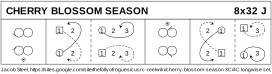
1-8
Mirror Reels3 on sides, 1c in
9-16
1c ½ Fig8 down round 2c ; dance down between 3c (2c up) | cast up to 2plx
17-24
Mirror Reels3 on sides, 1c in and up
25-32
1c ½ Fig8 up round 2c ; dance down between 3c | cast up to 2pl (2,1,3)

Заметки
Cherry Blossoms
To the Japanese, cherry blossoms are an extremely important cultural symbol for the transience of life, and every year a source of communal bliss when the flowery splendour rolls across the Japanese islands in a wave from South to North.
Hanami
(花見) or “flower watching” is a reason for joyful picnics during the day or at nighttime from late March to early May, and requires careful planning because at every given location the cherry blossoms last for just one or two weeks. At the time of year in question, cherry blossom predictions are part of the official forecast by the
Japan Meteorological Agency
.
Should one have missed the cherry blossom season, one can still console oneself with the plum blossom season, which is celebrated a little more sedately and with which the phenomenon started in the Nara period (8th century CE); a few centuries later the cherry dominated, and is now the archetype of the “flower” at least for the purposes of
hanami
. Originally
hanami
was a pastime of the Imperial court, later the
samurai
nobility, and in the Edo period (17th to 19th c.) finally also for the common people. No wonder that
Iain Boyd
's dance,
Cherry Blossoms
, uses for its music
Sakura Sakura
(“cherry blossom, cherry blossom”), a pentatonic ditty whose popularity in Japan can only be compared to that of
Twinkle, Twinkle, Little Star
in the English-speaking world. Whether it is unequivocally suitable for Scottish dancing is a different question, but it is certainly a diversion.
From “Anselm's Notes on Dances”, by Anselm Lingnau
(Used by permission.)
To the Japanese, cherry blossoms are an extremely important cultural symbol for the transience of life, and every year a source of communal bliss when the flowery splendour rolls across the Japanese islands in a wave from South to North.
Hanami
(花見) or “flower watching” is a reason for joyful picnics during the day or at nighttime from late March to early May, and requires careful planning because at every given location the cherry blossoms last for just one or two weeks. At the time of year in question, cherry blossom predictions are part of the official forecast by the
Japan Meteorological Agency
.
Should one have missed the cherry blossom season, one can still console oneself with the plum blossom season, which is celebrated a little more sedately and with which the phenomenon started in the Nara period (8th century CE); a few centuries later the cherry dominated, and is now the archetype of the “flower” at least for the purposes of
hanami
. Originally
hanami
was a pastime of the Imperial court, later the
samurai
nobility, and in the Edo period (17th to 19th c.) finally also for the common people. No wonder that
Iain Boyd
's dance,
Cherry Blossoms
, uses for its music
Sakura Sakura
(“cherry blossom, cherry blossom”), a pentatonic ditty whose popularity in Japan can only be compared to that of
Twinkle, Twinkle, Little Star
in the English-speaking world. Whether it is unequivocally suitable for Scottish dancing is a different question, but it is certainly a diversion.
From “Anselm's Notes on Dances”, by Anselm Lingnau
(Used by permission.)