Archduke John of Austria
Основная информация
| Автор: | John W Mitchell |
|---|---|
| RSCDS: | Не RSCDS |
| Сочинен в России: | Нет |
| Публикация: | Whetherly Book 4 |
| Рекомендуемая музыка: | - |
Параметры
| Тип танца: | Strathspey |
|---|---|
| Тип сета: | Longwise set |
| Размер: | 8x32 |
| Формат сета: | 4 couples |
| Танцующие пары: | 3 |
Источник:
https://my.strathspey.org/dd/dance/205/
E-Cribs
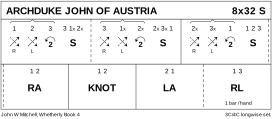
1-8
1c cross down RH to 2plx while 2c cross down LH to 3plx while 3c cast up to 1pl (to 3,1x,2x) | all set ; all repeat same pattern [1-4] (2x,3x,1)
9-16
All repeat same pattern [1-4] (to 1,2,3) ; 1c+2c RHA (1,2,3)
17-24
1c+2c The Knot (2,1,3)
25-32
2c+1c LHA ; 1c+3c R&L one step per hand (2,1,3)

Заметки
Archduke John of Austria
“Holleri di dudel dö” – our German audience will surely be familiar with the
Erzherzog-Johann-Jodler
from Loriot’s (that greatest of post-war German humorist’s) skit,
Die Jodelschule (The Yodeling School). That there is a Scottish country dance dedicated to the Austrian general and politician (1782–1859) may come as more of a surprise. James Stewart-Robertson’s
Athole Collection
, published in 1884 and an indispensable compendium of 19th-century Scottish dance music, however, does contain a tune called
Archduke John of Austria
, a classic, fairly energetic, strathspey, and it is quite conceivable that it should inspire a dance.
The namesake of the dance was a member of the house of Habsburg and a brother of the later emperor, Franz (Francis) I. Even in very young years he was elevated to exalted military rank (he became a major general in 1795, at age 13) and fought in the wars of the coalition at the start of the 19th century, with varying degrees of success, against Napoleonic France. Later on he settled in Styria and pursued – as a private person – various initiatives and measures to improve the lot of the Styrians. In 1815/16 he travelled to England to study the industry there, and it is quite possible that the strathspey named after him came about at that time. In 1819, John met the 15-year-old Anna Plochl, daughter of the Aussee postmaster (John himself was 37, creepy), whom he married (Anna, not the postmaster) ten years later – a step which catapulted him out of the line of succession and made it impossible for his children to be part of the nobility. (In 1834, Franz I styled Anna “baroness of Brandhofen”, and Anna’s and John’s son Franz, born in 1839, was eventually made the count of Meran, a hereditary title; five more years on Anna became countess of Meran.)
In 1848, the (German) National Assembly in Frankfurt elected John imperial regent, or
Reichsverweser, in other words the head of a provisional pan-German government. John was particularly qualified for this job because he was of the nobility (which the monarchists liked), Austrian (grist to the mill for the proponents of a Grossdeutschland
(Greater Germany) including Austria), and popular with the people (which reconciled the Left with him). In addition, John was a declared opponent of Metternich, who in turn was an uncompromising arch-enemy of any and all national and liberal tendencies and therefore anathema at the National Assembly. John’s office survived the violent overthrow of the 1848 revolution, but even so in December 1849 he transferred his privileges to the “Federal Central Commission” (
Bundeszentralkommission
), which merged with the
Deutscher Bund
(German League) in 1851. Subsequently he returned to Styria, where in 1850 he was elected mayor of Stainz town, an office which he maintained until 1858. In 1859 John died from the consequences of pneumonia, and he is buried near Castle Schenna in South Tyrol.
Incidentally, the
Erzherzog-Johann-Jodler
actually exists; its lyrics were written in 1830 by Anton Schosser in Schärding (Upper Austria), but we don’t know who composed the melody.
From “Anselm's Notes on Dances”, by Anselm Lingnau
(Used by permission.)
“Holleri di dudel dö” – our German audience will surely be familiar with the
Erzherzog-Johann-Jodler
from Loriot’s (that greatest of post-war German humorist’s) skit,
Die Jodelschule (The Yodeling School). That there is a Scottish country dance dedicated to the Austrian general and politician (1782–1859) may come as more of a surprise. James Stewart-Robertson’s
Athole Collection
, published in 1884 and an indispensable compendium of 19th-century Scottish dance music, however, does contain a tune called
Archduke John of Austria
, a classic, fairly energetic, strathspey, and it is quite conceivable that it should inspire a dance.
The namesake of the dance was a member of the house of Habsburg and a brother of the later emperor, Franz (Francis) I. Even in very young years he was elevated to exalted military rank (he became a major general in 1795, at age 13) and fought in the wars of the coalition at the start of the 19th century, with varying degrees of success, against Napoleonic France. Later on he settled in Styria and pursued – as a private person – various initiatives and measures to improve the lot of the Styrians. In 1815/16 he travelled to England to study the industry there, and it is quite possible that the strathspey named after him came about at that time. In 1819, John met the 15-year-old Anna Plochl, daughter of the Aussee postmaster (John himself was 37, creepy), whom he married (Anna, not the postmaster) ten years later – a step which catapulted him out of the line of succession and made it impossible for his children to be part of the nobility. (In 1834, Franz I styled Anna “baroness of Brandhofen”, and Anna’s and John’s son Franz, born in 1839, was eventually made the count of Meran, a hereditary title; five more years on Anna became countess of Meran.)
In 1848, the (German) National Assembly in Frankfurt elected John imperial regent, or
Reichsverweser, in other words the head of a provisional pan-German government. John was particularly qualified for this job because he was of the nobility (which the monarchists liked), Austrian (grist to the mill for the proponents of a Grossdeutschland
(Greater Germany) including Austria), and popular with the people (which reconciled the Left with him). In addition, John was a declared opponent of Metternich, who in turn was an uncompromising arch-enemy of any and all national and liberal tendencies and therefore anathema at the National Assembly. John’s office survived the violent overthrow of the 1848 revolution, but even so in December 1849 he transferred his privileges to the “Federal Central Commission” (
Bundeszentralkommission
), which merged with the
Deutscher Bund
(German League) in 1851. Subsequently he returned to Styria, where in 1850 he was elected mayor of Stainz town, an office which he maintained until 1858. In 1859 John died from the consequences of pneumonia, and he is buried near Castle Schenna in South Tyrol.
Incidentally, the
Erzherzog-Johann-Jodler
actually exists; its lyrics were written in 1830 by Anton Schosser in Schärding (Upper Austria), but we don’t know who composed the melody.
From “Anselm's Notes on Dances”, by Anselm Lingnau
(Used by permission.)