The Fife Hunt
Основная информация
| Автор: | Unknown |
|---|---|
| RSCDS: |
 RSCDS HQ publication
|
| Сочинен в России: | Нет |
| Публикация: |
|
| Рекомендуемая музыка: | The Fife Hunt |
Параметры
| Тип танца: | Reel |
|---|---|
| Тип сета: | Longwise set |
| Размер: | 8x32 |
| Формат сета: | 4 couples |
| Танцующие пары: | 3 |
Источник:
https://my.strathspey.org/dd/dance/2156/
MiniCribs
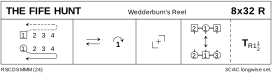
1-8
1s cast down below 3s turn out & cast back to top
9-16
1s lead down the middle for 3 steps, back to top & cast to 2nd place & face 1st corners
17-24
1s turn 1st corner RH, partner LH, 2nd corner RH & partner LH to end 2nd place opposite sides
25-32
2s+1s+3s Adv+Ret, 1s turn RH 1.1/2 times
E-Cribs
1-8
1c cast off two ; cast back to places
9-16
1c lead down the middle {3}, and up {3}, cast off to face 1cnrs (2c up)
17-24
Turn CPCP, finish between corners
25-32
2c+1c+3c A&R, 1c 1½ RH turn to 2pl.

Заметки
The choreography of this dance is identical to that of
Wedderburn's Reel
.
The Fife Hunt
Hunts began in early times in Scotland as an autumn gathering
for the driving out of the deer from the forests for winter food
and, eventually, they became military exercises
to perfect that type of warfare based upon stalking and surprise attack
that was peculiar to the Scots.
In more modern times the gathering would culminate in a ball or a series of them on successive nights.
Now that a gathering is no longer needed to show off military prowess
the hunts which occur during the shooting season in various parts of Scotland
hav bcome largely social occasions.
Carolina Oliphant, Baroness Nairne (1766–1845),
wrote some amusing verses to the original tune “The Fife Hunt”
composed by William Gow (1751–1791) which,
though they have nothing to do with either the hunt or the hall, are worth reproducing.
Ye should na’ ca’ the Laird daft, tho’ daft-like he may be;
Ye should na’ ca’ the Laird daft, he’s just as wise as me;
Ye should na’ ca’ the Laird daft, his bannet has a bee, –
He’s just a wee bit Fifish, like some Fife Lairds that be.
Last Lammas when the Laird set out, to see Auld Reekie’s toun,
The Firth it had nae waves at a’, the waves were sleepin’ soun’;
But wicked witches bide about gude auld St Andrews toun,
And they steer’d up an unco’ blast, our ain dear Laird to droun.
Afore he got to Inchkeith Isle, the waves were white an’ hie –
“O weel I ken thae witches woud hae aye a spite at me!”
They drove him up, they drove him doun, the Fife touns a’ they pass,
And up and round Queensferry toun, then doun unto the Bass.
The sailors row, but row in vain, Leith port they canna gain –
Nae meat nor beds they hae on board, but
there
they maun remain;
O mirk and cauld the midnight hour, how thankfu’ they did see
The first blush o’ dawnin’ day, fair spreadin’ ower the sea.
“Gae hame, gae hame,” the Laird cried out, “as fast as ye can gang,
O! rather than wi’ witches meet, I’d meet an
ournatang
.
A’ nicht and day I’ve been a way, an’ naething could I see,
But auld wives’ cantrips on broomsticks, wild cap’ring ower the sea.
I ha’e na’ had a mouth o’ meat, not yet had aff my claes –
Afore I gang to sea again, some
folk
maun mend their ways;”
The Laird is hame wi’ a’ his ain, below the Lomond hill,
Richt glad to see his sheep again, his ookit and his mill!
The east coast county of Fife is very nearly an island for,
jutting out as it does into the North Sea
between the Firth of Forth to the south and the Firth of Tay to th enorth,
its coastline measures a little over a hundred miles.
By tradition Fife is called “kingdom” as opposed to the usual term “shire”.
While never a separate kingdom, Fife was once ruled as such by its overlords, the MacDuff Earls of Fife.
Its southern coast, within view of Edinburgh across the Firth of Forth,
is dotted with the ancient fishing villages of Largo, Elie, Anstruther and Crail.
Beyond the headland of Fife Ness is St. Andrews,
the venerable grey town of red-robed university students
and the ruins of violently destroyed castle and cathedral.
Inland Fife is a douce land, verdant and fertile, a burgeoning market garden.
Western Fife was for centuries a coal mining centre,
but this industry had begun to wane from its former black glory for its owners
and bleak living conditions for its workers.
The Kingdom of Fife has been the scene of historic events.
Falkland was the pleasure palace of kings. (See “Falkland Beauty”)
At St. Andrews James III was born, James V and Marie de Guise were married,
Covenanting martyrs were burned at the stake
and Cardinal Beaton and Archbishop Sharp were murdered.
Malcolm III and Robert the Bruce are buried in Dunfermline Abbey.
Charles I was born in Dunfermline as was Andrew Carnegie.
There James VI signed the National Covenant and Charles II the Dunfermline Declaration,
a statement that expressed regret that his father, Charles I,
had opposed the Solemn League and Covenant.
Kirkcaldy was the birthplace of the economist and philosopher Adam Smith
and the great family of architects, city planners and designers,
William Adam and his sons, John, Robert and James.
From “Scotland Dances”, by Eugenia (Jeannie) Callander Sharp
(Used by permission.)
Wedderburn's Reel
.
The Fife Hunt
Hunts began in early times in Scotland as an autumn gathering
for the driving out of the deer from the forests for winter food
and, eventually, they became military exercises
to perfect that type of warfare based upon stalking and surprise attack
that was peculiar to the Scots.
In more modern times the gathering would culminate in a ball or a series of them on successive nights.
Now that a gathering is no longer needed to show off military prowess
the hunts which occur during the shooting season in various parts of Scotland
hav bcome largely social occasions.
Carolina Oliphant, Baroness Nairne (1766–1845),
wrote some amusing verses to the original tune “The Fife Hunt”
composed by William Gow (1751–1791) which,
though they have nothing to do with either the hunt or the hall, are worth reproducing.
Ye should na’ ca’ the Laird daft, tho’ daft-like he may be;
Ye should na’ ca’ the Laird daft, he’s just as wise as me;
Ye should na’ ca’ the Laird daft, his bannet has a bee, –
He’s just a wee bit Fifish, like some Fife Lairds that be.
Last Lammas when the Laird set out, to see Auld Reekie’s toun,
The Firth it had nae waves at a’, the waves were sleepin’ soun’;
But wicked witches bide about gude auld St Andrews toun,
And they steer’d up an unco’ blast, our ain dear Laird to droun.
Afore he got to Inchkeith Isle, the waves were white an’ hie –
“O weel I ken thae witches woud hae aye a spite at me!”
They drove him up, they drove him doun, the Fife touns a’ they pass,
And up and round Queensferry toun, then doun unto the Bass.
The sailors row, but row in vain, Leith port they canna gain –
Nae meat nor beds they hae on board, but
there
they maun remain;
O mirk and cauld the midnight hour, how thankfu’ they did see
The first blush o’ dawnin’ day, fair spreadin’ ower the sea.
“Gae hame, gae hame,” the Laird cried out, “as fast as ye can gang,
O! rather than wi’ witches meet, I’d meet an
ournatang
.
A’ nicht and day I’ve been a way, an’ naething could I see,
But auld wives’ cantrips on broomsticks, wild cap’ring ower the sea.
I ha’e na’ had a mouth o’ meat, not yet had aff my claes –
Afore I gang to sea again, some
folk
maun mend their ways;”
The Laird is hame wi’ a’ his ain, below the Lomond hill,
Richt glad to see his sheep again, his ookit and his mill!
The east coast county of Fife is very nearly an island for,
jutting out as it does into the North Sea
between the Firth of Forth to the south and the Firth of Tay to th enorth,
its coastline measures a little over a hundred miles.
By tradition Fife is called “kingdom” as opposed to the usual term “shire”.
While never a separate kingdom, Fife was once ruled as such by its overlords, the MacDuff Earls of Fife.
Its southern coast, within view of Edinburgh across the Firth of Forth,
is dotted with the ancient fishing villages of Largo, Elie, Anstruther and Crail.
Beyond the headland of Fife Ness is St. Andrews,
the venerable grey town of red-robed university students
and the ruins of violently destroyed castle and cathedral.
Inland Fife is a douce land, verdant and fertile, a burgeoning market garden.
Western Fife was for centuries a coal mining centre,
but this industry had begun to wane from its former black glory for its owners
and bleak living conditions for its workers.
The Kingdom of Fife has been the scene of historic events.
Falkland was the pleasure palace of kings. (See “Falkland Beauty”)
At St. Andrews James III was born, James V and Marie de Guise were married,
Covenanting martyrs were burned at the stake
and Cardinal Beaton and Archbishop Sharp were murdered.
Malcolm III and Robert the Bruce are buried in Dunfermline Abbey.
Charles I was born in Dunfermline as was Andrew Carnegie.
There James VI signed the National Covenant and Charles II the Dunfermline Declaration,
a statement that expressed regret that his father, Charles I,
had opposed the Solemn League and Covenant.
Kirkcaldy was the birthplace of the economist and philosopher Adam Smith
and the great family of architects, city planners and designers,
William Adam and his sons, John, Robert and James.
From “Scotland Dances”, by Eugenia (Jeannie) Callander Sharp
(Used by permission.)
Видео 1
Good