The Milngavie Maestro
Основная информация
| Автор: | Gary Coull |
|---|---|
| RSCDS: | Не RSCDS |
| Сочинен в России: | Нет |
| Публикация: | The Diack Dances |
| Рекомендуемая музыка: | The Milngavie Maestro |
Параметры
| Тип танца: | Jig |
|---|---|
| Тип сета: | Longwise set |
| Размер: | 8x32 |
| Формат сета: | 4 couples |
| Танцующие пары: | 3 |
MiniCribs
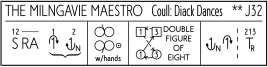
1-8
1s+2s set, dance RH across, 1s cast to 2nd place as 2s dance up & face out
9-16
2s+1s+3s dance mirror reels of 3 on sides giving hands (2s out/down,1s in/down, 3s out/up). 2s & 3s curve into place & 3s face out
17-24
1s+3s dance Double Fig 8 (1s cross down, 3s dance up to start)
25-32
1s dance up between 2s NHJ, cast to 2nd place & 2s+1s+3s turn partner RH. 2 1 3
E-Cribs
1-8
1c+2c set | RHA | 1c cast off as 2c dance up & face out (2,1,3)
9-16
Reels3 on sides, 1c start in & down, all join NH where possible. 2c & 3c end curving into place, 3c face out
17-24
1c+3c DblFig8, 1c start crossing down
25-32
1c dance up between 2c | cast off ; all turn P RH (2,1,3)

Заметки
NB “Milngavie” is pronounced “Mil-gai”.
Milngavie
Milngavie is one of those places in Scotland whose names can trip up the uninitiated: “Milngavie” is not pronounced as written, but sounds rather more like “Mllguy” (with the stress on the second syllable). The name derives from the Gaelic, either
Muileann Gaoithe
(windmill) or
Meall na Gaoithe
(wind mountain).
The town is located on the northern outskirts of Glasgow and is home to approximately 13,500 inhabitants; it is well-known to tourists mostly as the starting point of the popular long-distance hiking path,
The West Highland Way
(leading all the way to Fort William past such iconic landmarks as Loch Lomond, Rannoch Moor, and Glencoe). Other than that it mostly serves as a sleeping town for Glasgow commuters.
From “Anselm's Notes on Dances”, by Anselm Lingnau
(Used by permission.)
Milngavie
Milngavie is one of those places in Scotland whose names can trip up the uninitiated: “Milngavie” is not pronounced as written, but sounds rather more like “Mllguy” (with the stress on the second syllable). The name derives from the Gaelic, either
Muileann Gaoithe
(windmill) or
Meall na Gaoithe
(wind mountain).
The town is located on the northern outskirts of Glasgow and is home to approximately 13,500 inhabitants; it is well-known to tourists mostly as the starting point of the popular long-distance hiking path,
The West Highland Way
(leading all the way to Fort William past such iconic landmarks as Loch Lomond, Rannoch Moor, and Glencoe). Other than that it mostly serves as a sleeping town for Glasgow commuters.
From “Anselm's Notes on Dances”, by Anselm Lingnau
(Used by permission.)
Видео 1
Demonstration quality

Видео 2
Good