The Glasgow Highlanders
Основная информация
| Автор: | Unknown |
|---|---|
| RSCDS: |
 RSCDS HQ publication
|
| Сочинен в России: | Нет |
| Публикация: |
|
| Рекомендуемая музыка: |
|
Параметры
| Тип танца: | Strathspey |
|---|---|
| Тип сета: | Longwise set |
| Размер: | 8x32 |
| Формат сета: | 2 couples (Glasgow Highl) |
| Танцующие пары: | 2 |
Источник:
https://my.strathspey.org/dd/dance/2498/
MiniCribs
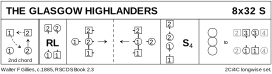
2 Ch - 1M stand as 1L crosses to 2M pl who crosses to ptnrs pl, 2L steps up
1-8
1s+2s dance R&L ending with 2M between 1L+2L facing down 1M directly behind 2M
9-16
All dance down middle, turn right about & 1M dances Ladies back to top (2M follows) to form a line 4 across with Men BtoB facing partners
17-24
All set to partners with suitable step
25-32
All dance reel of 4 across ending in new pstns with each couple having moved 1 place anticlockwise round set
On bars 31/32 3M crosses to partners place as 3L steps up to start next 32 bars
Similarly on bars 31/32 (2nd time through) 4M crosses to partners places as 4L steps up
E-Cribs
2 chords. On 2nd chord 1W crosses down to R of P, 2W moves 1 place up and 2M crosses to her place, so 1c faces 2c across.
1-8
1c+2c R&L, finish with 2M between 2W & 1W facing down and NHJ, 1M behind him
9-16
1W+2M+2W dance down the middle, 1M following ; all turn (W inwards, M R about) 1M NHJ with the women, and 2M following, dance up to finish in line across, the W on the sidelines facing P in the middle (1c on M side)
17-24
1c+2c set to P: Glasgow Highlanders step (M may do some other Highland step)
25-32
Reels4 {6} across the dance | 1c lead down the M side and 2c up the W side to face next couple. On reaching the top, 2c waits inactive on own side ; on reaching the bottom 1c waits inactive on own side. Notes: The RSCDS prescribes a 4c set, but the tradition is a longwise set ‘for as many as will’.

Заметки
Tue 2020-03-10 Robb Quint
volleyballjerry@aol.com
wrote:
RQ Having Marjorie McLaughlin “on the line” and knowing how knowledgeable she is about SCD history, I questioned her about something that had made me curious:
RQ My source information for the dance had come from the SCDDB, that The Glasgow Highlanders had been devised by one Walter F. Gillies (1851-1909) in the 1880s. And I had consulted my own dusty old copy of RSCDS Book 2 (no printing date, but it shows “Miss M. F. Hadden” as secretary, and she retired in 1967) to see whether there was anything more, and I had been surprised to find less, in fact nothing whatsoever about any deviser. Now I know that the folks at the SCDDB don’t just make things up, so I figured that perhaps subsequent research had led to the Society’s having added that source information in a later printing, and indeed Marjorie solved that particular mystery with:
MM My copy of Book 2 is a 1998 revised edition, and it does include the source as W. F. Gillies Manual of Dancing, or a Companion to the Ballroom, Glasgow, c. 1885.
RQ This still seemed odd to me, so I queried further. I mentioned to Marjorie that there is a “deviser gap” of about 150 years in RSCDS-published books in that dances from the 1923 founding of the Society until today have either been republished from devisers (if cited at all) in old manuscripts of the latter-18th or early-19th centuries or modern devisers whose dances were published sporadically from the 1960s onward and not consistently until the 1980s. And this RSCDS-dance deviser Walter Gillies, listed in the SCDDB with no other dances to his name (no doubt taken from the RSCDS information) from the latter 19th century, is just an anachronistic oddity with no other such that I had e’er seen from RSCDS-published materials…i.e., as previously mentioned, devisers otherwise all seeming to be early 1800s and earlier or 1960s and later with virtually none in between.
To this Marjorie in her wisdom replied:
MM I have no idea who found it there and thought that to be the origin of the dance, but RSCDS Publications Committee references, particularly in the early books, are suspect or nonexistent! It is very unlikely that Mr. Gillies can be credited with “devising” the dance; rather his 1885 publication happens to be the one to which the Society had access. I’ve reread references to The Glasgow Highlanders in Thurston’s Scotland’s Dances, Emmerson’s Scotland Through Her Country Dances, and the Fletts’ Traditional Dancing in Scotland. All of them mention The Glasgow Highlanders frequently but not one makes mention of W.F. Gillies. It’s quite clear that the dance was one of many that were in the repertoire of all of the itinerant dancing masters of the late 19th century. And it appears in Mozart Allan’s 1895 Ball-room Guide (of which I own a treasured copy), which itself is mentioned in the Fletts’ book specifically with reference to The Glasgow Highlanders. I would therefore say that Mr. Gillies was just one publisher of many who reprinted the dance.
Eric Ferguson (co-editor): On the basis of his information I have reset “Author” to “(unknown)”, and removed the date of creation. 2020-03-10.
The Glasgow Highlanders
The Jacobite Rising of 1745 ended on 16 April, 1746, with the battle of Culloden
and most of the leaders were executed or exiled and their estates and titles forfeited.
Simon Fraser, 12th Lord Lovat (1667–1747), was beheaded,
while another leader, George, 3rd Earl of Cromarty (1703–1766) was more fortunate in that,
though condemned to death, his countell was able to win him a reprieve.
Lord Lovat’s eldest son, Simon Fraser, Master of Lovat (1726–1782),
was pardoned in 1750 for his part in the rebellion
and in 1757 he raised the “78th Fraser’s Highlanders” for the king’s service.
The 78th was disbanded in 1763 and in 1778 Fraser, by then major-general,
raised the “71st Fraser’s Highlanders”.
Both regiments served in America.
John MacKenzie, Lord MacLeod (1727–1789), eldest son of the Earl of Cromarty,
was pardoned in 1746 upon surrender of his rights
and he went abroad to enter the army of Adolphus Frederick of Sweden.
The Swedish court was a haven for Jacobite intriguers
who dreamed about the “next” rising
and cherished hopes that the King of Sweden might make war against the House of Hanover.
An anonymous drinking song, to the old Scots tune “Hey Tutti Tatti”,
pointed to the forlorn hopes of the plotters.
Weel may we a’ be,
Ill may we never see;
God bless the King,
And this gude company.
Chorus
Fill, fill a bumper high,
Drain, drain your glasses dry;
Out upon him, fie! O fie!
That winna do’t again.
Here to the King, sirs,
Ye ken wha I mean, sirs,
And to every honest man
That will do’t again.
Here’s to the Chieftains,
Of the gallant Scottish clans;
They hae done it mair than ance
And will do’t again.
Here’s to the King of Swede,
May fresh laurels crown his head;
Foul fa’ every sneaking blade,
That winna do’t again.
To mak a’ things right,
He that drinks maun fight too,
To shew his heart’s upright too,
And that he’ll do’t again.
When you hear the pipe sounds
Tutti, tatti, to the drums,
Up your swords and down your guns,
And at the loons again!
In 1777 Lord MacLeod returned home,
raised a regiment for George III,
fought in India against Hyder Ali,
became a major-general and a member of parliament.
His estates were restored in 1784.
The regiment raised by MacLeod was the 73rd Highland Regiment (MacLeod’s Highlanders).
Its original composition was 840 Highlanders recruited from MacKenzie country,
240 from Glasgow and the rest from Ireland and England.
A second battalion was raised the following year
and in 1779 the 1st Battalion, under Lord MacLeod, went to southern India
and the 2nd Battalion, commanded by MacLeod’s brother, the Hon. George MacKenzie,
sailed to Gibraltar where it won a battle honour, the “Castle and Key”,
superscribed Gibraltar 1780–1783.
Following the disbandment of “Fraser’s Highlanders”,
“MacLeod’s Highlanders” became the 71st Regiment.
Battalions were raised or disbanded according to military needs or political expediency
and in 1804 a new 2nd Battalion was raised.
Recruitment for this battalion was chiefly from Glasgow
and in 1808 the 71st became known as “The Glasgow Highland Regiment”.
In 1881 the 71st was linked with the 74th Highland Regiment
to become the 1st and 2nd Battalions of the Highland Light Infantry.
The 74th, similarly to MacLeod’s, was raised originally by Sir Archibald Campbell of Inverneil.
Recruitment was mainly from Campbell country, from Argyll, Knapdale and Kintyre
with a large quota from Glasgow.
As Britain’s need for fighting men increased during the Napoleonic Wars, the Boer War, and World War I,
a civilian army, attached to the regulars, came into being.
The movement began with the Volunteers and the Militia
and, eventually, evolved into the Territorial Army.
In the Highland Light Infantry,
the old Militia was designated as battallions of the Special Reserve
while the Volunteers became the Glasgow Highlanders, Territorial Army.
Homesick Highlanders living in Glasgow had long hoped
that a volunteer battalion made up of Highlanders could be formed
and in 1868 just such a battalion was raised,
the 105th Lanarkshir (Glasgow Highland) Rifle Volunteers.
From Crosshill and Partick, from Springburn and Whiteinch, Hillhead and Queen’s Park,
the eager Highlanders joined up.
In 1880 the battalion received a new number, the 10th,
and in 1887 it became the “5th (Glasgow Highland) Volunteer Battalion, the Highland Light Infantry”.
After World War I the regiment became known
as the Highland Light Infantry (City of Glasgow Regiment) (71 and 74).
In 1943 the Highland Light Infantry was, with great ceremony,
given “the Freedom of Entry into the City and Royal Burgh of Glasgow on ceremonial occasions
with bayonets fixed, drums beating and colours flying”.
Reductions in the British Army caused amalgamation in 1959
of the Highland Light Infantry with the Royal Scots Fusiliers to form the Royal Highland Fusiliers.
One hundred and eighty-two years had passed since “MacLeod’s Highlanders” were raised.
Battles had been fought from India to Africa to the Near East.
The “Assays” Colour of the 74th was laid up in Glasgow Cathedral.
“Glesca Keelies” in their thousands had died for their country.
The Glasgow Highlanders were no more.
From “Scotland Dances”, by Eugenia (Jeannie) Callander Sharp
(Used by permission.)
volleyballjerry@aol.com
wrote:
RQ Having Marjorie McLaughlin “on the line” and knowing how knowledgeable she is about SCD history, I questioned her about something that had made me curious:
RQ My source information for the dance had come from the SCDDB, that The Glasgow Highlanders had been devised by one Walter F. Gillies (1851-1909) in the 1880s. And I had consulted my own dusty old copy of RSCDS Book 2 (no printing date, but it shows “Miss M. F. Hadden” as secretary, and she retired in 1967) to see whether there was anything more, and I had been surprised to find less, in fact nothing whatsoever about any deviser. Now I know that the folks at the SCDDB don’t just make things up, so I figured that perhaps subsequent research had led to the Society’s having added that source information in a later printing, and indeed Marjorie solved that particular mystery with:
MM My copy of Book 2 is a 1998 revised edition, and it does include the source as W. F. Gillies Manual of Dancing, or a Companion to the Ballroom, Glasgow, c. 1885.
RQ This still seemed odd to me, so I queried further. I mentioned to Marjorie that there is a “deviser gap” of about 150 years in RSCDS-published books in that dances from the 1923 founding of the Society until today have either been republished from devisers (if cited at all) in old manuscripts of the latter-18th or early-19th centuries or modern devisers whose dances were published sporadically from the 1960s onward and not consistently until the 1980s. And this RSCDS-dance deviser Walter Gillies, listed in the SCDDB with no other dances to his name (no doubt taken from the RSCDS information) from the latter 19th century, is just an anachronistic oddity with no other such that I had e’er seen from RSCDS-published materials…i.e., as previously mentioned, devisers otherwise all seeming to be early 1800s and earlier or 1960s and later with virtually none in between.
To this Marjorie in her wisdom replied:
MM I have no idea who found it there and thought that to be the origin of the dance, but RSCDS Publications Committee references, particularly in the early books, are suspect or nonexistent! It is very unlikely that Mr. Gillies can be credited with “devising” the dance; rather his 1885 publication happens to be the one to which the Society had access. I’ve reread references to The Glasgow Highlanders in Thurston’s Scotland’s Dances, Emmerson’s Scotland Through Her Country Dances, and the Fletts’ Traditional Dancing in Scotland. All of them mention The Glasgow Highlanders frequently but not one makes mention of W.F. Gillies. It’s quite clear that the dance was one of many that were in the repertoire of all of the itinerant dancing masters of the late 19th century. And it appears in Mozart Allan’s 1895 Ball-room Guide (of which I own a treasured copy), which itself is mentioned in the Fletts’ book specifically with reference to The Glasgow Highlanders. I would therefore say that Mr. Gillies was just one publisher of many who reprinted the dance.
Eric Ferguson (co-editor): On the basis of his information I have reset “Author” to “(unknown)”, and removed the date of creation. 2020-03-10.
The Glasgow Highlanders
The Jacobite Rising of 1745 ended on 16 April, 1746, with the battle of Culloden
and most of the leaders were executed or exiled and their estates and titles forfeited.
Simon Fraser, 12th Lord Lovat (1667–1747), was beheaded,
while another leader, George, 3rd Earl of Cromarty (1703–1766) was more fortunate in that,
though condemned to death, his countell was able to win him a reprieve.
Lord Lovat’s eldest son, Simon Fraser, Master of Lovat (1726–1782),
was pardoned in 1750 for his part in the rebellion
and in 1757 he raised the “78th Fraser’s Highlanders” for the king’s service.
The 78th was disbanded in 1763 and in 1778 Fraser, by then major-general,
raised the “71st Fraser’s Highlanders”.
Both regiments served in America.
John MacKenzie, Lord MacLeod (1727–1789), eldest son of the Earl of Cromarty,
was pardoned in 1746 upon surrender of his rights
and he went abroad to enter the army of Adolphus Frederick of Sweden.
The Swedish court was a haven for Jacobite intriguers
who dreamed about the “next” rising
and cherished hopes that the King of Sweden might make war against the House of Hanover.
An anonymous drinking song, to the old Scots tune “Hey Tutti Tatti”,
pointed to the forlorn hopes of the plotters.
Weel may we a’ be,
Ill may we never see;
God bless the King,
And this gude company.
Chorus
Fill, fill a bumper high,
Drain, drain your glasses dry;
Out upon him, fie! O fie!
That winna do’t again.
Here to the King, sirs,
Ye ken wha I mean, sirs,
And to every honest man
That will do’t again.
Here’s to the Chieftains,
Of the gallant Scottish clans;
They hae done it mair than ance
And will do’t again.
Here’s to the King of Swede,
May fresh laurels crown his head;
Foul fa’ every sneaking blade,
That winna do’t again.
To mak a’ things right,
He that drinks maun fight too,
To shew his heart’s upright too,
And that he’ll do’t again.
When you hear the pipe sounds
Tutti, tatti, to the drums,
Up your swords and down your guns,
And at the loons again!
In 1777 Lord MacLeod returned home,
raised a regiment for George III,
fought in India against Hyder Ali,
became a major-general and a member of parliament.
His estates were restored in 1784.
The regiment raised by MacLeod was the 73rd Highland Regiment (MacLeod’s Highlanders).
Its original composition was 840 Highlanders recruited from MacKenzie country,
240 from Glasgow and the rest from Ireland and England.
A second battalion was raised the following year
and in 1779 the 1st Battalion, under Lord MacLeod, went to southern India
and the 2nd Battalion, commanded by MacLeod’s brother, the Hon. George MacKenzie,
sailed to Gibraltar where it won a battle honour, the “Castle and Key”,
superscribed Gibraltar 1780–1783.
Following the disbandment of “Fraser’s Highlanders”,
“MacLeod’s Highlanders” became the 71st Regiment.
Battalions were raised or disbanded according to military needs or political expediency
and in 1804 a new 2nd Battalion was raised.
Recruitment for this battalion was chiefly from Glasgow
and in 1808 the 71st became known as “The Glasgow Highland Regiment”.
In 1881 the 71st was linked with the 74th Highland Regiment
to become the 1st and 2nd Battalions of the Highland Light Infantry.
The 74th, similarly to MacLeod’s, was raised originally by Sir Archibald Campbell of Inverneil.
Recruitment was mainly from Campbell country, from Argyll, Knapdale and Kintyre
with a large quota from Glasgow.
As Britain’s need for fighting men increased during the Napoleonic Wars, the Boer War, and World War I,
a civilian army, attached to the regulars, came into being.
The movement began with the Volunteers and the Militia
and, eventually, evolved into the Territorial Army.
In the Highland Light Infantry,
the old Militia was designated as battallions of the Special Reserve
while the Volunteers became the Glasgow Highlanders, Territorial Army.
Homesick Highlanders living in Glasgow had long hoped
that a volunteer battalion made up of Highlanders could be formed
and in 1868 just such a battalion was raised,
the 105th Lanarkshir (Glasgow Highland) Rifle Volunteers.
From Crosshill and Partick, from Springburn and Whiteinch, Hillhead and Queen’s Park,
the eager Highlanders joined up.
In 1880 the battalion received a new number, the 10th,
and in 1887 it became the “5th (Glasgow Highland) Volunteer Battalion, the Highland Light Infantry”.
After World War I the regiment became known
as the Highland Light Infantry (City of Glasgow Regiment) (71 and 74).
In 1943 the Highland Light Infantry was, with great ceremony,
given “the Freedom of Entry into the City and Royal Burgh of Glasgow on ceremonial occasions
with bayonets fixed, drums beating and colours flying”.
Reductions in the British Army caused amalgamation in 1959
of the Highland Light Infantry with the Royal Scots Fusiliers to form the Royal Highland Fusiliers.
One hundred and eighty-two years had passed since “MacLeod’s Highlanders” were raised.
Battles had been fought from India to Africa to the Near East.
The “Assays” Colour of the 74th was laid up in Glasgow Cathedral.
“Glesca Keelies” in their thousands had died for their country.
The Glasgow Highlanders were no more.
From “Scotland Dances”, by Eugenia (Jeannie) Callander Sharp
(Used by permission.)
Видео 1
Demonstration quality

Видео 2
Demonstration quality
Видео 3
Good
Видео 4
Good
Видео 5
Reasonable
Видео 6
Social
Видео 7
Social
Видео 8
Social
Видео 9
Animation
Видео 10
Animation