The Glens of Angus
Основная информация
| Автор: | Douglas Henderson |
|---|---|
| RSCDS: |
 RSCDS HQ publication
|
| Сочинен в России: | Нет |
| Публикация: |
|
| Рекомендуемая музыка: |
|
Параметры
| Тип танца: | Reel |
|---|---|
| Тип сета: | Longwise set |
| Размер: | 4x32 |
| Формат сета: | 4 couples |
| Танцующие пары: | 4 |
Источник:
https://my.strathspey.org/dd/dance/2562/
MiniCribs
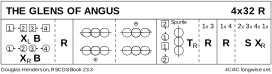
1-8
1s+2s & 3s+4s change places on sides (Ladies LH & Men RH) & retaining hands all Bal-in-Line, repeat back to places & Bal-in-Line
9-16
All dance reels of 4 on sides (Ladies LSh & Men RSh) with 1s crossing at bottom (1s end at top on opposite sides BtoB facing 2s)
17-24
1s dance the Spurtle: 1s dance 1/2 reel of 4 with 2s & turn partner RH to face 3s, 1s dance 1/2 reel of 4 with 3s & turn partner RH to face 4s
25-32
1s dance 1/2 reel with 4s & turn RH to 4th place opposite sides, all set & cross RH 1s ending in 4th place
E-Cribs
1-8
1c (passing inside)+2c & 3c(passing inside)+4c change places EH on the side | BiL on sidelines ; change places back same hand | BiL again (1,2,3,4)
9-16
Mirror Reels4 on the sides, the M Rsh, W Lsh, on [11-12] 1c cross down into opposite reel. At end 1c dances through 1plx to finish between 2c in 2pl facing opposite side (for the last pass in middle Rsh is allowed), 3c & 4c finish in places
17-32
The Spurtle (½Reel4 across, 2c to 1plx, and 1c makes fast RH turn to between 3c ; repeat with 3c ;; repeat with 4c ; All set and cross RH) (2,3,4,1)

Заметки
Note that after the publication of the original Book 23, the Spurtle formation was changed to finish with »set and cross over« rather than »cross over and set« (which is what the book says).
The Glens of Angus
Cutting like dead-end thoroughfares
into the fastness of the lonely eastern Grampians in the county of Angus
are the great glens of Isla, Clova, Esk and Prosen
with the lesser glens of Doll, Lee, Lethnot, Mark and Quharity.
With the exception of Glens Esk and Lee, approached from the town of Edzell,
the glens fan out like spokes from the hub of the town of Kirriemuir, the birthplace of Sir James Barrie.
While the Glens of Angus all line up rather parallel to each other,
each is marked with its own individuality.
Glen Esk, to the north, is a douce, verdant strath following the North Esk until Loch Lee is reached
and then the mountains close in dramatically near the towering cliff of Craigmaskeldie
and the Water of Unich tumbles through its great gorge.
Lord Airlie’s castle of Cortachy stands at the entrance to Glen Clova,
a glen wild and rocky, abounding with Alpine plants,
which follows the South Esk until it meets the White Water at Glen Doll.
Halfway up the glen, near Loch Brandy, is the village of Clova.
In June of 1650, Charles II, as yet uncrowned, landed in Scotland from exile
and after pledging to support Presbyterianism
he escaped from the Covenanters in an event known as “The Start” and took refuge at Clova.
The support he expected from his Royalist friends proved weaker than he had estimated
and, when his hiding place in a village cottage was discovered,
he was returned to Perth where he was crowned on 1 January, 1651,
but not before he had formalised his pledges to the Covenanters.
Glen Prosen, through which Prosen Water flows,
lies to the south of Glen Clova and is not as wildly grand.
A mile up the glen, beneath Tulloch Hill,
is a sandstone fountain erected in memory of Captain Robert Sott and Dr Edward Wilson
who perished during their expedition to the South Pole in 1912.
Nearby is the cottage where the two explorers planned their ill-fated Antarctic trip.
Glen Isla, on the River Isla, is the southernmost of the Glens of Angus
and skirts the Angus-Perthshire border.
Glen Isla is noted for its many rare plants.
O to dream, O to awake and wander
There, and with delight to take and render,
Through the trance of silence,
Quiet breath;
Lo! for there, among the flowers and grasses,
Only the mightier movement sounds and passes;
Only winds and rivers,
Life and death.
– From “In the Highlands”, Robert Louis Stevenson (1850–1894)
From “Scotland Dances”, by Eugenia (Jeannie) Callander Sharp
(Used by permission.)
The Glens of Angus
Cutting like dead-end thoroughfares
into the fastness of the lonely eastern Grampians in the county of Angus
are the great glens of Isla, Clova, Esk and Prosen
with the lesser glens of Doll, Lee, Lethnot, Mark and Quharity.
With the exception of Glens Esk and Lee, approached from the town of Edzell,
the glens fan out like spokes from the hub of the town of Kirriemuir, the birthplace of Sir James Barrie.
While the Glens of Angus all line up rather parallel to each other,
each is marked with its own individuality.
Glen Esk, to the north, is a douce, verdant strath following the North Esk until Loch Lee is reached
and then the mountains close in dramatically near the towering cliff of Craigmaskeldie
and the Water of Unich tumbles through its great gorge.
Lord Airlie’s castle of Cortachy stands at the entrance to Glen Clova,
a glen wild and rocky, abounding with Alpine plants,
which follows the South Esk until it meets the White Water at Glen Doll.
Halfway up the glen, near Loch Brandy, is the village of Clova.
In June of 1650, Charles II, as yet uncrowned, landed in Scotland from exile
and after pledging to support Presbyterianism
he escaped from the Covenanters in an event known as “The Start” and took refuge at Clova.
The support he expected from his Royalist friends proved weaker than he had estimated
and, when his hiding place in a village cottage was discovered,
he was returned to Perth where he was crowned on 1 January, 1651,
but not before he had formalised his pledges to the Covenanters.
Glen Prosen, through which Prosen Water flows,
lies to the south of Glen Clova and is not as wildly grand.
A mile up the glen, beneath Tulloch Hill,
is a sandstone fountain erected in memory of Captain Robert Sott and Dr Edward Wilson
who perished during their expedition to the South Pole in 1912.
Nearby is the cottage where the two explorers planned their ill-fated Antarctic trip.
Glen Isla, on the River Isla, is the southernmost of the Glens of Angus
and skirts the Angus-Perthshire border.
Glen Isla is noted for its many rare plants.
O to dream, O to awake and wander
There, and with delight to take and render,
Through the trance of silence,
Quiet breath;
Lo! for there, among the flowers and grasses,
Only the mightier movement sounds and passes;
Only winds and rivers,
Life and death.
– From “In the Highlands”, Robert Louis Stevenson (1850–1894)
From “Scotland Dances”, by Eugenia (Jeannie) Callander Sharp
(Used by permission.)
Видео 1
Demonstration quality
Видео 2
Demonstration quality
Видео 3
Demonstration quality
Видео 4
Social
Видео 5
Social
Видео 6
Animation