Green grow the Rashes
Основная информация
| Автор: | Jno Johnson (18C) |
|---|---|
| RSCDS: |
 RSCDS HQ publication
|
| Сочинен в России: | Нет |
| Публикация: |
|
| Рекомендуемая музыка: |
|
Параметры
| Тип танца: | Strathspey |
|---|---|
| Тип сета: | Longwise set |
| Размер: | 8x32 |
| Формат сета: | 4 couples |
| Танцующие пары: | 3 |
Источник:
https://my.strathspey.org/dd/dance/2661/
MiniCribs
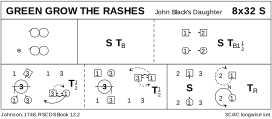
1-8
1s dance parallel RSh reels of 3 on own sides
9-16
1s set, turn 2H, 1s facing 2s on sides set & turn 2s with 2H 1.1/2 times
17-24
1M+3s circle 3H round to L end 3s on opp sides & 1M casts to 2nd pl, 1L+3s circle 3H round to right & end 3s own sides & 1L casts to 2nd pl
25-32
1s set dance up to top, cast to 2nd place & turn 2H
E-Cribs
1-8
1c+2c+3c Rsh Parallel Reels3 on own side
9-16
1c set | turn BH, finish facing 2c ; with person opposite set and turn BH 1½ (2,1,3)
17-24
1M+3c Circle3 L, break early and finish (2,1,3x) ; 1W+3c repeat R (to 2,1,3)
25-32
1c set, dance to the top ; cast off, turn RH (2,1,3) note: on [17-20], 1M may finish turning 3W BH ½, likewise for [21-24]

Заметки
Notes:
In bars 17-20, the circle needs to break in time to allow 3rd man to dance out to his partner’s place while 1st man and 3rd woman continue to dance round, finishing with 1st man in 2nd man’s place and 3rd woman in her partner’s place.
Bars 21-24 are danced similarly.
Green Grow the Rashes
(or “John Black’s Daughter”)
Over the centuries there have been several versions of the song “Green Grow the Rashes”
and so popular was one that it established Robert Burns’ reputation as a song writer.
The old tune was mentioned in the “Complaynt of Scotland”, printed in 1548,
and was called “Cow thou me the Rashes green”.
“A Dance, Green grows the Rashes” is found in Robert Gordon of Straloch’s
An Playing Booke for the Lute
of 1627.
William Stenhouse said:
“The air of this song is old;
a bad set of it occurs in Oswald’s first collection, 1740,
but he seems to have forgot the tune had been used as a reel as well as a song, in Scotland,
time out of memory. Some fragments of the ancient song are still preserved”.
We’re a’ dry wi’ drinkin’ o’t,
We’re a’ dry wi’ drinkin’ o’t,
The parson kissed the fiddler’s wife
And he couldna preach for thinkin’ o’t.
Chorus
Green grow the rashes O,
Green grow the rashes O,
The feather bed is no’ sae saft
As a bed amang the rashes O.
The down bed, the feather bed,
The bed amang the rashes O;
Yet a’ the beds is no’ sae saft
As the bellies o’ the lasses O.
According to Stenhouse “the song seems to have been one of those burlesque and sly satires
on the real or supposed profligacy of the priests prior to the reformation.”
Satire or not, the ancient song and its tune fascinated and inspired Robert Burns.
In 1784 he wrote his own “Green Grow the Rashes”
and it was published in James Johnson’s
The Scots Musical Museum
, Volume 1, 1787.
There’s nought but care on ev’ry han’,
In every hour that passes, O;
What signifies the life o’ man,
An’ 'twere na for the lasses, O.
Chorus
Green grow the rashes, O;
Green grow the rashes, O;
The sweetest hours that e’er I spend,
Are spent among the lasses, O.
The war’ly race may riches chase,
An’ riches still may fly them, O;
An’ tho’ at least they catch them fast,
Their hearts can ne’er enjoy them, O.
But gie me a cannie hour at e’en,
My arms about my dearie, O,
And war’ly cares and war’ly men
May a’ gae tapsalteerie, O!
For you sae douce, ye sneer at this;
Ye’re nought but senseless asses, O;
The wisest men the warl’ e’er saw,
He dearly lov’d the lasses, O.
Auld Nature swears, the lovely dears
Her noblest work she classes, O:
Her prentice han’ she tried on man,
An’ then she made the lasses, O.
In the
Commonplace Book
, finished in 1784,
Burns felt compelled to write the following in regard to his composition:
“I do not see that the turn of mind, and pursuits of such a one as the above verses describe –
one who spends the hours & thoughts which the vocations of the day can spare
with Ossian, Shakespeare, Thomson, Shenstone, Sterne &c.
or as the maggot takes him, a gun, a fiddle, or a Song to make, or men;
and at all times some heartsdear bony lass in view –
I say that I do not see the turn of mind & pursuits of such a one
are in the least more inimical to the sacred interests of Piety & Virtue,
than the, even lawful, bustling, & straining after the world’s riches & honours.”
Sub rosa, Burns wrote two other versions of “Green Grow the Rashes”,
neither of them fit to be sung in the drawing room.
While quite different in mood from his earlier work,
they are more in the spirit of the ancient song
and, while not written as sheer pornography, they do reflect the earthy sexuality of the period.
One, sent to his close companion, John Richmond, in 1786, begins:
In sober hours I am a priest;
A hero when I’m tipsey, O;
But I’m a king and ev’rything,
When wi’ a wanton Gipsey, O.
Of the chorus, only the line “Green grow the rashes, O” remains the same.
The second version, beginning “O wat ye ought o’ Fisher Meg”,
all considerations of pornography versus art aside,
is a jumble of crudities.
These two songs appeared in a private collection of bawdy Scots songs and poems,
some written by Burns, that he circulated among his friends.
In a letter that accompanied the collection, Burns wrote:
“I send you a perusal of what I have got together.
I could not conveniently spare them above five or six days,
and five or six glances at them will probably suffice you.”
This was written in December of 1793
to John M’Murdo of Drumlanrig, chamberlain to the Duke of Queensberry.
In 1800, four years after the death of Burns,
the manuscript collection was published as
The Merry Muses of Caledonia
.
The 1827 edition additional coarse ditties attributed to Burns, but were not, mercifully, his work.
From “Scotland Dances”, by Eugenia (Jeannie) Callander Sharp
(Used by permission.)
In bars 17-20, the circle needs to break in time to allow 3rd man to dance out to his partner’s place while 1st man and 3rd woman continue to dance round, finishing with 1st man in 2nd man’s place and 3rd woman in her partner’s place.
Bars 21-24 are danced similarly.
Green Grow the Rashes
(or “John Black’s Daughter”)
Over the centuries there have been several versions of the song “Green Grow the Rashes”
and so popular was one that it established Robert Burns’ reputation as a song writer.
The old tune was mentioned in the “Complaynt of Scotland”, printed in 1548,
and was called “Cow thou me the Rashes green”.
“A Dance, Green grows the Rashes” is found in Robert Gordon of Straloch’s
An Playing Booke for the Lute
of 1627.
William Stenhouse said:
“The air of this song is old;
a bad set of it occurs in Oswald’s first collection, 1740,
but he seems to have forgot the tune had been used as a reel as well as a song, in Scotland,
time out of memory. Some fragments of the ancient song are still preserved”.
We’re a’ dry wi’ drinkin’ o’t,
We’re a’ dry wi’ drinkin’ o’t,
The parson kissed the fiddler’s wife
And he couldna preach for thinkin’ o’t.
Chorus
Green grow the rashes O,
Green grow the rashes O,
The feather bed is no’ sae saft
As a bed amang the rashes O.
The down bed, the feather bed,
The bed amang the rashes O;
Yet a’ the beds is no’ sae saft
As the bellies o’ the lasses O.
According to Stenhouse “the song seems to have been one of those burlesque and sly satires
on the real or supposed profligacy of the priests prior to the reformation.”
Satire or not, the ancient song and its tune fascinated and inspired Robert Burns.
In 1784 he wrote his own “Green Grow the Rashes”
and it was published in James Johnson’s
The Scots Musical Museum
, Volume 1, 1787.
There’s nought but care on ev’ry han’,
In every hour that passes, O;
What signifies the life o’ man,
An’ 'twere na for the lasses, O.
Chorus
Green grow the rashes, O;
Green grow the rashes, O;
The sweetest hours that e’er I spend,
Are spent among the lasses, O.
The war’ly race may riches chase,
An’ riches still may fly them, O;
An’ tho’ at least they catch them fast,
Their hearts can ne’er enjoy them, O.
But gie me a cannie hour at e’en,
My arms about my dearie, O,
And war’ly cares and war’ly men
May a’ gae tapsalteerie, O!
For you sae douce, ye sneer at this;
Ye’re nought but senseless asses, O;
The wisest men the warl’ e’er saw,
He dearly lov’d the lasses, O.
Auld Nature swears, the lovely dears
Her noblest work she classes, O:
Her prentice han’ she tried on man,
An’ then she made the lasses, O.
In the
Commonplace Book
, finished in 1784,
Burns felt compelled to write the following in regard to his composition:
“I do not see that the turn of mind, and pursuits of such a one as the above verses describe –
one who spends the hours & thoughts which the vocations of the day can spare
with Ossian, Shakespeare, Thomson, Shenstone, Sterne &c.
or as the maggot takes him, a gun, a fiddle, or a Song to make, or men;
and at all times some heartsdear bony lass in view –
I say that I do not see the turn of mind & pursuits of such a one
are in the least more inimical to the sacred interests of Piety & Virtue,
than the, even lawful, bustling, & straining after the world’s riches & honours.”
Sub rosa, Burns wrote two other versions of “Green Grow the Rashes”,
neither of them fit to be sung in the drawing room.
While quite different in mood from his earlier work,
they are more in the spirit of the ancient song
and, while not written as sheer pornography, they do reflect the earthy sexuality of the period.
One, sent to his close companion, John Richmond, in 1786, begins:
In sober hours I am a priest;
A hero when I’m tipsey, O;
But I’m a king and ev’rything,
When wi’ a wanton Gipsey, O.
Of the chorus, only the line “Green grow the rashes, O” remains the same.
The second version, beginning “O wat ye ought o’ Fisher Meg”,
all considerations of pornography versus art aside,
is a jumble of crudities.
These two songs appeared in a private collection of bawdy Scots songs and poems,
some written by Burns, that he circulated among his friends.
In a letter that accompanied the collection, Burns wrote:
“I send you a perusal of what I have got together.
I could not conveniently spare them above five or six days,
and five or six glances at them will probably suffice you.”
This was written in December of 1793
to John M’Murdo of Drumlanrig, chamberlain to the Duke of Queensberry.
In 1800, four years after the death of Burns,
the manuscript collection was published as
The Merry Muses of Caledonia
.
The 1827 edition additional coarse ditties attributed to Burns, but were not, mercifully, his work.
From “Scotland Dances”, by Eugenia (Jeannie) Callander Sharp
(Used by permission.)
Видео 1
Demonstration quality

Видео 2
Demonstration quality
Видео 3
Demonstration quality