Holyrood House
Основная информация
| Автор: | RSCDS |
|---|---|
| RSCDS: |
 RSCDS HQ publication
|
| Сочинен в России: | Нет |
| Публикация: |
|
| Рекомендуемая музыка: |
|
Параметры
| Тип танца: | Jig |
|---|---|
| Тип сета: | Longwise set |
| Размер: | 4x48 |
| Формат сета: | 4 couples |
| Танцующие пары: | 4 |
Источник:
https://my.strathspey.org/dd/dance/2962/
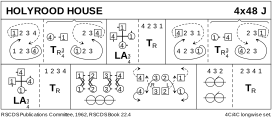
MiniCribs
1-8
1L casts to bottom as 4M casts up to top to meet in centre of dance, 1M+4L do the same while 1L+4M turn 3/4 RH
9-16
1s+4s dance LH across in centre 1s end in 4th place as 4s end at top, all 4 couples turn RH
17-32
Repeat bars 1-16 with 4L+1M starting
33-40
All in prom hold dance 1/2 RSh reel of 4 in centre of set & end with 4s/1s casting into top/bottom places as 3s & 2s cross LH to own sides. 4 3 2 1
41-48
4s+3s+2s dance 1/2 RSh reels of 3 on sides 4s (4s RSh to 3s), all turn RH
E-Cribs
1-8
1W & 4M cast behind own line, and round its other end to meet in middle ; they turn ¾ RH while{4} 1M & 4W repeat [1-4] (Lsh cast) to meet the others for
9-16
All four ½ LHA and dance short way to exchanged places (4,2,3,1) ; all C turn RH
17-32
Repeat [1-16] from new positions (4W & 1M begin), all C finish in promhold, C facing C up/down (1,2,3,4) for
33-40
The couples dance ½Reel4 {8}, finishing (4,3,2,1), at end 4c&1c cast into place and 2c&3c cross into place, 2W & 3M facing out, their P pivoting R
41-48
4c+3c+2c Parallel Rsh ½Reel3 on own sides (to 2,3,4,1) ; all C turn RH

Заметки
Holyrood House
At the end of the Royal Mile, beyond the Canongate, beneath the lowering bulk of Arthur’s Seat,
lies the Palace of Holyrood House,
the official Scottish residence of the sovereign.
Holyrood House is a splendid combination of museum and palace,
where the 12th century meets the 17th with heavy accents of ecclesiastic ruin,
French flamboyance and Victorian gemutlich.
Begun as the Abbey of the Holy Rood, the Virgin and All Saints
by David I about 1128 as a penance for having gone stag hunting on a holy day,
all that remains of the original abbey church are the ruins of the Chapel Royal.
The abbey guest house gradually evolved into a palace,
the older part built by James IV (1473–1513) and James V (1512–1542)
and the newer by Charles II (1630–1685)
from plans by Sir William Bruce of Kinross.
Holyrood House, both palace and abbey, suffered in Scotland’s wars with England
and through internal strife after the Union of the Crowns
when James VI (I) (1567–1625) became king of both Scotland and England.
The abbey was sacked and burned in 1544
by the English army under Edward Seymour, 1st Earl of Hertford, and again in 1547.
In 1650 the palace itself was burned by the soldiers of Oliver Cromwell who were billeted there.
In the so-called historical apartments, Mary (1542–1587)
lived out most of her unhappy days as reigning queen.
In the victorious autumn of 1745, Prince Charles Edward (1720–1788) held festive court there.
George IV (1762–1830) donned kilt and silk tights
and entertained there during his visit to Edinburgh in 1822,
a production stage-managed by Sir Walter Scott(1771–1832).
Some of the apartments in the palace were used by Queen Victoria
who made Holyrood House her occasional residence.
The following is an excerpt from Victoria’s diary for Wednesday, 14 August, 1872.
“We drove up to the door of the old, gloomy, but historical Palace of Holyrood,
where a guard of honour with a band of the 93rd Highlanders
were stationed in the quadrangle of the court.
We got out, walked up the usual stairs,
and passed through two of the large gloomy rooms we used to occupy,
and then went past some passages up another and very steep staircase
to the so-called “Argyll rooms”,
which have been arranged for me, with very pretty light paper, chintz, and carpets (chosen by Louise).
There is a suite, beginning with a dining-room (the least cheerful) at the fartest end,
and then my sitting-room, a large and most cheerful room,
the nicest of all, with very light paper;
next to this the bedroom, almost too large a room, and out of this the dressing room.
All open one out of the other, and have, except the dining room,
the same pretty carpets and chintzes (red geraniums on a white ground).”
From “Scotland Dances”, by Eugenia (Jeannie) Callander Sharp
(Used by permission.)
At the end of the Royal Mile, beyond the Canongate, beneath the lowering bulk of Arthur’s Seat,
lies the Palace of Holyrood House,
the official Scottish residence of the sovereign.
Holyrood House is a splendid combination of museum and palace,
where the 12th century meets the 17th with heavy accents of ecclesiastic ruin,
French flamboyance and Victorian gemutlich.
Begun as the Abbey of the Holy Rood, the Virgin and All Saints
by David I about 1128 as a penance for having gone stag hunting on a holy day,
all that remains of the original abbey church are the ruins of the Chapel Royal.
The abbey guest house gradually evolved into a palace,
the older part built by James IV (1473–1513) and James V (1512–1542)
and the newer by Charles II (1630–1685)
from plans by Sir William Bruce of Kinross.
Holyrood House, both palace and abbey, suffered in Scotland’s wars with England
and through internal strife after the Union of the Crowns
when James VI (I) (1567–1625) became king of both Scotland and England.
The abbey was sacked and burned in 1544
by the English army under Edward Seymour, 1st Earl of Hertford, and again in 1547.
In 1650 the palace itself was burned by the soldiers of Oliver Cromwell who were billeted there.
In the so-called historical apartments, Mary (1542–1587)
lived out most of her unhappy days as reigning queen.
In the victorious autumn of 1745, Prince Charles Edward (1720–1788) held festive court there.
George IV (1762–1830) donned kilt and silk tights
and entertained there during his visit to Edinburgh in 1822,
a production stage-managed by Sir Walter Scott(1771–1832).
Some of the apartments in the palace were used by Queen Victoria
who made Holyrood House her occasional residence.
The following is an excerpt from Victoria’s diary for Wednesday, 14 August, 1872.
“We drove up to the door of the old, gloomy, but historical Palace of Holyrood,
where a guard of honour with a band of the 93rd Highlanders
were stationed in the quadrangle of the court.
We got out, walked up the usual stairs,
and passed through two of the large gloomy rooms we used to occupy,
and then went past some passages up another and very steep staircase
to the so-called “Argyll rooms”,
which have been arranged for me, with very pretty light paper, chintz, and carpets (chosen by Louise).
There is a suite, beginning with a dining-room (the least cheerful) at the fartest end,
and then my sitting-room, a large and most cheerful room,
the nicest of all, with very light paper;
next to this the bedroom, almost too large a room, and out of this the dressing room.
All open one out of the other, and have, except the dining room,
the same pretty carpets and chintzes (red geraniums on a white ground).”
From “Scotland Dances”, by Eugenia (Jeannie) Callander Sharp
(Used by permission.)
Видео 1
Demonstration quality

Видео 2
Good