Inveraray
Основная информация
| Автор: | Unknown |
|---|---|
| RSCDS: |
 RSCDS HQ publication
|
| Сочинен в России: | Нет |
| Публикация: |
|
| Рекомендуемая музыка: | Inverary |
Параметры
| Тип танца: | Strathspey |
|---|---|
| Тип сета: | Longwise set |
| Размер: | 8x32 |
| Формат сета: | 4 couples |
| Танцующие пары: | 3 |
Источник:
https://my.strathspey.org/dd/dance/3104/
MiniCribs
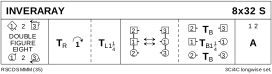
1-8
1s+3s dance double Fig of 8 round 2s (1s cross down to start)
9-16
1s turn RH, cast 1 place, turn LH to form lines across 1L between 2s & 1M between 3s
17-24
2s+1s+3s Adv+Ret 1 step twice, turn opposite person 2H & 1s+2s end in centre for Allemande
25-32
1s+2s dance Allemande
E-Cribs
1-8
1c+3c DblFig8 round 2c (to start, 1c cross down, 3c casts up) (1,2,3)
9-16
1c turn RH, cast (2c up) ; 1c 1¼ turn LH, finishing 1W(1M) between 2c(3c)
17-24
All in lines across A&R (1+1) | repeat ; All turn dancer opposite BH, finishing 3c in 3pl and 1c+2c ready for
25-32
1c+2c Allemande (2,1,3)

Заметки
Inverary
After a day of wind and rain, James Boswell and Dr Johnson arrived at Inverary.
Boswell’s entry for Saturday, 23 October, 1773,
in his
Journal of a Tour of the Hebrides with Samuel Johnson
states:
“We got at night to Inverary, to a most excellent inn …
the sight of good accommodation cheered us much.
We supped well; and after supper, Mr Johnson,
whom I had not seen taste any fermented liquor during our expedition,
had a gill of whisky brought to him.
‘Come,’ said he, ‘let me know what it is that makes a Scotsman happy.‘ …
He owned tonight that he got as good a room and bed as at an English inn.”
On Monday, Boswell and Johnson visited Inverary Castle.
“Mr Johnson was much pleased with the remarkable grandeur and improvements about Inverary.
He said, ‘What I admire here is the total defiance of expense.’
He thought the castle too low, and wished it had be a storey higher.”
Robert Burns had the misfortune to arrive at Inverary in June, 1787,
at a time when there was a large houseparty at the castle
and the overflow was lodged at the inn.
In a fit of pique Burns wrote:
Who’er he be that sojourns here,
I pity much his case,
Unless he come to wait upon
The Lord their God, “His Grace”.
There’s nothing here but Highland pride
And Highland scab and hunger:
If Providence has sent me here,
'Twas surely in an anger.
It is a pity that the temporary over-crowding of an inn had to be thus preserved for posterity.
The English poet, Robert Southey (1774–1843), toured Scotland with Thomas Telford
(See “Dean Bridge of Edinburgh”)
and on Friday, 24 September, 1819, they arrived at Inverary.
“… The road goes thro’ the Duke’s woods and, passing under an arch, comes to the Inn,
which is upon the shore of Loch Fyne, looking to Inverary Castle,
to the wooded heights behind it, the handsome bridge over the little river Ary (?)
– this noble inlet of the sea, and the surrounding mountains.
“Inverary is a small town, built by the last Duke, who spent a long life most meritoriously
in improving his extensive estates and especially this fine place.
The main street, terminated by a Kirk, reminded me of those little German towns,
which in like manner have been created by small Potentates, in the plenitude of their power.
They are building a town-house, which is in a good style, and will be a handsome edifice:
and they have built on a line with the Inn a huge prison …
Inverary still, on the whole, exceeded anything which I have seen in G. Britain.”
And Queen Victoria came to Inverary.
On Wednesday, 18 August, 1847, she wrote:
“The approach to Inverary is splendid; the loch is very wide;
straight before you a fine range of mountains splendidly lit up – green, pink, and lilac;
to the left, the little town of Inverary;
and above it, surrounded by pine woods, stands the Castle of Inverary,
square, with turrets at the corners …
The weather was particularly find, and we were much struck with the extreme beauty of Inverary –
presenting as it does such a combination of magnificent timber, with high mountains,
and a truly noble lake.”
Inverary, in Argyllshire, in western Scotland, a place of deep sea lochs slashed by the Atlantic,
towering hills and islands of every shape and size,
is an 18th century Scottish “New Torn”,
of which many were planned and executed by the wealthy “improvers” of the time.
Created a Royal Burgh in 1648,
there had long been an ancient castle from which the Campbells of Argyll ruled their vast territory,
and a village close by the castle chiefly consisting of,
as Thomas Pennant (1726–1798) called them, “wretched hovels”.
In 1644 James Graham, 1st Marquess of Montrose (1612–1650), and his Royalist troops
burned the fishermen’s portion of Inverary
as a blow against Archibald Campbell, 1st Marquess of Argyll (1598–1661),
who had supported Cromwell up to the time of the execution of Charles I in 1649.
It was Archibald, 3rd Duke of Argyll (1682–1761), who planned and rebuilt Inverary,
both castle and village.
The third duke, who was liberal and progressive,
was through his high government posts virtually the ruler of Scotland from 1743 to 1761.
To put his plans into the action he hired the London architect Roger Norris,
with William Adam of Kirkcaldy serving as Morris’ clerk of works.
The old village was demolised and was rebuilt on a promontory jutting out into Loch Fyne.
Morris died in 1749 and the work of building the present castle and town
was put into the capable hands of Robert Mylne,
last of the family who had been master masons to the Crown of Scotland,
and John Adam, son of William Adam who had died before the work was completed.
Construction continued through the times of John, 4th Duke, who died in 1770
and John, 5th Duke (1732–1806) who had married Elizabeth Gunning, Dowager Duchess of Hamilton.
(See “The Duke of Hamilton’s Reel”)
The fourth duke was Johnson’s and Boswell’s host at Inverary Castle.
Today Inverary is a postcard town of white harled Georgian buildings,
a perfect Highland village in a perfect setting.
The imposing old inn,
reconstructed to John Adam’s design after the first inn was destroyed by fire,
appears much the same as it did when Johnson and Boswell stayed there.
The parish church, designed by Mylne and built between 1794 and 1804,
is interesting in that it once had a dividing wall,
on one side of which services were held in English and on the other in Gaelic.
Many of the 18th century houses, especially the tall tenements or “lands”,
were rehabilitated about 1957 by the late Ian Lindsay.
The present castle, standing in green wooded parkland through which flows the River Ary,
was begun in 1746 and completed between 1760 and 1770.
The residence is Georgian Neo-Gothic which was very fashionable in the 18th century,
the outside being Gothic while the inside is elegantly Georgian.
The addition of conical caps to the four turrets occurred after a disastrous fire in 1877,
two years after Victoria’s second visit to Inverary.
On the night of 5 November, 1975, Inverary Castle was again swept by fire
and damage was extensive,
but the building has since been repaired.
From “Scotland Dances”, by Eugenia (Jeannie) Callander Sharp
(Used by permission.)
After a day of wind and rain, James Boswell and Dr Johnson arrived at Inverary.
Boswell’s entry for Saturday, 23 October, 1773,
in his
Journal of a Tour of the Hebrides with Samuel Johnson
states:
“We got at night to Inverary, to a most excellent inn …
the sight of good accommodation cheered us much.
We supped well; and after supper, Mr Johnson,
whom I had not seen taste any fermented liquor during our expedition,
had a gill of whisky brought to him.
‘Come,’ said he, ‘let me know what it is that makes a Scotsman happy.‘ …
He owned tonight that he got as good a room and bed as at an English inn.”
On Monday, Boswell and Johnson visited Inverary Castle.
“Mr Johnson was much pleased with the remarkable grandeur and improvements about Inverary.
He said, ‘What I admire here is the total defiance of expense.’
He thought the castle too low, and wished it had be a storey higher.”
Robert Burns had the misfortune to arrive at Inverary in June, 1787,
at a time when there was a large houseparty at the castle
and the overflow was lodged at the inn.
In a fit of pique Burns wrote:
Who’er he be that sojourns here,
I pity much his case,
Unless he come to wait upon
The Lord their God, “His Grace”.
There’s nothing here but Highland pride
And Highland scab and hunger:
If Providence has sent me here,
'Twas surely in an anger.
It is a pity that the temporary over-crowding of an inn had to be thus preserved for posterity.
The English poet, Robert Southey (1774–1843), toured Scotland with Thomas Telford
(See “Dean Bridge of Edinburgh”)
and on Friday, 24 September, 1819, they arrived at Inverary.
“… The road goes thro’ the Duke’s woods and, passing under an arch, comes to the Inn,
which is upon the shore of Loch Fyne, looking to Inverary Castle,
to the wooded heights behind it, the handsome bridge over the little river Ary (?)
– this noble inlet of the sea, and the surrounding mountains.
“Inverary is a small town, built by the last Duke, who spent a long life most meritoriously
in improving his extensive estates and especially this fine place.
The main street, terminated by a Kirk, reminded me of those little German towns,
which in like manner have been created by small Potentates, in the plenitude of their power.
They are building a town-house, which is in a good style, and will be a handsome edifice:
and they have built on a line with the Inn a huge prison …
Inverary still, on the whole, exceeded anything which I have seen in G. Britain.”
And Queen Victoria came to Inverary.
On Wednesday, 18 August, 1847, she wrote:
“The approach to Inverary is splendid; the loch is very wide;
straight before you a fine range of mountains splendidly lit up – green, pink, and lilac;
to the left, the little town of Inverary;
and above it, surrounded by pine woods, stands the Castle of Inverary,
square, with turrets at the corners …
The weather was particularly find, and we were much struck with the extreme beauty of Inverary –
presenting as it does such a combination of magnificent timber, with high mountains,
and a truly noble lake.”
Inverary, in Argyllshire, in western Scotland, a place of deep sea lochs slashed by the Atlantic,
towering hills and islands of every shape and size,
is an 18th century Scottish “New Torn”,
of which many were planned and executed by the wealthy “improvers” of the time.
Created a Royal Burgh in 1648,
there had long been an ancient castle from which the Campbells of Argyll ruled their vast territory,
and a village close by the castle chiefly consisting of,
as Thomas Pennant (1726–1798) called them, “wretched hovels”.
In 1644 James Graham, 1st Marquess of Montrose (1612–1650), and his Royalist troops
burned the fishermen’s portion of Inverary
as a blow against Archibald Campbell, 1st Marquess of Argyll (1598–1661),
who had supported Cromwell up to the time of the execution of Charles I in 1649.
It was Archibald, 3rd Duke of Argyll (1682–1761), who planned and rebuilt Inverary,
both castle and village.
The third duke, who was liberal and progressive,
was through his high government posts virtually the ruler of Scotland from 1743 to 1761.
To put his plans into the action he hired the London architect Roger Norris,
with William Adam of Kirkcaldy serving as Morris’ clerk of works.
The old village was demolised and was rebuilt on a promontory jutting out into Loch Fyne.
Morris died in 1749 and the work of building the present castle and town
was put into the capable hands of Robert Mylne,
last of the family who had been master masons to the Crown of Scotland,
and John Adam, son of William Adam who had died before the work was completed.
Construction continued through the times of John, 4th Duke, who died in 1770
and John, 5th Duke (1732–1806) who had married Elizabeth Gunning, Dowager Duchess of Hamilton.
(See “The Duke of Hamilton’s Reel”)
The fourth duke was Johnson’s and Boswell’s host at Inverary Castle.
Today Inverary is a postcard town of white harled Georgian buildings,
a perfect Highland village in a perfect setting.
The imposing old inn,
reconstructed to John Adam’s design after the first inn was destroyed by fire,
appears much the same as it did when Johnson and Boswell stayed there.
The parish church, designed by Mylne and built between 1794 and 1804,
is interesting in that it once had a dividing wall,
on one side of which services were held in English and on the other in Gaelic.
Many of the 18th century houses, especially the tall tenements or “lands”,
were rehabilitated about 1957 by the late Ian Lindsay.
The present castle, standing in green wooded parkland through which flows the River Ary,
was begun in 1746 and completed between 1760 and 1770.
The residence is Georgian Neo-Gothic which was very fashionable in the 18th century,
the outside being Gothic while the inside is elegantly Georgian.
The addition of conical caps to the four turrets occurred after a disastrous fire in 1877,
two years after Victoria’s second visit to Inverary.
On the night of 5 November, 1975, Inverary Castle was again swept by fire
and damage was extensive,
but the building has since been repaired.
From “Scotland Dances”, by Eugenia (Jeannie) Callander Sharp
(Used by permission.)
Видео 1
Reasonable

Видео 2
Animation