Invercauld's Reel
Основная информация
| Автор: | Alexander Bowman |
|---|---|
| RSCDS: |
 RSCDS HQ publication
|
| Сочинен в России: | Нет |
| Публикация: |
|
| Рекомендуемая музыка: | Invercauld's Reel |
Параметры
| Тип танца: | Strathspey |
|---|---|
| Тип сета: | Longwise set |
| Размер: | 8x32 |
| Формат сета: | 4 couples |
| Танцующие пары: | 3 |
Источник:
https://my.strathspey.org/dd/dance/3105/
MiniCribs
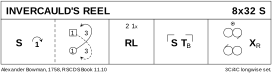
1-8
1s set, cast 1 place (2s step up 3-4) & dance 1/2 Fig 8 down round 3s
9-16
2s+1s dance R&L, 1s end facing 1st corners
17-24
1s set to & turn 1st corners, set to & turn 2nd corners finishing on sides between corners
25-32
1s dance 6 bar reels of 3 on sides giving LSh to 1st corners & cross to 2nd place own side bars 31-32
E-Cribs
1-8
1c set | cast off (2c up) ; cross down between 3c and cast up to 2plx
9-16
2c+1c R&L, 1c finish facing 1cnr
17-24
1c set to and turn corners, finish between cnrs
25-32
Reels3{6} on the sides (Lsh to 1cnrs) | 1c cross (to 2,1,3)

Заметки
Invercauld's Reel
The Farquharsons of Invercauld were members “of the blood” of Clan Chattan.
Farquhar was the son of Shaw of Rothiemurchus
and his son, Donald Farquharson, obtained the Deeside property of Invercauld, near Braemar,
through his marriage with Isobel Stewart.
Their son, Finlay Mor, 1st of Invercauld, carried the Royal Standard at the battle of Pinkie
on 10 September, 1547, a day known as “Black Saturday”,
when the Scots suffered a tragic defeat by the English army
led by Edward Seymour, Earl of Hertford, later Duke of Somerset, Protector of England.
Among the ten thousand Scots that died that bitter day was Finlay Mor.
From that time the Farquharsons were know as Clann Fhionnlaigh, the descendents of Finlay.
In 1595 the Farquharsons signed a document at Invercauld recognising The Mackintosh as their chief,
but by 1745 they were operating as a separate clan from the main Clan Chattan.
As property owners in Deeside, the Farquharsons of Invercauld also owed allegiance to the Earls of Mar
and it was only after the attainder of John Erskine, 6th Earl of Mar (1675–1732),
known as “Bobbing John”,
who led the unsuccessful Jacobite Rising of 1715,
that the Farquharsons of Invercauld held their charter directly from the Crown.
John Farquharson, 9th of Invercauld,
was a lieutenant colonel in the Clan Chattan Regiment in the Rising of 1715
and he led a force of Highlanders into England and defeat at Preston on 13 November, 1715,
the same day that the Earl of Mar was fighting his only battle at Sheriffmuir.
(See “Argyll’s Fancy”)
In all of the events of the Rising of 1715, Invercauld was a most reluctant vassal of “Bobbing John”
and, though he spent ten months as a prisoner of the Hanoverians, his property was not attainted.
Invercauld scrupulously avoided taking part in the Rising of 1745,
but his daughter, Anne, married to Angus, 22nd Chief of Clan Mackintosh, a Hanoverian,
raised her husband’s clansmen for Prince Charles Edward.
(See “Lady Macintosh’s Reel”)
In 1776 Robert Burns, then only seventeen years old,
composed one of this earliest songs which begins “O Tibbie, I hae seen the day”
which was set to the charming old tune of “Invercauld’s Reel”.
From “Scotland Dances”, by Eugenia (Jeannie) Callander Sharp
(Used by permission.)
The Farquharsons of Invercauld were members “of the blood” of Clan Chattan.
Farquhar was the son of Shaw of Rothiemurchus
and his son, Donald Farquharson, obtained the Deeside property of Invercauld, near Braemar,
through his marriage with Isobel Stewart.
Their son, Finlay Mor, 1st of Invercauld, carried the Royal Standard at the battle of Pinkie
on 10 September, 1547, a day known as “Black Saturday”,
when the Scots suffered a tragic defeat by the English army
led by Edward Seymour, Earl of Hertford, later Duke of Somerset, Protector of England.
Among the ten thousand Scots that died that bitter day was Finlay Mor.
From that time the Farquharsons were know as Clann Fhionnlaigh, the descendents of Finlay.
In 1595 the Farquharsons signed a document at Invercauld recognising The Mackintosh as their chief,
but by 1745 they were operating as a separate clan from the main Clan Chattan.
As property owners in Deeside, the Farquharsons of Invercauld also owed allegiance to the Earls of Mar
and it was only after the attainder of John Erskine, 6th Earl of Mar (1675–1732),
known as “Bobbing John”,
who led the unsuccessful Jacobite Rising of 1715,
that the Farquharsons of Invercauld held their charter directly from the Crown.
John Farquharson, 9th of Invercauld,
was a lieutenant colonel in the Clan Chattan Regiment in the Rising of 1715
and he led a force of Highlanders into England and defeat at Preston on 13 November, 1715,
the same day that the Earl of Mar was fighting his only battle at Sheriffmuir.
(See “Argyll’s Fancy”)
In all of the events of the Rising of 1715, Invercauld was a most reluctant vassal of “Bobbing John”
and, though he spent ten months as a prisoner of the Hanoverians, his property was not attainted.
Invercauld scrupulously avoided taking part in the Rising of 1745,
but his daughter, Anne, married to Angus, 22nd Chief of Clan Mackintosh, a Hanoverian,
raised her husband’s clansmen for Prince Charles Edward.
(See “Lady Macintosh’s Reel”)
In 1776 Robert Burns, then only seventeen years old,
composed one of this earliest songs which begins “O Tibbie, I hae seen the day”
which was set to the charming old tune of “Invercauld’s Reel”.
From “Scotland Dances”, by Eugenia (Jeannie) Callander Sharp
(Used by permission.)
Видео 1
Reasonable

Видео 2
Social
Видео 3
Animation