John McAlpin
Основная информация
| Автор: | Hugh Foss |
|---|---|
| RSCDS: |
 RSCDS HQ publication
|
| Сочинен в России: | Нет |
| Публикация: |
|
| Рекомендуемая музыка: | John McAlpin |
Параметры
| Тип танца: | Strathspey |
|---|---|
| Тип сета: | Longwise set |
| Размер: | 8x32 |
| Формат сета: | 4 couples |
| Танцующие пары: | 3 |
Источник:
https://my.strathspey.org/dd/dance/3323/
MiniCribs
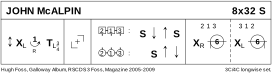
1-8
1s Adv+Ret 1 step (touch RH) & cross LH, lead down RH 1 place & 3/4 turn LH to face 1st corners
9-16
1s turn RH 1st corner & turn partner LH, turn RH 2nd corner then cross LH to 2nd place own sides
17-24
2L+1L+3L set, Adv+Ret & set while 2M+1M+3M stand for 2 bars, set, Adv+Ret
25-32
2s+1s+3s cross RH, circle 6H round to left 1/2 way, cross LH & circle 6H round to right 1/2 way
E-Cribs
1-8
1c advance and touch RH {1}, retire {1} | cross LH ; lead down RH (2c up) | turn LH to face 1cnrs
9-16
Turn CPCP (to 2,1,3)
17-24
2W+1W+3W set, advance ; retire, and set, while{8} 2M+1M+3M stand | set ; A&R
25-32
All cross RH | ½ circle6 L ; All cross LH | ½ circle6 R (to 2,1,3)

Заметки
According to
The Thistle #28
(May 1966):
The ideas in this dance came from fencing. But it is not a “fencing lilt”. The origin is only of historical
interest and does not affect the manner of dancing.
Bars 1–4 represent a one-two, where a fencer feints on one side of his opponent’s blade and
disengages to make the real attack on the other side. Bars 5–8 represent one-two-deceive
(get a fencer to explain this). When one fencer retires his opponent usually advances. This inspired
bars 17–24. Sometimes fencers rush up so close to each other that they have to be separated by the
referee. This is known as a corps-à-corps. Hence bars 25–32.
The tune was chosen first. Then the fencing ideas were poured into the mould.
The Thistle #28
(May 1966):
The ideas in this dance came from fencing. But it is not a “fencing lilt”. The origin is only of historical
interest and does not affect the manner of dancing.
Bars 1–4 represent a one-two, where a fencer feints on one side of his opponent’s blade and
disengages to make the real attack on the other side. Bars 5–8 represent one-two-deceive
(get a fencer to explain this). When one fencer retires his opponent usually advances. This inspired
bars 17–24. Sometimes fencers rush up so close to each other that they have to be separated by the
referee. This is known as a corps-à-corps. Hence bars 25–32.
The tune was chosen first. Then the fencing ideas were poured into the mould.
Видео 1
Demonstration quality

Видео 2
Good
Видео 3
Good
Видео 4
Good
Видео 5
Reasonable
Видео 6
Reasonable
Видео 7
Animation