Kingussie Flower
Основная информация
| Автор: | Unknown |
|---|---|
| RSCDS: |
 RSCDS HQ publication
|
| Сочинен в России: | Нет |
| Публикация: |
|
| Рекомендуемая музыка: |
|
Параметры
| Тип танца: | Reel |
|---|---|
| Тип сета: | Longwise set |
| Размер: | 8x40 |
| Формат сета: | 4 couples |
| Танцующие пары: | 2 |
Источник:
https://my.strathspey.org/dd/dance/3506/
MiniCribs
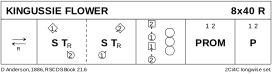
1-8
1s lead down the middle & back to top
9-16
1L+2M set & turn RH; 1M+2L set & turn RH into a line of 4 across (Bar 16 1L steps in to be BtoB with partner, 1M facing 2L, 1L facing 2M)
17-24
1s+2s dance reel of 4 across
25-32
1s+2s Promenade
33-40
1s+2s dance Poussette
E-Cribs
1-8
1c lead down the middle and up
9-16
1W+2M set adv. | turn RH to places (1,2) ; 1M+2W set adv. | turn RH to W side as 1W crosses on [16] to face 2M (all 2pos, 1c BtoB between 2c)
17-24
Reel4 across, at end 1c meet as 2c curves down into
25-32
1c+2c Promenade
33-40
1c+2c Poussette

Заметки
Kingussie Flower
Kingussie straddles the main highway between Perth and Inverness
and in recent years has become a centre for summer and winter sports.
Situated in the pine woods of Badenoch, the lofty Cairngorms loom on the east
and to the west are the grey mountains, the lonely Monadhliadth.
Kingussie has not always appeared as it does now, a bustling resort centre.
Elizabeth Grant of Rothiemurchus in her
Memoirs of a Highland Lady
describes what she saw in 1812:
“A mile on from Pitmain were the indications of a village –
the present town of Kingussie –
a few very untidy-looking slated stone houses each side of a road,
the bare heather on each side of the Spey,
the bare mountains on each side of the heather,
a few white-walled houses here and there,
a good many black turf huts, frightful without, though warm and comfortable within.”
In October, 1861, Queen Victoria saw Kingussie as “a very straggling place with very few cottages”.
Life in Kingussie was not so dreary as it might at first appear,
according to Elizabeth Grant’s description of the cattle tryst or fair
held by ancient custom in September each year
on a moor outside the town where farmers and drovers came to buy and sell.
“After the market in the morning, there was dinner in the evening,
drovers, farmers, and lairds all meeting in the large room at Pitmain
to enjoy the best good cheer the county afforded.
Lord Huntly presided, and sent a stag from Gaig forest.
My father was croupier,
and very grand speeches he and others made after the punch began to circulate.
“This year it was proposed that the ladies should be invited to shine on the assemblage –
not at the dinner, but to prepare tea in another room, which would break up the punch party earlier,
and allow of the large apartment being meanwhile prepared for dancing.
Both Lord Huntly and my father were promoters of this sort of mixed meeting,
so consonant to the spirit of feudalism still cherished throughout our mountains.
They themselves were the life and soul of such gatherings,
courteous to all, gay in manner, and very gallant to the fair.
The ball was received with much favour, and in future always followed the Tryst,
doing more in the way of improving the country than any one at first sight would suppose.
Besides the renewal of intercourse between the ranks,
leading to a continuance of kind feeling,
a sort of stimulus was given to the spirits of those whom Belleville called
the bodies
.
They had hardly finished talking over the pleasures of the one meeting
before the preparations for the next had to be begun.
Husbands were proud of producing handsome wives nicely dressed;
mothers looked forward to bringing with them pretty daughters to be introduced to grander friends.
The dress and the manners of the higher portion of the company had a sensible effect on the lower.
Mrs John Macnab’s first cap was greatly moderated on her second appearance,
and Janet Mitchell’s boisterous dancing fined down into a not unbecoming sprightliness of movement.”
Just off the High Street is Am Fasgadh, “the shelter”, the Highland Folk Museum
which was originally founded in Iona in 1935 by historian Dr I. F. Grant
and which houses a splendid collection of furniture, clothing and utensils
of the Highlanders of the past several centuries.
Kingussie has its thunderous echoes of the Rising of 1745,
for on a grassy mound across the Spey,
on a site once occupied by the stronghold of Alexander Stewart (?1343–?1405),
son of Robert II by Elizabeth Mure, Earl of Buchan, the “Wolf of Badenoch”,
the royal ruffian who burned Elgin Cathedral,
are the ruins of Ruthven Barracks.
Built originally as a garrison against the Highland Jacobites in 1716,
the building was enlarged by General George Wade in 1734.
After the defeat of the Jacobites at Culloden on 16 April, 1746,
five thousand clansmen rallied there with high hopes of carrying on the fight.
When Prince Charles Edward ordered them to disperse,
“every man must seek his safety in the best way he can”,
they angrily destroyed Ruthven Barracks to prevent its military use by the Hanoverians.
From “Scotland Dances”, by Eugenia (Jeannie) Callander Sharp
(Used by permission.)
Kingussie straddles the main highway between Perth and Inverness
and in recent years has become a centre for summer and winter sports.
Situated in the pine woods of Badenoch, the lofty Cairngorms loom on the east
and to the west are the grey mountains, the lonely Monadhliadth.
Kingussie has not always appeared as it does now, a bustling resort centre.
Elizabeth Grant of Rothiemurchus in her
Memoirs of a Highland Lady
describes what she saw in 1812:
“A mile on from Pitmain were the indications of a village –
the present town of Kingussie –
a few very untidy-looking slated stone houses each side of a road,
the bare heather on each side of the Spey,
the bare mountains on each side of the heather,
a few white-walled houses here and there,
a good many black turf huts, frightful without, though warm and comfortable within.”
In October, 1861, Queen Victoria saw Kingussie as “a very straggling place with very few cottages”.
Life in Kingussie was not so dreary as it might at first appear,
according to Elizabeth Grant’s description of the cattle tryst or fair
held by ancient custom in September each year
on a moor outside the town where farmers and drovers came to buy and sell.
“After the market in the morning, there was dinner in the evening,
drovers, farmers, and lairds all meeting in the large room at Pitmain
to enjoy the best good cheer the county afforded.
Lord Huntly presided, and sent a stag from Gaig forest.
My father was croupier,
and very grand speeches he and others made after the punch began to circulate.
“This year it was proposed that the ladies should be invited to shine on the assemblage –
not at the dinner, but to prepare tea in another room, which would break up the punch party earlier,
and allow of the large apartment being meanwhile prepared for dancing.
Both Lord Huntly and my father were promoters of this sort of mixed meeting,
so consonant to the spirit of feudalism still cherished throughout our mountains.
They themselves were the life and soul of such gatherings,
courteous to all, gay in manner, and very gallant to the fair.
The ball was received with much favour, and in future always followed the Tryst,
doing more in the way of improving the country than any one at first sight would suppose.
Besides the renewal of intercourse between the ranks,
leading to a continuance of kind feeling,
a sort of stimulus was given to the spirits of those whom Belleville called
the bodies
.
They had hardly finished talking over the pleasures of the one meeting
before the preparations for the next had to be begun.
Husbands were proud of producing handsome wives nicely dressed;
mothers looked forward to bringing with them pretty daughters to be introduced to grander friends.
The dress and the manners of the higher portion of the company had a sensible effect on the lower.
Mrs John Macnab’s first cap was greatly moderated on her second appearance,
and Janet Mitchell’s boisterous dancing fined down into a not unbecoming sprightliness of movement.”
Just off the High Street is Am Fasgadh, “the shelter”, the Highland Folk Museum
which was originally founded in Iona in 1935 by historian Dr I. F. Grant
and which houses a splendid collection of furniture, clothing and utensils
of the Highlanders of the past several centuries.
Kingussie has its thunderous echoes of the Rising of 1745,
for on a grassy mound across the Spey,
on a site once occupied by the stronghold of Alexander Stewart (?1343–?1405),
son of Robert II by Elizabeth Mure, Earl of Buchan, the “Wolf of Badenoch”,
the royal ruffian who burned Elgin Cathedral,
are the ruins of Ruthven Barracks.
Built originally as a garrison against the Highland Jacobites in 1716,
the building was enlarged by General George Wade in 1734.
After the defeat of the Jacobites at Culloden on 16 April, 1746,
five thousand clansmen rallied there with high hopes of carrying on the fight.
When Prince Charles Edward ordered them to disperse,
“every man must seek his safety in the best way he can”,
they angrily destroyed Ruthven Barracks to prevent its military use by the Hanoverians.
From “Scotland Dances”, by Eugenia (Jeannie) Callander Sharp
(Used by permission.)
Видео 1
Demonstration quality

Видео 2
Good
Видео 3
Reasonable
Видео 4
Social
Видео 5
Animation