The Lads of Saltcoats
Основная информация
| Автор: | Unknown |
|---|---|
| RSCDS: |
 RSCDS HQ publication
|
| Сочинен в России: | Нет |
| Публикация: |
|
| Рекомендуемая музыка: | The Lads Of Saltcoats |
Параметры
| Тип танца: | Reel |
|---|---|
| Тип сета: | Longwise set |
| Размер: | 8x32 |
| Формат сета: | 4 couples |
| Танцующие пары: | 2 |
Источник:
https://my.strathspey.org/dd/dance/3585/
MiniCribs
1-8
1s+2L dance diagonal reel of 3 (1s start by passing RSh)
9-16
1s+2M dance diagonal reel of 3 (1s start by passing LSh)
17-24
1s lead down the middle, back to top & cast to 2nd places
25-32
2s+1s dance R&L
E-Cribs
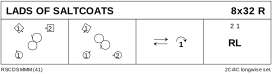
1-8
1c+2W (1c Rsh) diagonal Reel3
9-16
1c+2M (1c Lsh) diagonal Reel3
17-24
1c lead down {3}, up {3}| cast off (2c up)
25-32
2c+1c R&L

Заметки
Saltcoats is a town on the west coast of Scotland, south-west of
Glasgow. Its name is based on the earliest local industry, namely the
extraction of salt from sea water.
The Lads Of Saltcoats
Saltcoats, an Ayrshire coastal town, had its beginnings in the salt works
established by James V In 1528 and the name means the “huts of the salt workers”.
Salt was an invaluable commodity all over Scotland, especially in the Highlands,
where meat was in short supply and had to be preserved,
and along the coasts and on the islands where the salting of fish was a major food industry.
Much of Scotland’s salt was exported to France and Holland.
The ancient harbour of Saltcoats, like that of Wemyss in Fife,
was built by local salt-masters in the 17th century.
Salt was as important to the economy as coal
and the workers in the salt pans all over Scotland, like the coal miners,
were kept in virtual serfdom by their masters.
The 17th and 18th century workers were unskilled and underpaid
and they bound their children over at birth.
It was not unusual for the salt pan workers, just as with the mine workers,
to be included with the real and tangible assets in the salt-masters’ inventories.
These workers were not released from their bondage until 1799
when an act was passed by Parliament removing, at last,
the yoke of servitude from the miners and salt panners.
Today Saltcoats is a bustling resort on Ayrshire’s warm and often sunny seacoast
and the workers from inland industrial towns who come there for holiday recreation
bear no resemblance to the workers who laboured there two hundred years ago.
From “Scotland Dances”, by Eugenia (Jeannie) Callander Sharp
(Used by permission.)
Glasgow. Its name is based on the earliest local industry, namely the
extraction of salt from sea water.
The Lads Of Saltcoats
Saltcoats, an Ayrshire coastal town, had its beginnings in the salt works
established by James V In 1528 and the name means the “huts of the salt workers”.
Salt was an invaluable commodity all over Scotland, especially in the Highlands,
where meat was in short supply and had to be preserved,
and along the coasts and on the islands where the salting of fish was a major food industry.
Much of Scotland’s salt was exported to France and Holland.
The ancient harbour of Saltcoats, like that of Wemyss in Fife,
was built by local salt-masters in the 17th century.
Salt was as important to the economy as coal
and the workers in the salt pans all over Scotland, like the coal miners,
were kept in virtual serfdom by their masters.
The 17th and 18th century workers were unskilled and underpaid
and they bound their children over at birth.
It was not unusual for the salt pan workers, just as with the mine workers,
to be included with the real and tangible assets in the salt-masters’ inventories.
These workers were not released from their bondage until 1799
when an act was passed by Parliament removing, at last,
the yoke of servitude from the miners and salt panners.
Today Saltcoats is a bustling resort on Ayrshire’s warm and often sunny seacoast
and the workers from inland industrial towns who come there for holiday recreation
bear no resemblance to the workers who laboured there two hundred years ago.
From “Scotland Dances”, by Eugenia (Jeannie) Callander Sharp
(Used by permission.)
Видео 1
Demonstration quality