Lady Baird's Reel
Основная информация
| Автор: | Thomas (19C) Wilson |
|---|---|
| RSCDS: |
 RSCDS HQ publication
|
| Сочинен в России: | Нет |
| Публикация: |
|
| Рекомендуемая музыка: |
|
Параметры
| Тип танца: | Reel |
|---|---|
| Тип сета: | Longwise set |
| Размер: | 8x32 |
| Формат сета: | 4 couples |
| Танцующие пары: | 3 |
Источник:
https://my.strathspey.org/dd/dance/3589/
MiniCribs
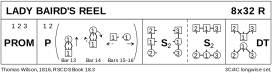
1-8
1s+2s+3s Promenade
9-16
1s+2s dance Poussette to end 1L between 2s facing down & 1M between 3s facing up
17-24
2s+1s+3s set twice 1s turning on to own sides (bars19-20), 2s+1s+3s set twice 1s turning to centre BtoB facing own sides (bars 23-24)
25-32
1s dance Double Triangles with 2s+3s & cross to 2nd places

Заметки
Note that the tune published by the RSCDS in Book 18 as the “own tune” for Lady Baird’s Reel is in fact
Lord St. Clair's Reel
. See
issue 3201
for more details.
Lady Baird's Reel
General Sir David Baird, K.C.B. (1757–1829), was born at Newbyth near Whitekirk in East Lothian,
the second son of William, 2nd Baronet Newbyth
and grandson of Sir John Baird of Newbyth and Saughtonhall
who became a Lord of Session as Lord Newbyth.
Baird joined the 73rd (late 71st) Highland Light Infantry in 1773.
(See “Glasgow Highlanders”)
He was sent to India in 1780 where he fought against Hyder Ali of Mysore.
He was taken prisoner and spent four years n the filthy dungeons of Seringapatam.
Released and repatriated, he fought at the Cape of Good Hope
and then returned to India to lead the war against Tippo, Hyder’s son,
and it was poetic justice that he should be the one to capture Seringapatam.
A choleric, formidable man, he was keenly disappointed
when command was given to Sir Arthur Wellesley, the future Duke of Wellington,
and he resigned.
Back in the army in 1805, he was in command of 6,000 men of the Highland Light Infantry,
the Seaforth Highlanders and the Argyll and Sutherland Highlanders
in the campaign to take the Cape of Good Hope from the Dutch
and in 1807 he commanded the siege of Copenhagen.
Baird was second in command at Coruña in 1808 in the Peninsular War against Napoleon
and was commander-in-chief when Sir John Moore fell in battle.
He himself was so severely wounded in the arm at Coruña
that he was taken aboard ship in the harbour where it was amputated.
As a reward from a grateful nation, Baird was given a baronetcy in 1809.
He received no further field command but he was promoted full general in 1814
and served as commander-in-chief in Ireland from 1820 to 1822.
In 1810 Sir David married Anne Preston Menzies Campbell.
It is probable that “Lady Baird’s Reel” was devised for Sir David’s wife,
while the music for “Lady Baird of Saughtonhall”, composed by Daniel Dow and published in 1776,
honoured Sir David’s mother.
The accomplished amateur composer, Miss Baird of Saughtonhall,
was, doubtless, Sir David’s sister.
From “Scotland Dances”, by Eugenia (Jeannie) Callander Sharp
(Used by permission.)
Lord St. Clair's Reel
. See
issue 3201
for more details.
Lady Baird's Reel
General Sir David Baird, K.C.B. (1757–1829), was born at Newbyth near Whitekirk in East Lothian,
the second son of William, 2nd Baronet Newbyth
and grandson of Sir John Baird of Newbyth and Saughtonhall
who became a Lord of Session as Lord Newbyth.
Baird joined the 73rd (late 71st) Highland Light Infantry in 1773.
(See “Glasgow Highlanders”)
He was sent to India in 1780 where he fought against Hyder Ali of Mysore.
He was taken prisoner and spent four years n the filthy dungeons of Seringapatam.
Released and repatriated, he fought at the Cape of Good Hope
and then returned to India to lead the war against Tippo, Hyder’s son,
and it was poetic justice that he should be the one to capture Seringapatam.
A choleric, formidable man, he was keenly disappointed
when command was given to Sir Arthur Wellesley, the future Duke of Wellington,
and he resigned.
Back in the army in 1805, he was in command of 6,000 men of the Highland Light Infantry,
the Seaforth Highlanders and the Argyll and Sutherland Highlanders
in the campaign to take the Cape of Good Hope from the Dutch
and in 1807 he commanded the siege of Copenhagen.
Baird was second in command at Coruña in 1808 in the Peninsular War against Napoleon
and was commander-in-chief when Sir John Moore fell in battle.
He himself was so severely wounded in the arm at Coruña
that he was taken aboard ship in the harbour where it was amputated.
As a reward from a grateful nation, Baird was given a baronetcy in 1809.
He received no further field command but he was promoted full general in 1814
and served as commander-in-chief in Ireland from 1820 to 1822.
In 1810 Sir David married Anne Preston Menzies Campbell.
It is probable that “Lady Baird’s Reel” was devised for Sir David’s wife,
while the music for “Lady Baird of Saughtonhall”, composed by Daniel Dow and published in 1776,
honoured Sir David’s mother.
The accomplished amateur composer, Miss Baird of Saughtonhall,
was, doubtless, Sir David’s sister.
From “Scotland Dances”, by Eugenia (Jeannie) Callander Sharp
(Used by permission.)
Видео 1
Demonstration quality