Lady MacIntosh's Rant
Основная информация
| Автор: | David Rutherford |
|---|---|
| RSCDS: |
 RSCDS HQ publication
|
| Сочинен в России: | Нет |
| Публикация: |
|
| Рекомендуемая музыка: | The Duke is Welcome to Inverness |
Параметры
| Тип танца: | Strathspey |
|---|---|
| Тип сета: | Longwise set |
| Размер: | 8x32 |
| Формат сета: | 3 couples (1x) |
| Танцующие пары: | 3 |
Источник:
https://my.strathspey.org/dd/dance/3617/
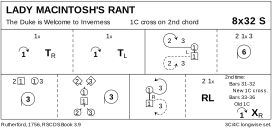
MiniCribs
1s start on opp sides
1-8
1s cast to 2nd place, turn RH, cast to 3rd place & turn LH
9-16
1s lead up to top & cast to 2nd place, 2s+1s+3s circle 6H round to left
17-24
2s+1L & 1M+3s circle 3H round to left, 1M+2L+3L & 1L+2M+3M circle 3H round to left
25-32
1s lead down below 3s & cast up to 2nd place (opposite sides), 2s+1s dance R&L
E-Cribs
or The Duke is Welcome to Inverness
On 2nd chord, 1c changes sides, where they remain till the have reached the bottom
1-8
1c cast off one, turn RH, cast off one, turn LH
9-16
1c lead up to the top and cast off one (2c up) ; 2c+1c+3c circle6 to the left
17-24
1W+2c & 1M+3c circle3 to the left ; 1W+2M+3M & 1M+2W+3W circle3 to the left (the transition is not explained)
25-32
1c lead down between 3c and cast up to 2pl opposite side ; 2c+1c R&L

Заметки
Lady Macintosh's Rant
(or “The Duke Is Welcome to Inverness”)
(See also “Invercauld’s Reel”)
Lady Macintosh was Anne, daughter of John Farquharson, 9th of Invercauld,
wife of Angus, 22nd Chief of Clan Macintosh,
a young lady who at the age of twenty raised two battalions among Clan Chattan
for Prince Charles Edward.
It is interesting to note that while “Colonel Anne” was riding about the clan countryside
in blue bonnet and tartan habit
that her husband was away, an officer in the service of George II who remained loyal to his commission.
The seat of the Macintosh is Moy Hall, eleven miles from Inverness and very near to Culloden Moor.
On the night of 16 February, 1746, Prince Charles Edward was staying with Lady Macintosh at Moy Hall
when word was brought by young Lachlan Macintosh from the Dowager Lady Macintosh
then at her town house in Inverness
that 1,500 of Lord Loudon’s soldiers were marching upon Moy in the hope of capturing the prince.
Lady Macintosh did not wish to awaken her sleeping royal guest
so she put the situation into the capable hands of Donald Fraser, the local blacksmith.
Fraser and four other men, armed with muskets, moved into the darkness past the prince’s sentries
and through the hamlet of Moy
until they came upon Loudon’s men creeping steadily through the shadows.
The five men then spread out until they formed a line a regiment in width.
They fired, killing one of Loudon’s men.
With shouts and orders that would make the Hanoverians think that they had run into the prince’s army,
and with the five men racing back and forth and firing their muskets,
Loudon’s soldiers turned and ran, with Fraser and his companions in hot pursuit.
One of the men left dead among the peat stacks after the Rout of Moy
was Donald Ban MacCrimmon, that paragon of pipers,
who had accompanied the Hanoverians that night.
Before he left Skye, Donald Ban had had a premonition
and he composed the great pipe lament, “Cha till, cha till, cha till Mac Cruimein”,
“MacCrimmon will never return”.
Lady Macintosh was taken prisoner after Culloden, but she survived captivity and died at Leith in 1787,
a staunch Jacobite to the end.
There is another side to the story behind this dance, the Hanoverian, the other side of the coin.
From 21 February until just before the battle of Culloden,
Inverness was the headquarters of the Highland army of Prince Charles Edward.
Inverness had been a Jacobite city, but on the afternoon of 16 April there was a reversal in loyalty.
At four o’ clock, fresh from his victory on Culloden Moor,
Prince William Augustus, Duke of Cumberland (1721–1765), rode into Inverness
and was greeted with thundering peals from the city’s church towers.
When the duke went to his lodging, it was to the townhouse of the Dowager Lady Macintosh,
the same house that had sheltered his cousin during his stay in Inverness.
When Lady Macintosh was taken prisoner, she was reputed to have said,
“I’ve had two king’s bairns living under my roof in my time,
and to tell you the truth I wish I may never have another”.
From “Scotland Dances”, by Eugenia (Jeannie) Callander Sharp
(Used by permission.)
(or “The Duke Is Welcome to Inverness”)
(See also “Invercauld’s Reel”)
Lady Macintosh was Anne, daughter of John Farquharson, 9th of Invercauld,
wife of Angus, 22nd Chief of Clan Macintosh,
a young lady who at the age of twenty raised two battalions among Clan Chattan
for Prince Charles Edward.
It is interesting to note that while “Colonel Anne” was riding about the clan countryside
in blue bonnet and tartan habit
that her husband was away, an officer in the service of George II who remained loyal to his commission.
The seat of the Macintosh is Moy Hall, eleven miles from Inverness and very near to Culloden Moor.
On the night of 16 February, 1746, Prince Charles Edward was staying with Lady Macintosh at Moy Hall
when word was brought by young Lachlan Macintosh from the Dowager Lady Macintosh
then at her town house in Inverness
that 1,500 of Lord Loudon’s soldiers were marching upon Moy in the hope of capturing the prince.
Lady Macintosh did not wish to awaken her sleeping royal guest
so she put the situation into the capable hands of Donald Fraser, the local blacksmith.
Fraser and four other men, armed with muskets, moved into the darkness past the prince’s sentries
and through the hamlet of Moy
until they came upon Loudon’s men creeping steadily through the shadows.
The five men then spread out until they formed a line a regiment in width.
They fired, killing one of Loudon’s men.
With shouts and orders that would make the Hanoverians think that they had run into the prince’s army,
and with the five men racing back and forth and firing their muskets,
Loudon’s soldiers turned and ran, with Fraser and his companions in hot pursuit.
One of the men left dead among the peat stacks after the Rout of Moy
was Donald Ban MacCrimmon, that paragon of pipers,
who had accompanied the Hanoverians that night.
Before he left Skye, Donald Ban had had a premonition
and he composed the great pipe lament, “Cha till, cha till, cha till Mac Cruimein”,
“MacCrimmon will never return”.
Lady Macintosh was taken prisoner after Culloden, but she survived captivity and died at Leith in 1787,
a staunch Jacobite to the end.
There is another side to the story behind this dance, the Hanoverian, the other side of the coin.
From 21 February until just before the battle of Culloden,
Inverness was the headquarters of the Highland army of Prince Charles Edward.
Inverness had been a Jacobite city, but on the afternoon of 16 April there was a reversal in loyalty.
At four o’ clock, fresh from his victory on Culloden Moor,
Prince William Augustus, Duke of Cumberland (1721–1765), rode into Inverness
and was greeted with thundering peals from the city’s church towers.
When the duke went to his lodging, it was to the townhouse of the Dowager Lady Macintosh,
the same house that had sheltered his cousin during his stay in Inverness.
When Lady Macintosh was taken prisoner, she was reputed to have said,
“I’ve had two king’s bairns living under my roof in my time,
and to tell you the truth I wish I may never have another”.
From “Scotland Dances”, by Eugenia (Jeannie) Callander Sharp
(Used by permission.)