Lady of the Lake
Основная информация
| Автор: | Unknown |
|---|---|
| RSCDS: |
 RSCDS HQ publication
|
| Сочинен в России: | Нет |
| Публикация: |
|
| Рекомендуемая музыка: |
|
Параметры
| Тип танца: | Reel |
|---|---|
| Тип сета: | Longwise set |
| Размер: | 8x32 |
| Формат сета: | 4 couples |
| Танцующие пары: | 2 |
Источник:
https://my.strathspey.org/dd/dance/3631/
MiniCribs
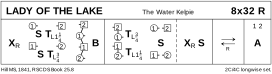
1-8
1s cross RH, set to 2s on sides & turn LH into line of 4 across with 1s in centre holding RH & Balance-in-Line
9-16
1s turn 2s LH onto sides (1s into 1st place) & set to 2s on sides, 1s cross RH & set to partner
17-24
1s lead down the middle & back to top
25-32
1s+2s Allemande
E-Cribs
1-8
1c cross RH, 1c face 2c and set ; 1M+2W turn 1¼ LH while{2} 1W+2M turn ¾ LH | BiL across
9-16
1M+2W turn ¾ LH while{2} 1W+2M turn 1¼ LH | 1c set to 2c ; 1c cross back to places RH | set
17-24
1c down the middle and up
25-32
1c+2c Allemande

Заметки
In addition to the alternative title “The Water Kelpie” the table of contents in the original Book 25 publication has the main title as “The Lady of the Lake” though it was given as just “Lady of the Lake” on the dance page and elsewhere in later publications.
Lady of the Lake
(or “The Water Kelpie”)
Superstition and belief in creatures not of this world has always been an essential and colourful part
of the folk culture of Scotland.
It was thus when St. Columba arrived to preach Christianity and enlighten the Picts
and, in some of Scotland’s more remote regions of towering mountains and lonely lochans,
it may still be today.
In addition to the malevolent tricks of the fairies who stole babies at birth or christening
and brides at their weddings,
there was wide-spread belief in the water kelpie or the water horse
who haunted stretches of loch or river
and lured the unwary into his domain where they were either drowned or eaten.
Although it seems unfair to debunk a myth of the past,
which in the cold light of today might be pleasant to believe,
the kelpie was probably the thick weeds or rushes of the lochs
that entangled the hapless Highlander who ventured into the water,
compounded by the fact that the victim could probably not swim a stroke
and that the watchers on the shore or the lucky ones who might have survived drowning
had powerful imaginations.
Sir Walter Scott (1771–1832) wrote
The Lady of the Lake
in 1809.
This long poem of six cantos is set in the Trossachs above Loch Katrine,
where “James Fitz James” first saw Ellen Douglas:
The boat had touched the silver strand
Just as the Hunter left his stand,
And stood concealed amid the brake
To view this Lady of the Lake.
The maiden paused, as if again,
She thought to catch the distant strain.
With head upraised, and look intent,
And eye and ear attentive bent
And locks flung back, and lips apart,
Like monument of Grecian art,
In listening mood, she seemed to stand,
The guardian Naiad of the Strand.
“The Lady of the Lake” was popular from the time it was first published
and as a result crowds of people travelled into the Trossachs
to view the scenes so vividly, if somewhat lengthily, described by Scott.
From “Scotland Dances”, by Eugenia (Jeannie) Callander Sharp
(Used by permission.)
Lady of the Lake
(or “The Water Kelpie”)
Superstition and belief in creatures not of this world has always been an essential and colourful part
of the folk culture of Scotland.
It was thus when St. Columba arrived to preach Christianity and enlighten the Picts
and, in some of Scotland’s more remote regions of towering mountains and lonely lochans,
it may still be today.
In addition to the malevolent tricks of the fairies who stole babies at birth or christening
and brides at their weddings,
there was wide-spread belief in the water kelpie or the water horse
who haunted stretches of loch or river
and lured the unwary into his domain where they were either drowned or eaten.
Although it seems unfair to debunk a myth of the past,
which in the cold light of today might be pleasant to believe,
the kelpie was probably the thick weeds or rushes of the lochs
that entangled the hapless Highlander who ventured into the water,
compounded by the fact that the victim could probably not swim a stroke
and that the watchers on the shore or the lucky ones who might have survived drowning
had powerful imaginations.
Sir Walter Scott (1771–1832) wrote
The Lady of the Lake
in 1809.
This long poem of six cantos is set in the Trossachs above Loch Katrine,
where “James Fitz James” first saw Ellen Douglas:
The boat had touched the silver strand
Just as the Hunter left his stand,
And stood concealed amid the brake
To view this Lady of the Lake.
The maiden paused, as if again,
She thought to catch the distant strain.
With head upraised, and look intent,
And eye and ear attentive bent
And locks flung back, and lips apart,
Like monument of Grecian art,
In listening mood, she seemed to stand,
The guardian Naiad of the Strand.
“The Lady of the Lake” was popular from the time it was first published
and as a result crowds of people travelled into the Trossachs
to view the scenes so vividly, if somewhat lengthily, described by Scott.
From “Scotland Dances”, by Eugenia (Jeannie) Callander Sharp
(Used by permission.)
Видео 1
Demonstration quality