The Lassies of Dunse
Основная информация
| Автор: | David Rutherford |
|---|---|
| RSCDS: |
 RSCDS HQ publication
|
| Сочинен в России: | Нет |
| Публикация: |
|
| Рекомендуемая музыка: |
|
Параметры
| Тип танца: | Jig |
|---|---|
| Тип сета: | Longwise set |
| Размер: | 8x32 |
| Формат сета: | 4 couples |
| Танцующие пары: | 3 |
Источник:
https://my.strathspey.org/dd/dance/3735/
MiniCribs
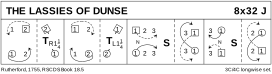
1-8
1M casts down 1 place as 2L casts up, 1M+2L turn RH ending in original places
9-16
1L casts down 1 place as 2M casts up, 1L+2M turn LH ending in original places
17-24
1s lead down to 3rd place & set (2s+3s step up 17-18); 1s dance 1/2 Fig of 8 up round 3s
25-32
1s lead up to 2nd place & set (3s step down 25-26); 1s dance 1/2 Fig of 8 up round 2s
E-Cribs
1-8
1M casts off while{4} 2W casts up ; turn RH 1¼ to own places
9-16
1W casts off while{4} 2M casts up ; turn LH 1¼ to own places
17-24
1c dance to 3pl (2c+3c up) | set ; ½ Fig8 up around 3c (2,3,1x)
25-32
1c dance up to 2pl (3c down) and set ; dance ½ Fig8 up around 2c (2,1,3)

Заметки
The Society’s version of this dance can be traced to Rutherford’s first collection of about 1755 where it is given as
The Lasses of Dunce
.
The original version of RSCDS Book 18 for bars 17-20 and 25-28 has 1st couple “lead” down or up (assumed as right hands joined) whereas the revised edition now has “dance” (nearer hands).
The Ladies of Dunse
Through a quirk of history, the pleasant little Border town of Duns, and not Berwick,
is the seat of government for Berwickshire.
(See “Berwick Johnny”)
In 1696 Greenlaw, in the foothills of the Lammermuirs, became the county town
and it was not until 1853 that county administration was transferred to Duns.
Originally, ancient Duns was situated atop Duns Law, a hill fort.
In 1545, the English army under Edward Seymour, 1st Earl of Hertford(1506–1552),
came rampaging through southern Scotland and Duns was destroyed.
When it was rebuilt in 1588, it was at the foot of the law.
General Alexander Leslie, 1st Earl of Leven (1580–1661) and his Covenanting army
camped on Duns Law in 1639
and the site is marked with a commemorative stone.
(See “Blue Bonnets”)
Duns Castle is modern except for an ancient tower built in 1320 by Thomas Randolph, 1st Earl of Moray,
one of Robert Bruce’s most trusted advisers in the Scottish hero’s long campaign
to rid the country of the oppressive yoke imposed by the English.
Near the castle is a tiny loch with the intriguing name, the Hen Poo.
Duns may well boast of two famous sons, born seven centuries apart, both of whom died in Germany.
John Duns Scotus, the greatest British medieval philosopher, was born about 1265
and was known as Doctor Subtilis in recognition of his great dialectic skill.
A Franciscan friar, Duns Scotus studied at Oxford
and, later, lectured in his university, in Paris and in Cologne, where he died circa 1308.
He was the founder of a scholastic system called Scotism.
It was the Scotists’ opposition to the classical philosophy of the period
and the manner in which they did so that gave the word “dunce” to the English language.
Jim Clark, the auto racing champion, was also born in Duns.
Twice, in 1963 and 1965, Clark drove his Lotus-Ford to victory in the World Grand Prix
and in 1965 he won the American Indianapolis “500”
where he averaged just a fraction over 150 miles per hour.
Clark was killed in his racing car in Germany in 1968.
From “Scotland Dances”, by Eugenia (Jeannie) Callander Sharp
(Used by permission.)
The Lasses of Dunce
.
The original version of RSCDS Book 18 for bars 17-20 and 25-28 has 1st couple “lead” down or up (assumed as right hands joined) whereas the revised edition now has “dance” (nearer hands).
The Ladies of Dunse
Through a quirk of history, the pleasant little Border town of Duns, and not Berwick,
is the seat of government for Berwickshire.
(See “Berwick Johnny”)
In 1696 Greenlaw, in the foothills of the Lammermuirs, became the county town
and it was not until 1853 that county administration was transferred to Duns.
Originally, ancient Duns was situated atop Duns Law, a hill fort.
In 1545, the English army under Edward Seymour, 1st Earl of Hertford(1506–1552),
came rampaging through southern Scotland and Duns was destroyed.
When it was rebuilt in 1588, it was at the foot of the law.
General Alexander Leslie, 1st Earl of Leven (1580–1661) and his Covenanting army
camped on Duns Law in 1639
and the site is marked with a commemorative stone.
(See “Blue Bonnets”)
Duns Castle is modern except for an ancient tower built in 1320 by Thomas Randolph, 1st Earl of Moray,
one of Robert Bruce’s most trusted advisers in the Scottish hero’s long campaign
to rid the country of the oppressive yoke imposed by the English.
Near the castle is a tiny loch with the intriguing name, the Hen Poo.
Duns may well boast of two famous sons, born seven centuries apart, both of whom died in Germany.
John Duns Scotus, the greatest British medieval philosopher, was born about 1265
and was known as Doctor Subtilis in recognition of his great dialectic skill.
A Franciscan friar, Duns Scotus studied at Oxford
and, later, lectured in his university, in Paris and in Cologne, where he died circa 1308.
He was the founder of a scholastic system called Scotism.
It was the Scotists’ opposition to the classical philosophy of the period
and the manner in which they did so that gave the word “dunce” to the English language.
Jim Clark, the auto racing champion, was also born in Duns.
Twice, in 1963 and 1965, Clark drove his Lotus-Ford to victory in the World Grand Prix
and in 1965 he won the American Indianapolis “500”
where he averaged just a fraction over 150 miles per hour.
Clark was killed in his racing car in Germany in 1968.
From “Scotland Dances”, by Eugenia (Jeannie) Callander Sharp
(Used by permission.)
Видео 1
Good