Leith Country Dance
Основная информация
| Автор: | Thomas (19C) Wilson |
|---|---|
| RSCDS: |
 RSCDS HQ publication
|
| Сочинен в России: | Нет |
| Публикация: |
|
| Рекомендуемая музыка: |
|
Параметры
| Тип танца: | Jig |
|---|---|
| Тип сета: | Longwise set |
| Размер: | 8x32 |
| Формат сета: | 4 couples |
| Танцующие пары: | 2 |
Источник:
https://my.strathspey.org/dd/dance/3774/
MiniCribs
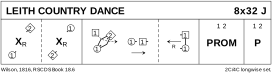
1-8
1M+2L cross RH & cross back RH, turn to face each other & form an arch
9-16
1L dances under the arch & followed by her partner dances to the bottom (2L falls back to original place), 1s lead up to top
17-24
1s+2s Promenade
25-32
1s+2s dance Poussette. 2 1
E-Cribs
1-8
1M+2W change places RH ; repeat going back and finish making a BH arch
9-16
1W dances down under the arch, followed by her P on bar 11 (2W falls back to 2pl) ; 1c lead up to the top
17-24
1c+2c Promenade
25-32
1c+2c Poussette.

Заметки
Leith Country Dance
Two hundred years ago Leith was a colourful place, indeed.
Ships from all over the world tied up at its docks
or stood off in the protected waters of the Firth of Forth,
sailors of many nationalities roved its narrow, twisting streets,
and above all of the bustle and din loomed Edinburgh’s Castle Rock.
Almost as old as Edinburgh, with which it has been incorporated since 1920,
Leith was established in the 12th century on both banks of the Water of Leith
where it flows into the Forth.
Leith’s importance as a major port was a result of the sacking of Berwick by Edward I in 1296
when wool from the Borders had to be sent through Edinburgh to Leith for shipment to the Continent.
The town was attacked and burned by the English in 1313,
in 1410 by Edward Seymour, 1st Earl of Hertford,
in 1544 and, again, in 1547.
Ship building began in Leith in the 14th century
and it was there that James IV built his
St. Michael
in 1511.
After the death of James V, a period from 1548 until 1560,
the French-Catholic faction under Marie de Guise (1515–1560), mother of Queen Mary,
made Leith their stronghold.
Montalembert, the Sieur d’Esse, commander of the French troops in Scotland,
walled and fortified Leith in 1549.
When Mary arrived from France in 1561 she spent her first day in the country of which she was queen
in the house of Andrew Lamb in Water’s Close.
Today Lamb’s House belongs to the National Trust for Scotland
and is used as an Old Folks’ Day Centre.
Charles I played golf on Leith Links in 1641
and it was while he was playing that he received word of the Irish Rebellion.
It is reputed that such disastrous news did not cause him to break off his game.
Leith Fort was built in 1779 in North Leith for the defence of the harbour
after the ships of John Paul Jones threatened Leith and Edinburgh
in the War of American Independence.
(See “Edinburgh Volunteers”)
When George IV visited in Scotland in 1822 he landed at Leith
and the spot where the royal foot first stepped is marked with a plaque on the quay,
known locally as “The Shoe”.
King George’s niece did not think highly of Leith,
which she visited first on 3 September, 1842, although she did admire the view.
“The view of Edinburgh from the road before you enter Leith is quite enchanting;
it is, as Albert said, ‘fairy-like’, and what you would only imagine as a thing to dream of,
or to see in a picture.
There was that beautiful large town, all of stone (no singled colours of brick to mar it),
with the bold Castle on one side, and the Calton Hll on the other,
with those high sharp hills of Arthur’s Seat and Salisbury Crags towering above all,
and making it the finest, boldest background imaginable.
Albert said he felt sure the Acropolis could not be finer;
and I hear they sometimes call Edinburgh ‘the modern Athens’.
The Archers Guard met us again at Leith, which is not a pretty town.”
From “Scotland Dances”, by Eugenia (Jeannie) Callander Sharp
(Used by permission.)
Two hundred years ago Leith was a colourful place, indeed.
Ships from all over the world tied up at its docks
or stood off in the protected waters of the Firth of Forth,
sailors of many nationalities roved its narrow, twisting streets,
and above all of the bustle and din loomed Edinburgh’s Castle Rock.
Almost as old as Edinburgh, with which it has been incorporated since 1920,
Leith was established in the 12th century on both banks of the Water of Leith
where it flows into the Forth.
Leith’s importance as a major port was a result of the sacking of Berwick by Edward I in 1296
when wool from the Borders had to be sent through Edinburgh to Leith for shipment to the Continent.
The town was attacked and burned by the English in 1313,
in 1410 by Edward Seymour, 1st Earl of Hertford,
in 1544 and, again, in 1547.
Ship building began in Leith in the 14th century
and it was there that James IV built his
St. Michael
in 1511.
After the death of James V, a period from 1548 until 1560,
the French-Catholic faction under Marie de Guise (1515–1560), mother of Queen Mary,
made Leith their stronghold.
Montalembert, the Sieur d’Esse, commander of the French troops in Scotland,
walled and fortified Leith in 1549.
When Mary arrived from France in 1561 she spent her first day in the country of which she was queen
in the house of Andrew Lamb in Water’s Close.
Today Lamb’s House belongs to the National Trust for Scotland
and is used as an Old Folks’ Day Centre.
Charles I played golf on Leith Links in 1641
and it was while he was playing that he received word of the Irish Rebellion.
It is reputed that such disastrous news did not cause him to break off his game.
Leith Fort was built in 1779 in North Leith for the defence of the harbour
after the ships of John Paul Jones threatened Leith and Edinburgh
in the War of American Independence.
(See “Edinburgh Volunteers”)
When George IV visited in Scotland in 1822 he landed at Leith
and the spot where the royal foot first stepped is marked with a plaque on the quay,
known locally as “The Shoe”.
King George’s niece did not think highly of Leith,
which she visited first on 3 September, 1842, although she did admire the view.
“The view of Edinburgh from the road before you enter Leith is quite enchanting;
it is, as Albert said, ‘fairy-like’, and what you would only imagine as a thing to dream of,
or to see in a picture.
There was that beautiful large town, all of stone (no singled colours of brick to mar it),
with the bold Castle on one side, and the Calton Hll on the other,
with those high sharp hills of Arthur’s Seat and Salisbury Crags towering above all,
and making it the finest, boldest background imaginable.
Albert said he felt sure the Acropolis could not be finer;
and I hear they sometimes call Edinburgh ‘the modern Athens’.
The Archers Guard met us again at Leith, which is not a pretty town.”
From “Scotland Dances”, by Eugenia (Jeannie) Callander Sharp
(Used by permission.)
Видео 1
Good