The Banks of Clyde
Основная информация
| Автор: | Unknown |
|---|---|
| RSCDS: |
 RSCDS HQ publication
|
| Сочинен в России: | Нет |
| Публикация: |
|
| Рекомендуемая музыка: |
|
Параметры
| Тип танца: | Strathspey |
|---|---|
| Тип сета: | Longwise set |
| Размер: | 8x32 |
| Формат сета: | 4 couples |
| Танцующие пары: | 3 |
Источник:
https://my.strathspey.org/dd/dance/392/
MiniCribs
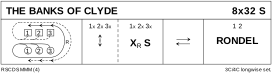
1-8
1s followed by 2s+3s cast on own sides & cross RH below 3rd place & dance up other side
9-16
1s+2s+3s Adv+Ret, cross RH & set
17-24
1s lead down the middle & back
25-32
1s+2s dance the Rondel
E-Cribs
1-8
1c followed by 2c+3c acknowledge partner and cast off behind own lines to 3pl ; cross RH (pass other dancers Rsh) and cast up to (1x,2x,3x)
9-16
1c+2c+3c A&R ; all cross RH and set
17-24
1c lead down the middle and up
25-32
1c+2c Rondel

Заметки
The Banks of Clyde
The River Clyde is a success story. Born near the small mining community of Leadhills, it served its
apprenticeship to the industry of Lanark, Hamilton, Bothwell and Uddingston and, at last, became
an economic giant at Glasgow.
Leadhills, in Lanarkshire near the border of Dumfriesshire, in the southern uplands, is one of the highest
villages in Scotland. Allan Ramsay (1686–1758), wigmaker, bookseller, poet and collector of
The Tea
Table Miscellany
, was a native of Leadhills and it was there that he established a circulating library,
the first in Britain.
On its way to the sea the Clyde makes four great leaps downward, at the waterfalls of the Clyde,
the linns of Bonnington, Dundaff, Corra and Stonebyres. The valley of the upper Clyde is agricultural,
with orchards and market gardens vying for importance with the famous Clydesdale horses,
while beneath the rich soil are the coal and iron of industry.
Officially, the Clyde runs from Daer Water to Dumbarton, a distance a bit over one hundred miles,
but the people of Glasgow consider the firth, where the Clyde mixes with the Atlantic and the
shores are dotted with holiday resorts, the “Costa Clyde”, as part of “their” river.
In 1812 Henry Bell, an innkeeper at Dumbarton, added a four-and-one-half horsepower engine to a
forty-two foot hull with paddle wheels and called it the
Comet
, the first successful passenger
steamship in Europe. On that January day when the
Comet
thrashed over the Clyde at seven
miles an hour, a great tradition was begun: those glorious days of steamships on the Clyde that
carried holiday-makers “doon the watter” to Dunoon, Rothesay, Wemyss Bay and as far away as
Arran and Campbeltown. From Glasgow’s Broomielaw during the 19th century, the golden age
of the Clyde steamers, throngs of hard-working city dwellers embarked on vessels with such
names as
Benmore
,
Ivanhoe
,
Balmoral
and
Meg Merrilies
.
There is something for everyone on the bonny banks of Clyde: from the racing trout stream to
the lush river banks of the Vale, to the burgeoning industry of Lanarkshire, to the bustling commerce
of Glasgow and the ship-building for the seven seas at Clydebank, to the excursion boats that still
sail down the now mighty river that flows between the mountains standing at the very edge of the sea.
In the early 17th century William Lithgow, also known as “Lugless Will”, a widely-travelled
adventurer, wrote:
Would God I might but live
To see my native soil,
Twice happy is my happy wish
To end this endless toil.
Yet still I would record
The pleasant banks of Clyde,
Where orchards, castles, towns and woods
Are planted side by side.
And chiefly, Lanark, thou
Thy country’s lowest lamp,
In which the bruised body now
Did first receive the stamp.
From “Scotland Dances”, by Eugenia (Jeannie) Callander Sharp
(Used by permission.)
The River Clyde is a success story. Born near the small mining community of Leadhills, it served its
apprenticeship to the industry of Lanark, Hamilton, Bothwell and Uddingston and, at last, became
an economic giant at Glasgow.
Leadhills, in Lanarkshire near the border of Dumfriesshire, in the southern uplands, is one of the highest
villages in Scotland. Allan Ramsay (1686–1758), wigmaker, bookseller, poet and collector of
The Tea
Table Miscellany
, was a native of Leadhills and it was there that he established a circulating library,
the first in Britain.
On its way to the sea the Clyde makes four great leaps downward, at the waterfalls of the Clyde,
the linns of Bonnington, Dundaff, Corra and Stonebyres. The valley of the upper Clyde is agricultural,
with orchards and market gardens vying for importance with the famous Clydesdale horses,
while beneath the rich soil are the coal and iron of industry.
Officially, the Clyde runs from Daer Water to Dumbarton, a distance a bit over one hundred miles,
but the people of Glasgow consider the firth, where the Clyde mixes with the Atlantic and the
shores are dotted with holiday resorts, the “Costa Clyde”, as part of “their” river.
In 1812 Henry Bell, an innkeeper at Dumbarton, added a four-and-one-half horsepower engine to a
forty-two foot hull with paddle wheels and called it the
Comet
, the first successful passenger
steamship in Europe. On that January day when the
Comet
thrashed over the Clyde at seven
miles an hour, a great tradition was begun: those glorious days of steamships on the Clyde that
carried holiday-makers “doon the watter” to Dunoon, Rothesay, Wemyss Bay and as far away as
Arran and Campbeltown. From Glasgow’s Broomielaw during the 19th century, the golden age
of the Clyde steamers, throngs of hard-working city dwellers embarked on vessels with such
names as
Benmore
,
Ivanhoe
,
Balmoral
and
Meg Merrilies
.
There is something for everyone on the bonny banks of Clyde: from the racing trout stream to
the lush river banks of the Vale, to the burgeoning industry of Lanarkshire, to the bustling commerce
of Glasgow and the ship-building for the seven seas at Clydebank, to the excursion boats that still
sail down the now mighty river that flows between the mountains standing at the very edge of the sea.
In the early 17th century William Lithgow, also known as “Lugless Will”, a widely-travelled
adventurer, wrote:
Would God I might but live
To see my native soil,
Twice happy is my happy wish
To end this endless toil.
Yet still I would record
The pleasant banks of Clyde,
Where orchards, castles, towns and woods
Are planted side by side.
And chiefly, Lanark, thou
Thy country’s lowest lamp,
In which the bruised body now
Did first receive the stamp.
From “Scotland Dances”, by Eugenia (Jeannie) Callander Sharp
(Used by permission.)
Видео 1
Reasonable