The Machine without Horses
Основная информация
| Автор: | David Rutherford |
|---|---|
| RSCDS: |
 RSCDS HQ publication
|
| Сочинен в России: | Нет |
| Публикация: |
|
| Рекомендуемая музыка: |
|
Параметры
| Тип танца: | Jig |
|---|---|
| Тип сета: | Longwise set |
| Размер: | 8x32 |
| Формат сета: | 4 couples |
| Танцующие пары: | 3 |
Источник:
https://my.strathspey.org/dd/dance/4032/
MiniCribs
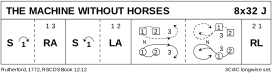
1-8
1s set, cast & dance RH across with 3s
9-16
1s set, cast up & dance LH across with 2s
17-24
1s followed by 2s dance down, cast up behind 3s, in & dance up to top & 1s cast back to 2nd place
25-32
2s+1s dance R&L
E-Cribs
1-8
1c set | cast off (2c up) ; 1c+3c RHA
9-16
1c set | cast up (2c down) ; 1c+2c LHA
17-24
1c followed by 2c dance between 3c, cast up round them, dance up, 1c cast off to 2pl, while 2c dance into 1pl (no loops)
25-32
2c+1c R&L

Заметки
##>>
In his book,
Scotland through her country dances
, George Emmerson argues that the 1772 date of the dance and tune is well before the invention of any ‘horseless carriage’ and concludes that the dance title refers to a sedan chair. While the argument seems sound, it should also be noted that the first steam engines date from around 1700.
##<<
Walter Ligon has pointed out the following pertinent excerpt for 19 October 1769 from
The Life of Samuel Johnson
by James Boswell:
There was a pretty large circle this evening. Dr. Johnson was in very good humour, lively, and ready to talk upon all subjects. Mr. Fergusson, the self-taught philosopher, told him of a new invented machine which went without horses: a man who sat in it turned a handle, which worked a spring that drove it forward. “Then, Sir, (said Johnson,) what is gained is, the man has his choice whether he will move himself alone, or himself and the machine too.”
The Machine Without Horses
About 1769 a new type of vehicle caught the imagination of, and possibly amused, a horse-drawn nation.
The age of self-propulsion had arrived.
The machine without horses of 1769 was a four-wheeled carriage.
In the front where the coachman usually sat were two wooden levers that led back to the rear wheels.
By depressing first one lever and then the other the back wheels were made to turn.
Perhaps the only person involved with this early horseless carriage who was not thrilled or amused
was the unlucky servant whose duty it was to pump the levers.
In 1770 another horseless carriage arrived on the scene to thrill the public.
This was a French invention, by Nicholas Joseph Cugnot (1725–1804),
a three-whelled carriage driven forward from the single front wheel by a crude steam engine.
This forerunner of the motor car was capable of a speed of two and one half miles an hour,
a velocity hampered by the fact that stops were required every hundred feet or so to get up steam.
Nevertheless, the world was on its way to the motor car.
Since “The Machine Without Horses” and its original tune
were first published in 1772 by David Rutherford,
and with some consideration given to the figures of the dance,
the machine it celebrated was undoubtedly either the self-propelled carriage
or the steam-driven French road wagon.
From “Scotland Dances”, by Eugenia (Jeannie) Callander Sharp
(Used by permission.)
In his book,
Scotland through her country dances
, George Emmerson argues that the 1772 date of the dance and tune is well before the invention of any ‘horseless carriage’ and concludes that the dance title refers to a sedan chair. While the argument seems sound, it should also be noted that the first steam engines date from around 1700.
##<<
Walter Ligon has pointed out the following pertinent excerpt for 19 October 1769 from
The Life of Samuel Johnson
by James Boswell:
There was a pretty large circle this evening. Dr. Johnson was in very good humour, lively, and ready to talk upon all subjects. Mr. Fergusson, the self-taught philosopher, told him of a new invented machine which went without horses: a man who sat in it turned a handle, which worked a spring that drove it forward. “Then, Sir, (said Johnson,) what is gained is, the man has his choice whether he will move himself alone, or himself and the machine too.”
The Machine Without Horses
About 1769 a new type of vehicle caught the imagination of, and possibly amused, a horse-drawn nation.
The age of self-propulsion had arrived.
The machine without horses of 1769 was a four-wheeled carriage.
In the front where the coachman usually sat were two wooden levers that led back to the rear wheels.
By depressing first one lever and then the other the back wheels were made to turn.
Perhaps the only person involved with this early horseless carriage who was not thrilled or amused
was the unlucky servant whose duty it was to pump the levers.
In 1770 another horseless carriage arrived on the scene to thrill the public.
This was a French invention, by Nicholas Joseph Cugnot (1725–1804),
a three-whelled carriage driven forward from the single front wheel by a crude steam engine.
This forerunner of the motor car was capable of a speed of two and one half miles an hour,
a velocity hampered by the fact that stops were required every hundred feet or so to get up steam.
Nevertheless, the world was on its way to the motor car.
Since “The Machine Without Horses” and its original tune
were first published in 1772 by David Rutherford,
and with some consideration given to the figures of the dance,
the machine it celebrated was undoubtedly either the self-propelled carriage
or the steam-driven French road wagon.
From “Scotland Dances”, by Eugenia (Jeannie) Callander Sharp
(Used by permission.)
Видео 1
Demonstration quality

Видео 2
Good
Видео 3
Good
Видео 4
Good
Видео 5
Reasonable
Видео 6
Reasonable
Видео 7
Reasonable
Видео 8
Reasonable
Видео 9
Animation