Основная информация
| Автор: | Unknown |
|---|---|
| RSCDS: |
 RSCDS HQ publication
|
| Сочинен в России: | Нет |
| Публикация: |
|
| Рекомендуемая музыка: |
|
Параметры
| Тип танца: | Reel |
|---|---|
| Тип сета: | Longwise set |
| Размер: | 4x64 |
| Формат сета: | 4 couples |
| Танцующие пары: | 4 |
Источник:
https://my.strathspey.org/dd/dance/43/
MiniCribs
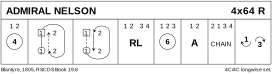
1-8
1s+2s circle 4H round & back
9-16
1L followed by partner casts down below 2s, cross & cast up on Men’s side & back to places
17-24
1M repeats this Fig starting by casting down own side followed by partner
25-32
1s+2s & 3s+4s R&L
33-40
1s+2s+3s circle 6H round & back
41-48
1s+2s Allemande
49-56
All dance Grand Chain
57-64
1s lead up to top & cast down own sides to 4th place
E-Cribs
1-8
1c+2c circle4 and back
9-16
1W followed by 1M casts off and dances round 2c and back to place
17-24
Repeat [9-16], 1M leading
25-32
1c+2c & 3c+4c R&L
33-40
1c+2c+3c Circle6 and back, finishing for
41-48
1c+2c Allemande (2,1,3,4)
49-56
2c+1c+3c+4c G-Chain, end couples crossing
57-54
1c lead up and cast to 4pl (3c+4c up)

Заметки
Admiral Nelson
On 21st October, 1805, the Right Honourable the Viscount Nelson, K. B., was mortally wounded aboard
Victory
during the triumphant battle of Trafalgar. It is ironic that this dance was published in the same
year as Nelson’s death.
Admiral Horatio Nelson, born in Norfolk, England, in 1758, created viscount in 1801, was the hero of
all Britain. He was courageous: he gave the sight of his right eye, his right arm, and later, his life in the
defense of his country. He was a romantic figure: one only need consider his long attachment to Emma
Hamilton, a fact that must have titillated the ladies of his time. He was a great humanitarian: unlike
Marlborough and Wellington, his common touch would appeal strongly to the Scots.
The Nelson Monument, atop Calton Hill in Edinburgh, was finished in 1815. Whether by accident or
design, it rather resembles an inverted telescope. The English monument to their native son in
Trafalgar Square, while in somewhat better taste than the Edinburgh memorial, was not finished
until 1849, over forty years after Nelson’s death. But, in Glasgow Green stands another monument
honouring Lord Nelson. The energetic Glaswegians began erecting theirs in 1805 and it was finished
in 1806. And at the same time there was erected another monument to Admiral Nelson, a
seventy-foot octagonal tower atop Cluny Hill in the small Morayshire town of Forres.
From “Scotland Dances”, by Eugenia (Jeannie) Callander Sharp
(Used by permission.)
Battle of Trafalgar
“England expects that every man will do his duty.” In the year 1805, the
War of the Third Coalition
is raging: The United Kingdom, the empires of Austria and Russia, and Sweden, Naples, and Sicily stand against France and her client states under Napoleon Bonaparte and Spain (Prussia remains neutral). On 21 October 1805, near Cape Trafalgar in south-west Spain – immediately outside the Straits of Gibraltar –, a British fleet under the vice-admirals Horatio, Lord Nelson and Cuthbert Collingwood meets a combined French-Spanish fleet under the admiral, Pierre-Charles Villeneuve. The French and Spanish’s goal is to break the British blockade of Brest and, reinforced by the ships shut in there, to take control of the English channel and cover an invasion of Britain – to the British, an unthinkable catastrophe. Nelson’s and Collingwood’s task is to avert this at all costs.
With 33 “ships of the line”, i.e., large sailing ships suitable for the usual tactic where two opposing fleets sail alongside each other in two long queues to make the most efficient use of their “broadsides” – including the largest man-o’-war afloat at the time, the Spanish 130-gun
Santísima Trinidad
–, the French and Spanish command superior numbers compared to the 27 British ships of the line. On the other hand, the British crews, after years at sea and on blockade duty, are much better trained and more experienced than their enemies, who spent most of the time in port. Nelson uses a novel strategy: He splits his fleet into two squadrons, which are supposed to break the French-Spanish line in two different places – a daring maneuver during which his ships are, at first, subject to enemy fire, but will be able to “rake” their opponents when crossing the line, i.e., fire their guns one after the other to shoot through the enemy ships lengthwise, with disastrous consequences for their crews and fighting capability. This plan pans out – while the vanguard of the French-Spanish fleet sails away before it can turn around and join the battle, the British are temporarily of superior strength –, and in the ensuing chaos, the British take or destroy 18 enemy ships without losing any themselves. Nelson’s flagship,
Victory
, leads one of the British squadrons and takes heavy damage. Nelson himself is hit by a French sharp-shooter, gravely injured, and dies shortly before the battle is finished.
Even so, the strategic goal has been reached and an invasion of Great Britain has been successfully foiled. Nelson, a celebrity already in his lifetime in spite of his notorious conduct, posthumously becomes the nation’s greatest war hero ever (even today this has not changed). Villeneuve is taken prisoner. The battle of Trafalgar cements the predominance of the Royal Navy on the seas and therefore represents an important stepping stone towards the British Empire.
From “Anselm's Notes on Dances”, by Anselm Lingnau
(Used by permission.)
On 21st October, 1805, the Right Honourable the Viscount Nelson, K. B., was mortally wounded aboard
Victory
during the triumphant battle of Trafalgar. It is ironic that this dance was published in the same
year as Nelson’s death.
Admiral Horatio Nelson, born in Norfolk, England, in 1758, created viscount in 1801, was the hero of
all Britain. He was courageous: he gave the sight of his right eye, his right arm, and later, his life in the
defense of his country. He was a romantic figure: one only need consider his long attachment to Emma
Hamilton, a fact that must have titillated the ladies of his time. He was a great humanitarian: unlike
Marlborough and Wellington, his common touch would appeal strongly to the Scots.
The Nelson Monument, atop Calton Hill in Edinburgh, was finished in 1815. Whether by accident or
design, it rather resembles an inverted telescope. The English monument to their native son in
Trafalgar Square, while in somewhat better taste than the Edinburgh memorial, was not finished
until 1849, over forty years after Nelson’s death. But, in Glasgow Green stands another monument
honouring Lord Nelson. The energetic Glaswegians began erecting theirs in 1805 and it was finished
in 1806. And at the same time there was erected another monument to Admiral Nelson, a
seventy-foot octagonal tower atop Cluny Hill in the small Morayshire town of Forres.
From “Scotland Dances”, by Eugenia (Jeannie) Callander Sharp
(Used by permission.)
Battle of Trafalgar
“England expects that every man will do his duty.” In the year 1805, the
War of the Third Coalition
is raging: The United Kingdom, the empires of Austria and Russia, and Sweden, Naples, and Sicily stand against France and her client states under Napoleon Bonaparte and Spain (Prussia remains neutral). On 21 October 1805, near Cape Trafalgar in south-west Spain – immediately outside the Straits of Gibraltar –, a British fleet under the vice-admirals Horatio, Lord Nelson and Cuthbert Collingwood meets a combined French-Spanish fleet under the admiral, Pierre-Charles Villeneuve. The French and Spanish’s goal is to break the British blockade of Brest and, reinforced by the ships shut in there, to take control of the English channel and cover an invasion of Britain – to the British, an unthinkable catastrophe. Nelson’s and Collingwood’s task is to avert this at all costs.
With 33 “ships of the line”, i.e., large sailing ships suitable for the usual tactic where two opposing fleets sail alongside each other in two long queues to make the most efficient use of their “broadsides” – including the largest man-o’-war afloat at the time, the Spanish 130-gun
Santísima Trinidad
–, the French and Spanish command superior numbers compared to the 27 British ships of the line. On the other hand, the British crews, after years at sea and on blockade duty, are much better trained and more experienced than their enemies, who spent most of the time in port. Nelson uses a novel strategy: He splits his fleet into two squadrons, which are supposed to break the French-Spanish line in two different places – a daring maneuver during which his ships are, at first, subject to enemy fire, but will be able to “rake” their opponents when crossing the line, i.e., fire their guns one after the other to shoot through the enemy ships lengthwise, with disastrous consequences for their crews and fighting capability. This plan pans out – while the vanguard of the French-Spanish fleet sails away before it can turn around and join the battle, the British are temporarily of superior strength –, and in the ensuing chaos, the British take or destroy 18 enemy ships without losing any themselves. Nelson’s flagship,
Victory
, leads one of the British squadrons and takes heavy damage. Nelson himself is hit by a French sharp-shooter, gravely injured, and dies shortly before the battle is finished.
Even so, the strategic goal has been reached and an invasion of Great Britain has been successfully foiled. Nelson, a celebrity already in his lifetime in spite of his notorious conduct, posthumously becomes the nation’s greatest war hero ever (even today this has not changed). Villeneuve is taken prisoner. The battle of Trafalgar cements the predominance of the Royal Navy on the seas and therefore represents an important stepping stone towards the British Empire.
From “Anselm's Notes on Dances”, by Anselm Lingnau
(Used by permission.)
Видео 1
Social