The Minister on the Loch
Основная информация
| Автор: | Roy Goldring |
|---|---|
| RSCDS: |
 RSCDS HQ publication
|
| Сочинен в России: | Нет |
| Публикация: |
|
| Рекомендуемая музыка: |
|
Параметры
| Тип танца: | Reel |
|---|---|
| Тип сета: | Longwise set |
| Размер: | 3x32 |
| Формат сета: | 3 couples |
| Танцующие пары: | 3 |
Источник:
https://my.strathspey.org/dd/dance/4411/
MiniCribs
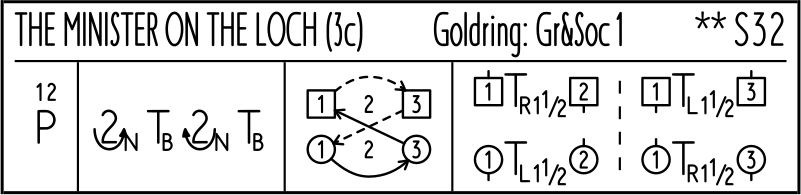
1-8
1s+2s dance Diamond Poussette
9-16
1s dance down for 2 steps, turn 2H, dance up to top & turn 2H remaining in centre facing up
17-24
1s+3s dance double Fig of 8 round 2s with 1s casting to start
25-32
1M+2M turn LH 1.1/2 times while 1L+2L turn RH 1.1/2 times, 1M+3M turn RH 1.1/2 times while 1L+3L turn LH 1.1/2 times
E-Cribs
1-8
1c+2c Poussette
9-16
1c dance down 2 places, turn BH ; dance up 2 places, turn BH, open upwards and face out
17-24
1c+3c DblFig8 round 2c, 1c casting, 3c crossing up to begin, 1c finish facing out for
25-32
1W+2W & 1M+2M turn EH 1½ ; 1c+3c repeat (2,3,1)

Заметки
The title refers to the portrait by
Sir Henry Raeburn
of “Reverend Robert Walker skating on Duddingston Loch”
(or “The Skating Minister”, for short)
which now hangs in the
National Gallery of Scotland
.
Art and artists were among
Roy Goldring
’s other great passions.
The Skating Minister
Reverend Robert Walker Skating on Duddingston Loch (Sir Henry Raeburn?, 1795, gemeinfrei)
“Reverend Robert Walker skating on Duddingston Loch” (or “The Skating Minister” to its friends) is a painting by
Sir Henry Raeburn
which is now on display at the
National Gallery of Scotland
in Edinburgh.
The Revd Dr Robert Walker (1755–1808), a personal friend of Henry Raeburn’s, was born in Ayrshire but – as his father served as the minister of the Scots Kirk in Rotterdam – he lived in the Netherlands as a child, and it is reasonable to assume that he learned to skate there. Having been licensed as a minister in 1770 (!) he eventually became minister of the Canongate Kirk in Edinburgh and joined the Edinburgh Skating Club (the world’s first figure skating club), whose members frequented Duddingston Loch (seen in the painting) or Lochend Loch when conditions were suitable for skating. According to the National Gallery of Scotland, “Walker’s pose, as he glides across the ice, looks effortless, but would have been recognised by fellow skaters as a difficult and sophisticated manœuvre.”
The picture, which was painted around 1795, spent a long time in the possession of the Walker family before passing through the hands of a number of owners during the first half of the 20th century and finally, in 1949, being acquired, for £525, by the National Gallery of Scotland where it languished in obscurity for another few decades. It was featured on a commemorative postage stamp in 1973 and eventually displayed in an exhibition of Raeburn pictures at the National Portrait Gallery in London in 1997, where it appeared on widely publicised posters and finally achieved its well-deserved popularity.
This painting is rather unlike other portraits by Raeburn and there is an ongoing controversy where some art historians claim it was actually executed by the French painter, Henri-Pierre Danloux. In spite of this, it is considered an iconic work, has been exhibited domestically and abroad, and has also found its way into popular culture, making cameo appearances in TV shows and popular fiction.
From “Anselm's Notes on Dances”, by Anselm Lingnau
(Used by permission.)
Sir Henry Raeburn
of “Reverend Robert Walker skating on Duddingston Loch”
(or “The Skating Minister”, for short)
which now hangs in the
National Gallery of Scotland
.
Art and artists were among
Roy Goldring
’s other great passions.
The Skating Minister
Reverend Robert Walker Skating on Duddingston Loch (Sir Henry Raeburn?, 1795, gemeinfrei)
“Reverend Robert Walker skating on Duddingston Loch” (or “The Skating Minister” to its friends) is a painting by
Sir Henry Raeburn
which is now on display at the
National Gallery of Scotland
in Edinburgh.
The Revd Dr Robert Walker (1755–1808), a personal friend of Henry Raeburn’s, was born in Ayrshire but – as his father served as the minister of the Scots Kirk in Rotterdam – he lived in the Netherlands as a child, and it is reasonable to assume that he learned to skate there. Having been licensed as a minister in 1770 (!) he eventually became minister of the Canongate Kirk in Edinburgh and joined the Edinburgh Skating Club (the world’s first figure skating club), whose members frequented Duddingston Loch (seen in the painting) or Lochend Loch when conditions were suitable for skating. According to the National Gallery of Scotland, “Walker’s pose, as he glides across the ice, looks effortless, but would have been recognised by fellow skaters as a difficult and sophisticated manœuvre.”
The picture, which was painted around 1795, spent a long time in the possession of the Walker family before passing through the hands of a number of owners during the first half of the 20th century and finally, in 1949, being acquired, for £525, by the National Gallery of Scotland where it languished in obscurity for another few decades. It was featured on a commemorative postage stamp in 1973 and eventually displayed in an exhibition of Raeburn pictures at the National Portrait Gallery in London in 1997, where it appeared on widely publicised posters and finally achieved its well-deserved popularity.
This painting is rather unlike other portraits by Raeburn and there is an ongoing controversy where some art historians claim it was actually executed by the French painter, Henri-Pierre Danloux. In spite of this, it is considered an iconic work, has been exhibited domestically and abroad, and has also found its way into popular culture, making cameo appearances in TV shows and popular fiction.
From “Anselm's Notes on Dances”, by Anselm Lingnau
(Used by permission.)
Видео 1
Demonstration quality

Видео 2
Demonstration quality
Видео 3
Demonstration quality
Видео 4
Demonstration quality
Видео 5
Demonstration quality
Видео 6
Good
Видео 7
Good
Видео 8
Good
Видео 9
Good
Видео 10
Good
Видео 11
Good
Видео 12
Reasonable
Видео 13
Social
Видео 14
Animation