The Belfast Hornpipe
Основная информация
| Автор: | Wesley Clindinning |
|---|---|
| RSCDS: | Не RSCDS |
| Сочинен в России: | Нет |
| Публикация: | Canada's Irish Rover |
| Рекомендуемая музыка: | Just For You |
Параметры
| Тип танца: | Reel |
|---|---|
| Тип сета: | Longwise set |
| Размер: | 3x32 |
| Формат сета: | 3 couples |
| Танцующие пары: | 3 |
Источник:
https://my.strathspey.org/dd/dance/454/
MiniCribs
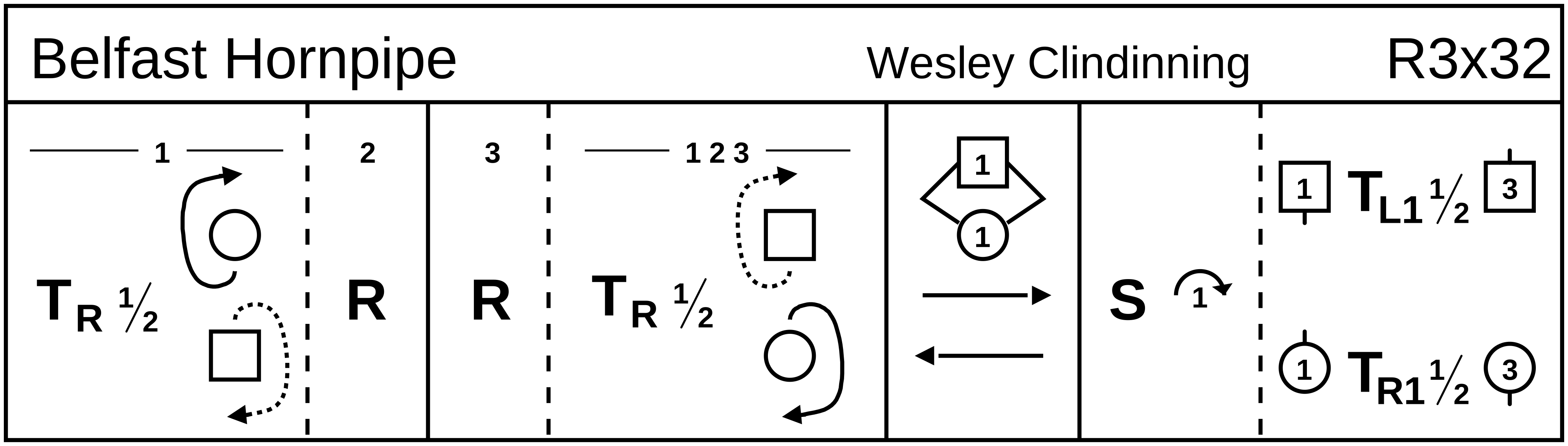
1-8
1s 1/2 turn RH & twirl (pull back RSh) & dance out to opposite sides, 2s repeat
9-16
3s repeat (all now on opp sides). 1s+2s+3s 1/2 turn & twirl to own sides
17-24
1s slip step down the middle & back to end at top facing partner
25-32
1s set & cast 1 place, 1M+3M turn RH 1.1/2 times while 1L+3L turn LH 1.1/2 times to end 2 3 1
(Variation - See “Wes Clindinning’s Hornpipe”)
E-Cribs
1-8
1c turn RH ½ and twirl to exchanged places ; 2c repeat (1x,2x,3)
9-16
3c repeat ; All repeat (1,2,3)
17-24
1c slip down the middle ; and up (1,2,3)
25-32
1c set and cast off (2c up) ; 1c starting inwards turn 3c EH 1½ (2,3,1)
(Note: A variant for [25-32] is now named Wes Clindinning’s Hornpipe)

Заметки
A variant, created inadvertently by Mel Briscoe, has now been given its own name “
Wes Clindinning's Hornpipe
” as it has become popular in its own right (see there for more information).
The dance denoted as “Belfast Hornpipe (New Way)” at
https://dances.e-cribs.org/var/Cincinnati_Demo_Dances_2007-2008.pdf
(there also attributed to Mel Briscoe) is not identically to either of the two dances above. However, all three dances only differ in bars [25-32].
Belfast
Belfast as the capital of Northern Ireland, with a population of somewhat over 670.000 in its metropolitan area (2021) is in a certain way the counterpoint to Dublin. The town was founded in the 17th century as an English settlement, but then mostly settled by Presbyterians of Scottish extraction. These promptly started to disagree with the Anglican establishment, and in 1798 there was an uprising where they tried to solidarise with the Catholic majority against the English upper class in the country in order to form a republic. Naturally this failed (in spite of French support) and eventually led to the dissolution of the Irish parliament and the annexation of Ireland by Great Britain. The city of Belfast benefited from this – there was an industrial transformation, and at the start of the 20th century, Belfast had the largest linen production and prospering dockyards. However, religiously-motivated conflicts kept popping up and led to the “troubles” during the last three decades of the 20th century, which the British government could only suppress by massive military power. Since the Good Friday Agreement of 1998 there is a tenuous peace which was further undermined by Brexit, and the problems are by no means over. It is safe to assume, however, that in the medium term there will be a reunificiation of Northern Ireland with the Republic; the approximate rules of how this could happen based on a referendum have already been delineated.
From “Anselm's Notes on Dances”, by Anselm Lingnau
(Used by permission.)
Wes Clindinning's Hornpipe
” as it has become popular in its own right (see there for more information).
The dance denoted as “Belfast Hornpipe (New Way)” at
https://dances.e-cribs.org/var/Cincinnati_Demo_Dances_2007-2008.pdf
(there also attributed to Mel Briscoe) is not identically to either of the two dances above. However, all three dances only differ in bars [25-32].
Belfast
Belfast as the capital of Northern Ireland, with a population of somewhat over 670.000 in its metropolitan area (2021) is in a certain way the counterpoint to Dublin. The town was founded in the 17th century as an English settlement, but then mostly settled by Presbyterians of Scottish extraction. These promptly started to disagree with the Anglican establishment, and in 1798 there was an uprising where they tried to solidarise with the Catholic majority against the English upper class in the country in order to form a republic. Naturally this failed (in spite of French support) and eventually led to the dissolution of the Irish parliament and the annexation of Ireland by Great Britain. The city of Belfast benefited from this – there was an industrial transformation, and at the start of the 20th century, Belfast had the largest linen production and prospering dockyards. However, religiously-motivated conflicts kept popping up and led to the “troubles” during the last three decades of the 20th century, which the British government could only suppress by massive military power. Since the Good Friday Agreement of 1998 there is a tenuous peace which was further undermined by Brexit, and the problems are by no means over. It is safe to assume, however, that in the medium term there will be a reunificiation of Northern Ireland with the Republic; the approximate rules of how this could happen based on a referendum have already been delineated.
From “Anselm's Notes on Dances”, by Anselm Lingnau
(Used by permission.)
Видео 1
Reasonable

Видео 2
Animation