The Montgomeries' Rant
Основная информация
| Автор: | Castle Menzies (18C) |
|---|---|
| RSCDS: |
 RSCDS HQ publication
|
| Сочинен в России: | Нет |
| Публикация: |
|
| Рекомендуемая музыка: |
|
Параметры
| Тип танца: | Reel |
|---|---|
| Тип сета: | Longwise set |
| Размер: | 8x32 |
| Формат сета: | 4 couples |
| Танцующие пары: | 3 |
Источник:
https://my.strathspey.org/dd/dance/4641/
MiniCribs
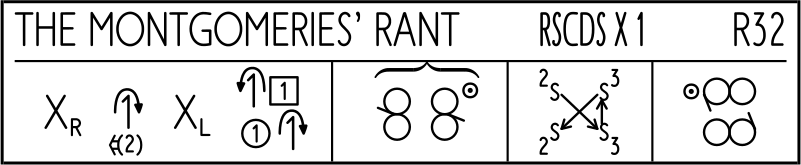
1-8
1s cross RH & cast down to 2nd place (2s step up), cross LH & 1L casts up while 1M casts down
9-16
1s dance reels of 3 across, 1L with 2s (RSh to 2M) & 1M with 3s (RSh to 3L)
17-24
1s NHJ (Lady on Mans left) set to 2L & turn inwards to set to 3M, set to 3L & turn inward & set to 2M. End facing own 2nd corner (1L pull back LSh to face down)
25-32
2s+1s+3s dance reels of 3 on opposite sides 1s giving RSh to 2nd corner, 1s cross RH to 2nd place own sides
E-Cribs
1-8
1c cross RH | cast off (2c up) ; cross LH | cast L (W up, M down)
9-16
2c+1W & 1M+3c RSh Reels3 across
17-24
1c NHJ set to 2W (swivel ½ inwards), set to 3M (veer L together), set to 3W (swivel ½ inwards), set to 2M (and face own 2cnr)
25-32
Reels3{6} on the sides, RSh to 2cnr | 1c cross RH to 2pl

Заметки
##>>
The source of this dance,
The Menzies Manuscript
, is part of the Atholl Collection. In the manuscript, the name of the dance is unequivocally The Montgomerie’s Rant ie referring to the Head of the Montgomerie family. Why the change was made is unknown.
In 1749, the date of the manuscript, Alexander Montgomerie had been 10th Earl of Eglinton for twenty years. He was prominent in London Society and a close friend of James Boswell, Samuel Johnson’s literary assistant. His main claim to fame is that he was shot to death on his estate by an exciseman claiming the right to carry arms on the estate, effectively claiming a right to hunt, or poach, depending on your point of view.
##<<
The Montgomeries' Rant
The first Montgomerie, Robert, came to England from Normandy with William I
and was created Earl of Arundel, a title which did not remain with the Montgomerie family.
The Scottish Montgomeries began with Robert’s grandson, another Robert,
who moved to Scotland prior to 1164 in the train of Walter, created first Steward of Scotland by David I.
This Robert de Mundegumri, whose name is found thus on records for the years 1165–1177,
was granted the barony of Eaglesham in Renfrewshire
which the family held without change for seven hundred years.
It was Sir John Montgomerie, 9th of Eaglesham,
who captured Sir Henry Percy, “Hotspur”, at the battle of Otterburn in 1388.
The Percy and Montgomery met,
That either of other were fain;
They swapped swords, and they two swat,
And aye the blood ran down between.
Sir John married the heiress of Sir Hugh of Eglinton
which brought the family Polnoon Castle and the baronies of Eglinton and Ardrossan.
Hugh, 3rd Baron Montgomerie (c. 1460–1545) was even more acquisitive.
He was one of the band of disaffected nobles
who defeated, and perhaps murdered, James III at the battle of Auchieburn in 1488
and was rewarded in the reign of James IV with land and power.
He was created Earl of Eglinton in 1508
and was given the island of Arran with custody of Brodick Castle.
In 1527 he was a Justice general and in 1536 a member of the Council of Regency.
He survived to an advanced age and outlived james III, IV, and V.
Hugh, 3rd Earl of Eglinton (1531–1585), supported Queen Mary,
fought for her at Langside in 1568 and was imprisoned in Doune Castle.
The sixth Earl was Alexander Seton (1588–1661),
son of Lady Mary Montgomerie, daughter of the third earl,
who had married Robert Seton, Earl of Winton.
As ardent a Covenanter as his grandfather had been a Roman Catholic,
the new Lord Eglinton, known as “Greysteel”,
fought against Charles I at the battle of Marston Moor in 1644,
but yet urged the recall of Charles II to the throne as a Covenanted king.
The Montgomerie Earls of Eglinton always seemed to make advantageous marriages
and their wives were the daughters of the great nobles of Scotland:
Argyll, Hamilton, Linlithgow, Buccleuch, Rothes, Dumfries, Dundonald, Aberdeen and Crawford.
Alexander, 9th Earl of Eglinton, married three noble heiresses during his long lifetime:
Margaret Cochrane, Ann Gordon and, last, Susanna Kennedy
and from each of them he gained more estates.
His widow, the Dowager Countess of Eglinton, a once famous beauty,
a lifelong Jacobite and an eccentric who preferred rats to cats as pets,
died in 1780 at the age of ninety.
The tenth earl, Alexander, Governor of Dumbarton Castle, Lord of the Bedchamber to George III
and a Representative Peer,
was shot and killed by a poacher on his estate in 1769.
He was the older friend of James Boswell
who introduced the journalist as a young man
to “the great, the gay, and the ingenious” of London
and very nearly turned the future travelling companion of Dr Samuel Johnson into a rake.
Archibald Montgomerie succeeded his brother as eleventh earl.
Known as “General Montgomerie”
he raised the old 77th Regiment of Foot (Montgomery’s Highlanders) in 1757,
a regiment recruited chiefly from among the Jacobite clans that was disbanded in 1763.
He became Governor of Edinburgh Castle in 1782.
The eleventh earl was succeeded by his cousin,
Colonel Hugh Montgomerie of Coilsfield (1740–1819),
Burns’ “Sodger Hugh” of “The Author’s Earnest Cry and Prayer to the Scotch Representatives in the House of Commons”.
The twelfth earl served in the army in the Seven Years War and in America.
There was another side to “Sodger Hugh”,
that of an expert fiddler and the composer of such tunes as “Lady Montgomerie’s Reel”,
“Ayrshire Lasses”, “The Island of Mull” and “Anwick Lodge”.
Niel Gow’s
Fourth Collection of Strathspey Reels
of 1800 was dedicated to the Earl of Eglinton.
Alas! I’m but a nameless wight,
Trode i’ the mire out o’ sight!
But could I like Montgomerie fight,
Or gab like Boswell,
There’s some sark-necks I wad draw tight,
An’ tie some hose well.
From “Scotland Dances”, by Eugenia (Jeannie) Callander Sharp
(Used by permission.)
The Montgomeries' Rant
One could write long treatises about
The Montgomeries' Rant
(
Hugh Foss
did exactly this in
The Reel #82
, where he analyses the connection between the dance and its music – very much worth reading). The dance comes to us via RSCDS
Book 10
from the
Register of Dances at Castle Menzies
of 1749, not a printed book but rather someone’s handwritten notes about their dance class. The original can be inspected at the A K Bell library in Perth (Scotland), or, as long as you are only interested in the text,
here
.
The Montgomerie’s Rant
is dance no. and looks like this:
The Montgomerie’s Rant a Strathspey Reele
1st pair goes back to back & casts off then back to back again & 2d woman casts up, & the man down, then reels above & below then the 1st pair sets hand in hand to the 2d woman then to the 3d man then to the 3d woman & then to the 2d man; then leads out att the sides.
For the moment we shall ignore the question of how much the 1749 description has to do with the one in the RSCDS book, and we will also cast aside the riddle of why this dance is called
The Montgomerie’s Rant
(i.e., the clan chief) in the manuscript but
The Montgomeries’ Rant
(i.e., the whole clan) at the Society, and will instead concentrate on the strange genre designation
a Strathspey Reele
.
So what is it now – strathspey or reel? To answer that question, we must remember that this difference didn’t exist in the first half of the 18th century. This is due, for one, to the fact that country dancing came from England, where the strathspey as a musical genre wasn’t really a thing. Music for country dances was being played a good deal slower than for our current reels and jigs, but quicker than our current strathspeys, and that was mostly due to ladies’ fashions, particularly the hooped skirt which used to be indispensable in polite society. This expansive garment made quick movements and tight curves a physical challenge, and the decline of the hooped skirt in the 18th century parallels the increasing differentiation of country dances into (faster) reels and (slower) strathspeys.
The Montgomeries’ Rant
as a “strathspey reele” marks the beginning of this transition period and is, in fact, the earliest recorded dance with such a designation. (If one wanted to “reconstruct” the dance for modern dancing practices – an euphemistic term for “reinventing” –, one would still have to pick one or the other. One might take the position that “reel” is a generic term for “dance”, so “strathspey reele” could simply be read as “strathspey”. That, however, is extremely debatable, and the Society apparently disagreed.) To be fair, one should also note that the
musical
genre of the strathspey only came into its own in the second half of the 18th century, with composers such as Niel Gow, Robert Mackintosh, and indeed William Marshall, and was developed into its present idiosyncratic form at that time. Our strathspeys today are probably still a bit slower than those of the late 18th century (some of Marshall’s strathspeys have the stage direction “SLOW if not danced”), but that is a topic for another day.
Colonel Hugh Montgomerie (John Singleton Copley, public domain)
We still need to come back briefly to the topic “music for
The Montgomeries’ Rant
”. Book 10 recommends the tune
Lord Eglintoune
, a somewhat wimpy-sounding finger twister in B-flat major. This, however, is not the tune usually played today. More popular instead is
Lady Montgomerie
, the second tune printed for the dance in Book 10 – written by Colonel Hugh Montgomerie (1739–1819), the 12th Earl of Eglinton and Baron Ardrossan, who dabbled in playing the cello and composing tunes. The namesake was Lady Mary Montgomerie (1787–1848), the daughter of General Archibald Montgomerie (1726–1796), the 11th Earl of Eglinton, a third cousin of Hugh Montgomerie; she married Hugh’s son, Major General Archibald Montgomerie of Coylsfield (1773–1814). (Confused yet?)
Your browser doesn't seem to support HTML5 audio.
Lord Eglintoune (Colin Finlayson & Band)
Your browser doesn't seem to support HTML5 audio.
Lady Montgomerie (Alex Macarthur & Band)
Lady Montgomerie
is also a finger twister in B-flat major, although it is packing considerably more oomph (Hugh Foss in his article has more to say about this), and some bands transpose the tune discreetly into a more congenial key such as C or D major. (Fiddlers prefer keys with a few sharps such as G, D, or A major because they can use “open strings” more efficiently. Accordion players prefer keys with few sharps such as G, D, or A major because the bass buttons for these are farther up than the ones for flat keys and it’s easier to keep the left part of the accordion balanced that way.) If you want to get an idea of the two tunes, check out the 15-second clips referenced here. Neither of them had been around at the time the
Castle Menzies
manuscript was compiled, so the connection between them and the dance is modern in any case.
From “Anselm's Notes on Dances”, by Anselm Lingnau
(Used by permission.)
The source of this dance,
The Menzies Manuscript
, is part of the Atholl Collection. In the manuscript, the name of the dance is unequivocally The Montgomerie’s Rant ie referring to the Head of the Montgomerie family. Why the change was made is unknown.
In 1749, the date of the manuscript, Alexander Montgomerie had been 10th Earl of Eglinton for twenty years. He was prominent in London Society and a close friend of James Boswell, Samuel Johnson’s literary assistant. His main claim to fame is that he was shot to death on his estate by an exciseman claiming the right to carry arms on the estate, effectively claiming a right to hunt, or poach, depending on your point of view.
##<<
The Montgomeries' Rant
The first Montgomerie, Robert, came to England from Normandy with William I
and was created Earl of Arundel, a title which did not remain with the Montgomerie family.
The Scottish Montgomeries began with Robert’s grandson, another Robert,
who moved to Scotland prior to 1164 in the train of Walter, created first Steward of Scotland by David I.
This Robert de Mundegumri, whose name is found thus on records for the years 1165–1177,
was granted the barony of Eaglesham in Renfrewshire
which the family held without change for seven hundred years.
It was Sir John Montgomerie, 9th of Eaglesham,
who captured Sir Henry Percy, “Hotspur”, at the battle of Otterburn in 1388.
The Percy and Montgomery met,
That either of other were fain;
They swapped swords, and they two swat,
And aye the blood ran down between.
Sir John married the heiress of Sir Hugh of Eglinton
which brought the family Polnoon Castle and the baronies of Eglinton and Ardrossan.
Hugh, 3rd Baron Montgomerie (c. 1460–1545) was even more acquisitive.
He was one of the band of disaffected nobles
who defeated, and perhaps murdered, James III at the battle of Auchieburn in 1488
and was rewarded in the reign of James IV with land and power.
He was created Earl of Eglinton in 1508
and was given the island of Arran with custody of Brodick Castle.
In 1527 he was a Justice general and in 1536 a member of the Council of Regency.
He survived to an advanced age and outlived james III, IV, and V.
Hugh, 3rd Earl of Eglinton (1531–1585), supported Queen Mary,
fought for her at Langside in 1568 and was imprisoned in Doune Castle.
The sixth Earl was Alexander Seton (1588–1661),
son of Lady Mary Montgomerie, daughter of the third earl,
who had married Robert Seton, Earl of Winton.
As ardent a Covenanter as his grandfather had been a Roman Catholic,
the new Lord Eglinton, known as “Greysteel”,
fought against Charles I at the battle of Marston Moor in 1644,
but yet urged the recall of Charles II to the throne as a Covenanted king.
The Montgomerie Earls of Eglinton always seemed to make advantageous marriages
and their wives were the daughters of the great nobles of Scotland:
Argyll, Hamilton, Linlithgow, Buccleuch, Rothes, Dumfries, Dundonald, Aberdeen and Crawford.
Alexander, 9th Earl of Eglinton, married three noble heiresses during his long lifetime:
Margaret Cochrane, Ann Gordon and, last, Susanna Kennedy
and from each of them he gained more estates.
His widow, the Dowager Countess of Eglinton, a once famous beauty,
a lifelong Jacobite and an eccentric who preferred rats to cats as pets,
died in 1780 at the age of ninety.
The tenth earl, Alexander, Governor of Dumbarton Castle, Lord of the Bedchamber to George III
and a Representative Peer,
was shot and killed by a poacher on his estate in 1769.
He was the older friend of James Boswell
who introduced the journalist as a young man
to “the great, the gay, and the ingenious” of London
and very nearly turned the future travelling companion of Dr Samuel Johnson into a rake.
Archibald Montgomerie succeeded his brother as eleventh earl.
Known as “General Montgomerie”
he raised the old 77th Regiment of Foot (Montgomery’s Highlanders) in 1757,
a regiment recruited chiefly from among the Jacobite clans that was disbanded in 1763.
He became Governor of Edinburgh Castle in 1782.
The eleventh earl was succeeded by his cousin,
Colonel Hugh Montgomerie of Coilsfield (1740–1819),
Burns’ “Sodger Hugh” of “The Author’s Earnest Cry and Prayer to the Scotch Representatives in the House of Commons”.
The twelfth earl served in the army in the Seven Years War and in America.
There was another side to “Sodger Hugh”,
that of an expert fiddler and the composer of such tunes as “Lady Montgomerie’s Reel”,
“Ayrshire Lasses”, “The Island of Mull” and “Anwick Lodge”.
Niel Gow’s
Fourth Collection of Strathspey Reels
of 1800 was dedicated to the Earl of Eglinton.
Alas! I’m but a nameless wight,
Trode i’ the mire out o’ sight!
But could I like Montgomerie fight,
Or gab like Boswell,
There’s some sark-necks I wad draw tight,
An’ tie some hose well.
From “Scotland Dances”, by Eugenia (Jeannie) Callander Sharp
(Used by permission.)
The Montgomeries' Rant
One could write long treatises about
The Montgomeries' Rant
(
Hugh Foss
did exactly this in
The Reel #82
, where he analyses the connection between the dance and its music – very much worth reading). The dance comes to us via RSCDS
Book 10
from the
Register of Dances at Castle Menzies
of 1749, not a printed book but rather someone’s handwritten notes about their dance class. The original can be inspected at the A K Bell library in Perth (Scotland), or, as long as you are only interested in the text,
here
.
The Montgomerie’s Rant
is dance no. and looks like this:
The Montgomerie’s Rant a Strathspey Reele
1st pair goes back to back & casts off then back to back again & 2d woman casts up, & the man down, then reels above & below then the 1st pair sets hand in hand to the 2d woman then to the 3d man then to the 3d woman & then to the 2d man; then leads out att the sides.
For the moment we shall ignore the question of how much the 1749 description has to do with the one in the RSCDS book, and we will also cast aside the riddle of why this dance is called
The Montgomerie’s Rant
(i.e., the clan chief) in the manuscript but
The Montgomeries’ Rant
(i.e., the whole clan) at the Society, and will instead concentrate on the strange genre designation
a Strathspey Reele
.
So what is it now – strathspey or reel? To answer that question, we must remember that this difference didn’t exist in the first half of the 18th century. This is due, for one, to the fact that country dancing came from England, where the strathspey as a musical genre wasn’t really a thing. Music for country dances was being played a good deal slower than for our current reels and jigs, but quicker than our current strathspeys, and that was mostly due to ladies’ fashions, particularly the hooped skirt which used to be indispensable in polite society. This expansive garment made quick movements and tight curves a physical challenge, and the decline of the hooped skirt in the 18th century parallels the increasing differentiation of country dances into (faster) reels and (slower) strathspeys.
The Montgomeries’ Rant
as a “strathspey reele” marks the beginning of this transition period and is, in fact, the earliest recorded dance with such a designation. (If one wanted to “reconstruct” the dance for modern dancing practices – an euphemistic term for “reinventing” –, one would still have to pick one or the other. One might take the position that “reel” is a generic term for “dance”, so “strathspey reele” could simply be read as “strathspey”. That, however, is extremely debatable, and the Society apparently disagreed.) To be fair, one should also note that the
musical
genre of the strathspey only came into its own in the second half of the 18th century, with composers such as Niel Gow, Robert Mackintosh, and indeed William Marshall, and was developed into its present idiosyncratic form at that time. Our strathspeys today are probably still a bit slower than those of the late 18th century (some of Marshall’s strathspeys have the stage direction “SLOW if not danced”), but that is a topic for another day.
Colonel Hugh Montgomerie (John Singleton Copley, public domain)
We still need to come back briefly to the topic “music for
The Montgomeries’ Rant
”. Book 10 recommends the tune
Lord Eglintoune
, a somewhat wimpy-sounding finger twister in B-flat major. This, however, is not the tune usually played today. More popular instead is
Lady Montgomerie
, the second tune printed for the dance in Book 10 – written by Colonel Hugh Montgomerie (1739–1819), the 12th Earl of Eglinton and Baron Ardrossan, who dabbled in playing the cello and composing tunes. The namesake was Lady Mary Montgomerie (1787–1848), the daughter of General Archibald Montgomerie (1726–1796), the 11th Earl of Eglinton, a third cousin of Hugh Montgomerie; she married Hugh’s son, Major General Archibald Montgomerie of Coylsfield (1773–1814). (Confused yet?)
Your browser doesn't seem to support HTML5 audio.
Lord Eglintoune (Colin Finlayson & Band)
Your browser doesn't seem to support HTML5 audio.
Lady Montgomerie (Alex Macarthur & Band)
Lady Montgomerie
is also a finger twister in B-flat major, although it is packing considerably more oomph (Hugh Foss in his article has more to say about this), and some bands transpose the tune discreetly into a more congenial key such as C or D major. (Fiddlers prefer keys with a few sharps such as G, D, or A major because they can use “open strings” more efficiently. Accordion players prefer keys with few sharps such as G, D, or A major because the bass buttons for these are farther up than the ones for flat keys and it’s easier to keep the left part of the accordion balanced that way.) If you want to get an idea of the two tunes, check out the 15-second clips referenced here. Neither of them had been around at the time the
Castle Menzies
manuscript was compiled, so the connection between them and the dance is modern in any case.
From “Anselm's Notes on Dances”, by Anselm Lingnau
(Used by permission.)
Видео 1
Demonstration quality

Видео 2
Demonstration quality
Видео 3
Good
Видео 4
Good
Видео 5
Good
Видео 6
Good
Видео 7
Reasonable
Видео 8
Reasonable
Видео 9
Reasonable
Видео 10
Social
Видео 11
Social
Видео 12
Social
Видео 13
Animation