Berwick Johnnie
Основная информация
| Автор: | Unknown |
|---|---|
| RSCDS: |
 RSCDS HQ publication
|
| Сочинен в России: | Нет |
| Публикация: |
|
| Рекомендуемая музыка: |
|
Параметры
| Тип танца: | Jig |
|---|---|
| Тип сета: | Longwise set |
| Размер: | 8x32 |
| Формат сета: | 4 couples |
| Танцующие пары: | 3 |
Источник:
https://my.strathspey.org/dd/dance/480/
MiniCribs
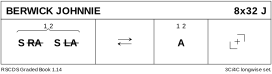
1-8
1s+2s set, dance 1/2 RH across, set & dance 1/2 LH across
9-16
1s lead down the middle & back to top
17-24
1s+2s dance Allemande 1s end facing 1st corners
25-32
1s turn 1st corners RH, partner LH, 2nd corners RH & partner LH to 2nd places
E-Cribs
1-8
1c+2c set | ½ RHA ; set | ½ LHA
9-16
1c down the middle and up, into
17-24
1c+2c Allemande, 1c finishing facing 1cnr
25-32
Turn CPCP

Заметки
Berwick Johnny
Go, go, go,
Go to Berwick, Johnny;
Thou shalt have the horse,
And I shall have the pony.
– Old Scots Nursery Rhyme
The ancient seaport of Berwick, with its grey stone houses and red tiled roofs on the banks of the
silvery Tweed, is a purloined Scots town in England. Situated on the Great North Road,
Berwick-upon-Tweed, as it is officially known, is a technicality and, indeed, at one time
government documents employed the phrase “Scotland, England and Berwick-upon-Tweed”.
Until the 14th century, Berwick with Roxburgh, Edinburgh and Stirling made up the “Court of Four
Burghs”, a royal favour granting especial considerations for trade, both foreign and domestic,
a concept that David I borrowed from the English.
After a brutal sacking in 1296, Berwick was finally taken by Edward I of England in 1302. It was there
that Edward caused Isabella, the young Countess of Buchan, to be imprisoned, supposedly in a cage
on Berwick Castle’s walls, for four years for her impudence in crowning Robert Bruce king of
Scotland in 1306. Edward reigned for thirty-two years and during that time his chief ambition
was to conquer Scotland. The “Hammer of the Scots” died at Carlisle on the way to his third
attempt at the age of seventy, but his other two invasions incurred the everlasting wrath of the Scots.
Harried by raiders, burned, besieged, captured and recaptured, Berwick changed hands thirteen times
before Richard Crouchback, later the unsavoury Richard III, captured it for his brother, Edward IV, in
1482.
From then on, while the shoe was on the other foot, Berwick was the centre for the English defense
against Scotland. With the Union of the Crowns in 1603, when James VI became king of Scotland
and England, life in Berwick calmed down and the burgh became a neutral zone, claiming to be
neither Scottish nor English. Even the fifteen-arch bridge built by James across the Tweed in 1624
seems symbolic of the town’s anomalous position.
Berwick’s county is Berwickshire, part of Scotland, but the county seat is the small town of Duns.
Berwickshire, a farming and sheep-raising district, was well loved by Sir Walter Scott and
was the source of inspiration for much of his work. John Hamilton (1761–1814), a poet and
Edinburgh bookseller who aided Scott in compiling the
Minstrelsy of the Scottish Border
,
wrote new words to the old tune, “Go to Berwick, Johnny”.
Go to Berwick, Johnny,
Bring her frae the border;
Yon sweet, bonnie lassie,
Let her gae nae farther.
English loons will twine ye
O’ the lovely treasure;
But we’ll let them ken
A sword with them we’ll measure.
Go to Berwick, Johnny,
And regain your honour;
Drive them owre the Tweed,
And shaw our Scottish banner.
I am Rob the King,
And ye are Jock, my brither,
But before we lose her,
We’ll a’ there thegither.
From “Scotland Dances”, by Eugenia (Jeannie) Callander Sharp
(Used by permission.)
Go, go, go,
Go to Berwick, Johnny;
Thou shalt have the horse,
And I shall have the pony.
– Old Scots Nursery Rhyme
The ancient seaport of Berwick, with its grey stone houses and red tiled roofs on the banks of the
silvery Tweed, is a purloined Scots town in England. Situated on the Great North Road,
Berwick-upon-Tweed, as it is officially known, is a technicality and, indeed, at one time
government documents employed the phrase “Scotland, England and Berwick-upon-Tweed”.
Until the 14th century, Berwick with Roxburgh, Edinburgh and Stirling made up the “Court of Four
Burghs”, a royal favour granting especial considerations for trade, both foreign and domestic,
a concept that David I borrowed from the English.
After a brutal sacking in 1296, Berwick was finally taken by Edward I of England in 1302. It was there
that Edward caused Isabella, the young Countess of Buchan, to be imprisoned, supposedly in a cage
on Berwick Castle’s walls, for four years for her impudence in crowning Robert Bruce king of
Scotland in 1306. Edward reigned for thirty-two years and during that time his chief ambition
was to conquer Scotland. The “Hammer of the Scots” died at Carlisle on the way to his third
attempt at the age of seventy, but his other two invasions incurred the everlasting wrath of the Scots.
Harried by raiders, burned, besieged, captured and recaptured, Berwick changed hands thirteen times
before Richard Crouchback, later the unsavoury Richard III, captured it for his brother, Edward IV, in
1482.
From then on, while the shoe was on the other foot, Berwick was the centre for the English defense
against Scotland. With the Union of the Crowns in 1603, when James VI became king of Scotland
and England, life in Berwick calmed down and the burgh became a neutral zone, claiming to be
neither Scottish nor English. Even the fifteen-arch bridge built by James across the Tweed in 1624
seems symbolic of the town’s anomalous position.
Berwick’s county is Berwickshire, part of Scotland, but the county seat is the small town of Duns.
Berwickshire, a farming and sheep-raising district, was well loved by Sir Walter Scott and
was the source of inspiration for much of his work. John Hamilton (1761–1814), a poet and
Edinburgh bookseller who aided Scott in compiling the
Minstrelsy of the Scottish Border
,
wrote new words to the old tune, “Go to Berwick, Johnny”.
Go to Berwick, Johnny,
Bring her frae the border;
Yon sweet, bonnie lassie,
Let her gae nae farther.
English loons will twine ye
O’ the lovely treasure;
But we’ll let them ken
A sword with them we’ll measure.
Go to Berwick, Johnny,
And regain your honour;
Drive them owre the Tweed,
And shaw our Scottish banner.
I am Rob the King,
And ye are Jock, my brither,
But before we lose her,
We’ll a’ there thegither.
From “Scotland Dances”, by Eugenia (Jeannie) Callander Sharp
(Used by permission.)
Видео 1
Reasonable

Видео 2
Reasonable
Видео 3
Reasonable
Видео 4
Social
Видео 5
Animation