The Munro Rant
Основная информация
| Автор: | Unknown |
|---|---|
| RSCDS: |
 RSCDS HQ publication
|
| Сочинен в России: | Нет |
| Публикация: |
|
| Рекомендуемая музыка: | The Munro Rant |
Параметры
| Тип танца: | Strathspey |
|---|---|
| Тип сета: | Longwise set |
| Размер: | 8x32 |
| Формат сета: | 4 couples |
| Танцующие пары: | 2 |
Источник:
https://my.strathspey.org/dd/dance/4830/
MiniCribs
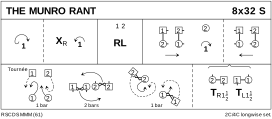
1-8
1s dance in & cast 1 place, cross RH & cast up to partners place
9-16
1s+2s dance R&L
17-24
2L+1M followed by 1L+2M lead down middle, (2M casts to partner as 1M dances up) 1s followed by 2s lead back to original places
25-32
1s+2s dance Tournee : 1s+2s dance into prom hold (Men with prtnr on right, 1s face M’s side & 2s L’s side), couples 1/2 wheel anticl’wise & Men turn Ladies into middle, both couples turn 1.1/2 times (2s RH, 1s LH) & dance out to places
E-Cribs
(This was formerly a 3c dance; 1c crossing below 3c on [5].
1-8
1c long cast ; cross RH and cast up to P’s place (1x,2)
9-16
1c+2c R&L, do not retain holds
17-24
1M+2W, followed by 2M+1W lead down the middle on own side (1M starts with a long step. 2M with a small step) [3], both Pairs turn inwards ; lead up [1], 2M casts off, 1M speeds up | 1c+2c lead up to own places.
25-32
Tournée.
To make 17-24 24 look seamlessly smooth, some components may take fractions of a bar longer or shorter than indicated

Заметки
This was originally published as a 3c dance; 1c then cross below 3c on [5]. It would be useful to look up in which editions of the RDCDS books and Pocket Books this change was made.
The Munro Rant
Unlike many Highland clans,
the Munros managed to lead a tranquil existence within their territorial boundaries.
Their fertile lands in Easter Ross were protected by the great mountain ranges to the north and west,
by Cromarty Firth on the east
and by Ross Castle at Dingwall on the south.
(See “The Ladies of Dingwall”)
While northern Scotland could never be called a Garden of Eden,
the Munros were in an ideal situation.
Never aggressive on their own behalf against their neighbors,
the chiefs and their families devoted themselves to their home territory of Ferindonald,
Fearan Domhnuill
or Donald’s Land,
and to a long history of public service
both to the Earls of Ross from whom they held their charter until 1476
and to their sovereigns
to whom they owed fealty after the forfeiture of the Macdonald Lordship of the Isles.
When the Munros had ardent desires for warfare
there was always the legitimate service of the king
and in this they excelled.
The origins of the Clann an Rothaich is open to speculation,
as is usual with very nearly all early clan histories.
By tradition the family was founded in a Donald Munro, a son of the Irish chief O’Cathain,
or, at least, a member of the Siol O’Cain.
The first chief of record was Hugh Munro of Foulis
and the chiefship of the clan stayed with the house of Foulis until the direct mail line failed in 1651.
For generations the Munros were good and loyal soldiers.
Robert Munro of Foulis, together with his son George and many of the clan,
fought for Robert Bruce at Bannockburn in 1314.
Sir William, 12th of Foulis, was a faithful servant to James IV
and it was while he was on the king’s business that he was slain in 1505 in Lochaber.
Robert, 14th chief, died while fighting against the invading English
at the battle of Pinkie on 10 September, 1547, a date known as “Black Saturday”.
His son Robert Mór, 15th of Foulis, was Chamberlain of Ross, keeper of the castle at Dingwall,
a man of great influence in the north and an avowed Protestant.
However, for a number of reasons, he supported Queen Mary when she came to Inverness in 1562
and was rumoured to be in danger of her life from the Earl of Huntly.
Robert Mór had two wives and a total of eleven children.
It was strange that so upright a man, of such strict religious and moral convictions,
could have his reputation so shadowed by the activities of his second wife, Katherine Ross,
and his son and heir.
Lady Munro and Hector, her step-son and the sixteenth chief,
were accused of witchcraft and attempted murder.
They were brought to trial after the pious old chief’s death in 1588,
but the charges were dropped, possibly out of respect for Robert Mór.
The eighteenth chief, Robert Dubh,
went to Sweden in 1626 with Sir Donald Mackay of Strathnaver, Lord Reay,
and with seven hundred Munros, called “The Invincibles”,
served in the army of Gustavus Adolphus, one of the royal defenders of Protestantism.
The “Black Baron” was colonel of both a regiment of foot and a regiment of cavalry.
At that time there were in the Swedish army
three generals, eight colonels, five lieutenant-colonels, eleven majors and well over thirty captains –
all Munros.
Robert Dubh died in 1633 of wounds received at the battle of Ulm.
He was succeeded by his brother, Hector, another soldier of note,
who was created a Nova Scotia Baron by Charles I in 1634.
When Sir Hector’s son died in the Netherlands in 1651 at the age of sixteen,
the title passed to Robert Munro of Opisdale
who was a major-general in the army of the Covenant
and who in 1642 was sent to suppress the Catholic uprising in Ireland.
On the other side of the political coin, his brother, Sir George, was a leading royalist
and commander-in-chief in Scotland from 1674 to 1677 after the restoration of Charles II.
Perhaps the most famous of the military Munros
was Sir Robert, 6th Baronet, Lieutenant-Colonel of the 43rd Regiment (The Black Watch).
At the battle of Fontenoy in May of 1745
Sir Robert put into practice a miltary tactic which he had devised and which as never been superseded.
He ordered his troops to drop to the ground when the French fired
and to fire back and charge forward while the French were reloading.
It must be noted, however, that the commander could not follow his own orders.
Then over sixty years of age and corpulent,
Sir Robert himself could not fall to the ground and rise again without aid,
so he alone stood during the battle,
a solitary figure beside the colours.
The victory against the French earned him promotion to colonel,
but his new command was an English regiment, the 37th of Foot,
a regiment that though it fought valiantly at Culloden
had been broken by the Jacobite forces at the battle of Falkirk some three months before.
The Munros had remained loyal to the Hanoverians during the Risings of 1715 and 1745
and thus it was that Sir Robert led his “redcoats” to the battle of Falkirk on 17 January, 1746,
where both he and his brother Duncan were killed.
After the defeat of the Jacobites, the soldierly Munros turned their sights to struggles further afield.
Sir Hector defeated the Nabwab of Oudh in Bengal in 1764
and wrenched Pondicherry from the grasp of the French in 1778.
Sir Charles, 9th Baronet, served under the Duke of Wellington in the Napoleonic Wars
and was described by the duke as “one of the bravest men in the British army”.
During the War of Independence in South America
Sir Charles commanded the 1st Regiment of English Lancers in the service of Simon Bolivar.
It was after the battle of Varabobo in 1821
that Bolivar called the nine hundred British “foreign legionnaires”
who pushed the Spanish from the field at bayonet point
“the saviors of my country.”
Sir Hector Munro commanded the 3rd Battalion (Militia) of the Seaforth Highlanders
which served in Egypt between 1899 and 1903.
He was A.D.C. to both Edward VII and George V
and for thirty-six years was Lord-Lieutenant of Ross and Cromarty.
There have been many Munro soldiers as well as many statesmen, ministers and scientists.
They have been worthy men of a great family.
From “Scotland Dances”, by Eugenia (Jeannie) Callander Sharp
(Used by permission.)
The Munro Rant
Unlike many Highland clans,
the Munros managed to lead a tranquil existence within their territorial boundaries.
Their fertile lands in Easter Ross were protected by the great mountain ranges to the north and west,
by Cromarty Firth on the east
and by Ross Castle at Dingwall on the south.
(See “The Ladies of Dingwall”)
While northern Scotland could never be called a Garden of Eden,
the Munros were in an ideal situation.
Never aggressive on their own behalf against their neighbors,
the chiefs and their families devoted themselves to their home territory of Ferindonald,
Fearan Domhnuill
or Donald’s Land,
and to a long history of public service
both to the Earls of Ross from whom they held their charter until 1476
and to their sovereigns
to whom they owed fealty after the forfeiture of the Macdonald Lordship of the Isles.
When the Munros had ardent desires for warfare
there was always the legitimate service of the king
and in this they excelled.
The origins of the Clann an Rothaich is open to speculation,
as is usual with very nearly all early clan histories.
By tradition the family was founded in a Donald Munro, a son of the Irish chief O’Cathain,
or, at least, a member of the Siol O’Cain.
The first chief of record was Hugh Munro of Foulis
and the chiefship of the clan stayed with the house of Foulis until the direct mail line failed in 1651.
For generations the Munros were good and loyal soldiers.
Robert Munro of Foulis, together with his son George and many of the clan,
fought for Robert Bruce at Bannockburn in 1314.
Sir William, 12th of Foulis, was a faithful servant to James IV
and it was while he was on the king’s business that he was slain in 1505 in Lochaber.
Robert, 14th chief, died while fighting against the invading English
at the battle of Pinkie on 10 September, 1547, a date known as “Black Saturday”.
His son Robert Mór, 15th of Foulis, was Chamberlain of Ross, keeper of the castle at Dingwall,
a man of great influence in the north and an avowed Protestant.
However, for a number of reasons, he supported Queen Mary when she came to Inverness in 1562
and was rumoured to be in danger of her life from the Earl of Huntly.
Robert Mór had two wives and a total of eleven children.
It was strange that so upright a man, of such strict religious and moral convictions,
could have his reputation so shadowed by the activities of his second wife, Katherine Ross,
and his son and heir.
Lady Munro and Hector, her step-son and the sixteenth chief,
were accused of witchcraft and attempted murder.
They were brought to trial after the pious old chief’s death in 1588,
but the charges were dropped, possibly out of respect for Robert Mór.
The eighteenth chief, Robert Dubh,
went to Sweden in 1626 with Sir Donald Mackay of Strathnaver, Lord Reay,
and with seven hundred Munros, called “The Invincibles”,
served in the army of Gustavus Adolphus, one of the royal defenders of Protestantism.
The “Black Baron” was colonel of both a regiment of foot and a regiment of cavalry.
At that time there were in the Swedish army
three generals, eight colonels, five lieutenant-colonels, eleven majors and well over thirty captains –
all Munros.
Robert Dubh died in 1633 of wounds received at the battle of Ulm.
He was succeeded by his brother, Hector, another soldier of note,
who was created a Nova Scotia Baron by Charles I in 1634.
When Sir Hector’s son died in the Netherlands in 1651 at the age of sixteen,
the title passed to Robert Munro of Opisdale
who was a major-general in the army of the Covenant
and who in 1642 was sent to suppress the Catholic uprising in Ireland.
On the other side of the political coin, his brother, Sir George, was a leading royalist
and commander-in-chief in Scotland from 1674 to 1677 after the restoration of Charles II.
Perhaps the most famous of the military Munros
was Sir Robert, 6th Baronet, Lieutenant-Colonel of the 43rd Regiment (The Black Watch).
At the battle of Fontenoy in May of 1745
Sir Robert put into practice a miltary tactic which he had devised and which as never been superseded.
He ordered his troops to drop to the ground when the French fired
and to fire back and charge forward while the French were reloading.
It must be noted, however, that the commander could not follow his own orders.
Then over sixty years of age and corpulent,
Sir Robert himself could not fall to the ground and rise again without aid,
so he alone stood during the battle,
a solitary figure beside the colours.
The victory against the French earned him promotion to colonel,
but his new command was an English regiment, the 37th of Foot,
a regiment that though it fought valiantly at Culloden
had been broken by the Jacobite forces at the battle of Falkirk some three months before.
The Munros had remained loyal to the Hanoverians during the Risings of 1715 and 1745
and thus it was that Sir Robert led his “redcoats” to the battle of Falkirk on 17 January, 1746,
where both he and his brother Duncan were killed.
After the defeat of the Jacobites, the soldierly Munros turned their sights to struggles further afield.
Sir Hector defeated the Nabwab of Oudh in Bengal in 1764
and wrenched Pondicherry from the grasp of the French in 1778.
Sir Charles, 9th Baronet, served under the Duke of Wellington in the Napoleonic Wars
and was described by the duke as “one of the bravest men in the British army”.
During the War of Independence in South America
Sir Charles commanded the 1st Regiment of English Lancers in the service of Simon Bolivar.
It was after the battle of Varabobo in 1821
that Bolivar called the nine hundred British “foreign legionnaires”
who pushed the Spanish from the field at bayonet point
“the saviors of my country.”
Sir Hector Munro commanded the 3rd Battalion (Militia) of the Seaforth Highlanders
which served in Egypt between 1899 and 1903.
He was A.D.C. to both Edward VII and George V
and for thirty-six years was Lord-Lieutenant of Ross and Cromarty.
There have been many Munro soldiers as well as many statesmen, ministers and scientists.
They have been worthy men of a great family.
From “Scotland Dances”, by Eugenia (Jeannie) Callander Sharp
(Used by permission.)
Видео 1
Demonstration quality

Видео 2
Demonstration quality