The Nether Bow has vanished
Основная информация
| Автор: | Robert Bremner |
|---|---|
| RSCDS: |
 RSCDS HQ publication
|
| Сочинен в России: | Нет |
| Публикация: |
|
| Рекомендуемая музыка: |
|
Параметры
| Тип танца: | Strathspey |
|---|---|
| Тип сета: | Longwise set |
| Размер: | 8x48 |
| Формат сета: | 4 couples |
| Танцующие пары: | 3 |
Источник:
https://my.strathspey.org/dd/dance/4907/
MiniCribs
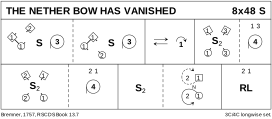
1-8
1s set to 2L & circle 3H round to left, 1s set to 2M & circle 3H round to left
9-16
1s lead down the middle for 3 steps, back to top & cast to 2nd places to face diagonally in with 3s
17-24
1s+3s set twice & circle 4H round to left
25-32
2s+1s set twice & circle 4H round to left
33-40
1s set twice, lead up to top & cast to 2nd places
41-48
2s+1s dance R&L

Заметки
The Society’s version of this dance can be traced to Robert Bremner’s “A Second Collection of Scots Reels or Country Dances” of about 1757 where it is given as a 32-bar version.
The Nether Bow Has Vanished
After the battle of Flodden on 9 September, 1513,
a stunning defeat that left James IV and the flower of Scottish knighthood dead upon the field,
it was deemed that the old King’s Wall,
built by James II in 1450,
was not sufficient to protect the expanding city.
A tax of £5, an enormous amount in the 16th century,
was levied on each inhabitant of the city
and work began on what was to become known as the Flodden Wall.
When it was finished,
the wall was twenty feet high in some places and three feet thick,
with numerous stout gates and towers.
It defined the city’s boundaries and ran southeast from the Castle rock,
across the end of the Grassmarket,
cut below the land where Heriot’s Hospital would be built in the next century,
around Greyfriar’s Church,
then ran east, then north to cross the eastern end of the Cowgate
to the Netherbow at the point where the High Street and the Canongate meet.
The wall then turned west again and ended at the Nor’ Loch which protected the city north.
It was punctuated by various ports or defendable gateways:
the West Port at the end of the Grassmarket below the Castle rock;
the Bristo Port near Greyfriars’;
the Potterrow Port near the present Old College;
the Cowgate Port;
the Netherbow Port;
and the New Port at the eastern end of the Nor’ Loch.
The finest of the gates, the Netherbow Port,
was the portal through which kings and queens entered the city from Holyrood.
In anticipation of the return to Edinburgh of James VI, then also James I of England,
the Town Council ordered the repair and beautification of the Netherbow Port in 1607.
When the king actually did return ten years later,
James’ portrait and royal arms were ordered to be erected on the Netherbow Port.
Charles I, however, made his official entry into the city of Edinburgh in 1633
through the West Port below the Castle,
but Charles’ great-grandson, Prince Charles Edward, entered through the Netherbow Port,
an entry gained without bloodshed on 17 September, 1745,
when Donald Cameron of Lochiel and a small party of men
stormed through the gates
that had been opened to allow the coach of the city deputies treating with the prince to pass through.
In 1764 the Netherbow Port was demolished.
From “Scotland Dances”, by Eugenia (Jeannie) Callander Sharp
(Used by permission.)
The Nether Bow Has Vanished
After the battle of Flodden on 9 September, 1513,
a stunning defeat that left James IV and the flower of Scottish knighthood dead upon the field,
it was deemed that the old King’s Wall,
built by James II in 1450,
was not sufficient to protect the expanding city.
A tax of £5, an enormous amount in the 16th century,
was levied on each inhabitant of the city
and work began on what was to become known as the Flodden Wall.
When it was finished,
the wall was twenty feet high in some places and three feet thick,
with numerous stout gates and towers.
It defined the city’s boundaries and ran southeast from the Castle rock,
across the end of the Grassmarket,
cut below the land where Heriot’s Hospital would be built in the next century,
around Greyfriar’s Church,
then ran east, then north to cross the eastern end of the Cowgate
to the Netherbow at the point where the High Street and the Canongate meet.
The wall then turned west again and ended at the Nor’ Loch which protected the city north.
It was punctuated by various ports or defendable gateways:
the West Port at the end of the Grassmarket below the Castle rock;
the Bristo Port near Greyfriars’;
the Potterrow Port near the present Old College;
the Cowgate Port;
the Netherbow Port;
and the New Port at the eastern end of the Nor’ Loch.
The finest of the gates, the Netherbow Port,
was the portal through which kings and queens entered the city from Holyrood.
In anticipation of the return to Edinburgh of James VI, then also James I of England,
the Town Council ordered the repair and beautification of the Netherbow Port in 1607.
When the king actually did return ten years later,
James’ portrait and royal arms were ordered to be erected on the Netherbow Port.
Charles I, however, made his official entry into the city of Edinburgh in 1633
through the West Port below the Castle,
but Charles’ great-grandson, Prince Charles Edward, entered through the Netherbow Port,
an entry gained without bloodshed on 17 September, 1745,
when Donald Cameron of Lochiel and a small party of men
stormed through the gates
that had been opened to allow the coach of the city deputies treating with the prince to pass through.
In 1764 the Netherbow Port was demolished.
From “Scotland Dances”, by Eugenia (Jeannie) Callander Sharp
(Used by permission.)