The New Town of Edinburgh
Основная информация
| Автор: | Unknown |
|---|---|
| RSCDS: |
 RSCDS HQ publication
|
| Сочинен в России: | Нет |
| Публикация: |
|
| Рекомендуемая музыка: | - |
Параметры
| Тип танца: | Strathspey |
|---|---|
| Тип сета: | Longwise set |
| Размер: | 8x32 |
| Формат сета: | 4 couples |
| Танцующие пары: | 3 |
Источник:
https://my.strathspey.org/dd/dance/4932/
MiniCribs
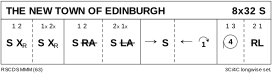
1-8
1s+2s set, cross RH, set & cross back RH
9-16
1s+2s set, dance RH across 1/2 way, set & dance LH across back to places
17-24
1s lead down 2 steps, set, lead back to top & cast to 2nd places
25-32
1s+3s circle 4H round to left, 2s+1s dance R&L
E-Cribs
1-8
1c+2c set and cross RH ; repeat
9-16
1c+2c set | ½ RHA ; set | ½ LHA
17-24
1c lead down | set ; lead to top and cast off (2c up) (2,1,3)
25-32
1c+3c circle4 L ; 2c+1c R&L (one step per hand)

Заметки
The New Town of Edinburgh
With the end of the last Jacobite Rising in 1746,
peace settled down on Scotland and with it, for Edinburgh at least, came prosperity.
The well-to-do were travelling
and what they saw of the expanding and gracious cities of England and the Continent
left them dissatisfied with the crowded, ancient rabbit-warren that was Edinburgh.
Perched high in their tall houses, high on the rocky ridge, like so many birds in their trees,
they could look out to the north and south to see nothing but unused and reasonably flat land.
The first new houses were built in the early 1760’s, in Brown Square, near the old Bristo Port,
and George Square and in St. John’s Street which opened off the Canongate,
all of them on the southern slopes of the ridge, but still crowded and overshadowed by the old city.
By that time plans had been put before the Town Council
that involved utilising the land north of the city,
between the Nor’ Loch, the city’s natural moat on the north,
and the waters of the Firth of Forth, toward Leith.
Drainage of the Nor’ Loch began in 1759
and ten years later the North Bridge was opened to pedestrians.
A few months later part of the bridge collapsed and a new bridge was not completed until 1772.
The Town Council had received six plans in all for building a new town
and on 2 August, 1766, they approved the plan of a young architect, James Craig.
The first “New Town”, designed by Craig, began to be built almost at once
and consisted of George Street, flanked by Princes Street to the south and Queen Street to the north,
both of them one-sided, all three nearly a mile in length.
George Street terminated at the east end with St. Andrew’s Square
and at the west with Charlotte Square.
Other architects,
Gillespie Graham, Robert Reid, William Sibbald, Robert Adam, William Burn,
William Playfair and Thomas Hamilton, joined Craig
and the New Town expanded at a steady and dignified pace
in a geometric series of broad parallel streets relieved by squares, crescents and circles,
a totality of design as lovely today as it was in the 18th and early 19th centuries.
Queen Victoria, on her first visit to Scotland in 1842,
described the city as she saw it from Leith.
“The view of Edinburgh from the road before you enter Leith is quite enchanting;
it is, as Albert said, ‘fairy-like’,
and what you would only imagine as a thing to dream of, or to see in a picture.
There was that beautiful large town, all of stone (no mingled colours of brick to mar it),
with the bold Castle on one side, and the Calton Hill on the other,
with those high sharp hills of Arthur’s Seat and the Salisbury Crags towering above all,
making the finest, boldest background imaginable.
Albert said he felt sure the Acropolis could not be finer;
and I hear they sometimes call Edinburgh ‘the modern Athens’.”
From “Scotland Dances”, by Eugenia (Jeannie) Callander Sharp
(Used by permission.)
With the end of the last Jacobite Rising in 1746,
peace settled down on Scotland and with it, for Edinburgh at least, came prosperity.
The well-to-do were travelling
and what they saw of the expanding and gracious cities of England and the Continent
left them dissatisfied with the crowded, ancient rabbit-warren that was Edinburgh.
Perched high in their tall houses, high on the rocky ridge, like so many birds in their trees,
they could look out to the north and south to see nothing but unused and reasonably flat land.
The first new houses were built in the early 1760’s, in Brown Square, near the old Bristo Port,
and George Square and in St. John’s Street which opened off the Canongate,
all of them on the southern slopes of the ridge, but still crowded and overshadowed by the old city.
By that time plans had been put before the Town Council
that involved utilising the land north of the city,
between the Nor’ Loch, the city’s natural moat on the north,
and the waters of the Firth of Forth, toward Leith.
Drainage of the Nor’ Loch began in 1759
and ten years later the North Bridge was opened to pedestrians.
A few months later part of the bridge collapsed and a new bridge was not completed until 1772.
The Town Council had received six plans in all for building a new town
and on 2 August, 1766, they approved the plan of a young architect, James Craig.
The first “New Town”, designed by Craig, began to be built almost at once
and consisted of George Street, flanked by Princes Street to the south and Queen Street to the north,
both of them one-sided, all three nearly a mile in length.
George Street terminated at the east end with St. Andrew’s Square
and at the west with Charlotte Square.
Other architects,
Gillespie Graham, Robert Reid, William Sibbald, Robert Adam, William Burn,
William Playfair and Thomas Hamilton, joined Craig
and the New Town expanded at a steady and dignified pace
in a geometric series of broad parallel streets relieved by squares, crescents and circles,
a totality of design as lovely today as it was in the 18th and early 19th centuries.
Queen Victoria, on her first visit to Scotland in 1842,
described the city as she saw it from Leith.
“The view of Edinburgh from the road before you enter Leith is quite enchanting;
it is, as Albert said, ‘fairy-like’,
and what you would only imagine as a thing to dream of, or to see in a picture.
There was that beautiful large town, all of stone (no mingled colours of brick to mar it),
with the bold Castle on one side, and the Calton Hill on the other,
with those high sharp hills of Arthur’s Seat and the Salisbury Crags towering above all,
making the finest, boldest background imaginable.
Albert said he felt sure the Acropolis could not be finer;
and I hear they sometimes call Edinburgh ‘the modern Athens’.”
From “Scotland Dances”, by Eugenia (Jeannie) Callander Sharp
(Used by permission.)