On The Quarter-Deck
Основная информация
| Автор: | Iain Boyd |
|---|---|
| RSCDS: | Не RSCDS |
| Сочинен в России: | Нет |
| Публикация: | The Harbour City |
| Рекомендуемая музыка: | On the Quarter-Deck |
Параметры
| Тип танца: | Hornpipe |
|---|---|
| Тип сета: | Longwise set |
| Размер: | 8x32 |
| Формат сета: | 4 couples |
| Танцующие пары: | 2 |
Источник:
https://my.strathspey.org/dd/dance/5080/
MiniCribs
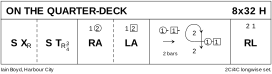
1-8
1s set & cross over RH, set & 3/4 turn RH
9-16
1s dance RH across with 2M & LH across with 2L
17-24
1L followed by 1M dance down for 2 & 1M followed by1L dance up for 2, both cast on Ladies side & 1M crosses to 2nd place own side
25-32
2s+1s R&L
E-Cribs
1-8
1c set, cross RH ; set, ¾ RH turn
9-16
1c+2M RHA ; 1c+2W LHA
17-24
1W followed by 1M dance down the middle | and up (1M leading) ; cast off round 2W (2c up) (2,1)
25-32
2c+1c R&L

Заметки
Quarterdeck
As friends of nautical historical fiction – such as Patrick O’Brian’s unsurpassed Aubrey/Maturin cycle, inspiration for Peter Weir’s masterful film
Master and Commander: The Far Side of the World
starring Russell Crowe and Paul Bettany, or C. S. Forester’s classic Horatio Hornblower novels – are sure to know, the
quarterdeck
(usually spelled without the dash) of a sailing ship is an elevated area behind the mast (or masts). Traditionally it was the realm of the captain or commander and the quartermaster(s), and generally restricted to officers – common sailors would enter it only to fulfil specific duties.
In the Middle Ages, sailing ships had a single deck and in front and aft a “castle”, a raised structure for, e.g., archers. With the introduction of cannon, the castles were abolished and replaced by a “halfdeck” above the main deck, which extended from the stern of the ship roughly to the main mast. Above that there was a “quarterdeck” of approximately half its length. Eventually the halfdeck was extended to the whole length of the ship and became the main deck while the former main deck, where the cannon were placed, became the “gun deck” immediately below, but the quarterdeck remained as a raised structure.
Above the quarterdeck there is only the
poop deck
, whose vaguely unsavoury-sounding name derives from the Latin word
puppis
, referring to the stern of a ship. It doesn’t mean that the toilets were located there, which wasn’t in fact the case. In effect the poop deck was the roof of the (captain’s) cabin below, and it afforded the best views.
From “Anselm's Notes on Dances”, by Anselm Lingnau
(Used by permission.)
As friends of nautical historical fiction – such as Patrick O’Brian’s unsurpassed Aubrey/Maturin cycle, inspiration for Peter Weir’s masterful film
Master and Commander: The Far Side of the World
starring Russell Crowe and Paul Bettany, or C. S. Forester’s classic Horatio Hornblower novels – are sure to know, the
quarterdeck
(usually spelled without the dash) of a sailing ship is an elevated area behind the mast (or masts). Traditionally it was the realm of the captain or commander and the quartermaster(s), and generally restricted to officers – common sailors would enter it only to fulfil specific duties.
In the Middle Ages, sailing ships had a single deck and in front and aft a “castle”, a raised structure for, e.g., archers. With the introduction of cannon, the castles were abolished and replaced by a “halfdeck” above the main deck, which extended from the stern of the ship roughly to the main mast. Above that there was a “quarterdeck” of approximately half its length. Eventually the halfdeck was extended to the whole length of the ship and became the main deck while the former main deck, where the cannon were placed, became the “gun deck” immediately below, but the quarterdeck remained as a raised structure.
Above the quarterdeck there is only the
poop deck
, whose vaguely unsavoury-sounding name derives from the Latin word
puppis
, referring to the stern of a ship. It doesn’t mean that the toilets were located there, which wasn’t in fact the case. In effect the poop deck was the roof of the (captain’s) cabin below, and it afforded the best views.
From “Anselm's Notes on Dances”, by Anselm Lingnau
(Used by permission.)
Видео 1
Good

Видео 2
Good
Видео 3
Reasonable
Видео 4
Social
Видео 5
Animation