The Birks of Abergeldie
Основная информация
| Автор: | Unknown |
|---|---|
| RSCDS: |
 RSCDS HQ publication
|
| Сочинен в России: | Нет |
| Публикация: |
|
| Рекомендуемая музыка: | The Birks of Abergeldie |
Параметры
| Тип танца: | Reel |
|---|---|
| Тип сета: | Longwise set |
| Размер: | 8x48 |
| Формат сета: | 4 couples |
| Танцующие пары: | 3 |
Источник:
https://my.strathspey.org/dd/dance/521/
MiniCribs
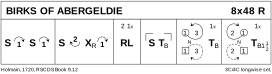
1-8
1s set & cast 1 place (2s step up), set & cast to 3rd place (3s step up)
9-16
1s set, lead up to places (2s+3s step down), cross RH & cast to 2nd place opposite sides (2s step up)
17-24
2s+1s dance R&L 1s end facing 1st corners
25-32
1s set & turn 1st corners, set & turn 2nd corners
33-40
1s dance down between 3s, cast up to 2nd place & turn partner 2H to end in centre (on opposite sides)
41-48
1s dance up between 2s, cast to 2nd place & turn partner 2H 1.1/2 times
E-Cribs
1-8
1c set | cast (2c up) ; 1c set | cast off (3c up)
9-16
1c set | dance up to 1pl (2c+3c down) ; 1c cross RH | cast (2c up) (to 2,1x,3)
17-24
2c+1c R&L, 1c finish facing 1cnrs
25-24
1c set to and turn corners
33-40
1c dance down between 3c, divide and cast up one ; turn BH to face up in the middle, opposite side
41-48
1c dance up between 2c, divide and cast off one ; 1½ BH turn to (2,1,3)

Заметки
The Birks of Abergeldie
Bonnie lassie, will ye go, will ye go, will ye go,
Bonnie lassie, will ye go to the Birks of Abergeldie?
Ye sall get a gown of silk, a gown of silk, a gown of silk,
Ye sall get a gown of silk and a coat of callimankel.
Na, kind sir, I daur na gang, I daur na gang, I daur na gang.
Na, kind sir, I daur na gang, my minnie wad be angry.
Sair, sair, wad she flyte, wad she flyte, wad she flyte,
Sair, sair, wad she flyte and sair, sair, she wad ban me.
– Old original words
Abergeldie and Aberfeldy sound very much alike and this coincidence naturally occured to
Robert Burns on a September day in 1787 when he and his rather bad-tempered friend,
William Nicol, Latin master of the Edinburgh High School, visited the Falls of Moness near Aberfeldy.
Aberfeldy is in Perthshire, on the River Tay, the site of one of General George Wade’s bridges
and the birthplace of the Black Watch (The Royal Highland Regiment). Abergeldie is in Aberdeenshire,
in Royal Deeside, about six miles west of Ballater on the south bank of the Dee. Abergeldie Castle
was a residence of Edward VII when he was Prince of Wales. Here the hillsides are thick with birch
trees, which are lacking in Aberfeldy. Thus, poetic license was taken.
“The Birks of Abergeldie” first appeared in John Playford’s
The English Dancing Master
(1657) and
was called a “Scotch Ayre”. It was also included in Henry Playford’s collection of 1700, called
A Collection of Original Scotch Tunes (Full of Highland Humours) for the Violin
.
Thus, Burns could hardly stop himself from writing the song that begins:
Now simmer blinks on flowery braes,
And o’er the crystal streamlet plays,
Come let us spend the lightsome days
In the Birks of Aberfeldy.
Chorus
Bonnie lassie, will ye go,
Will ye go, will ye go,
Bonnie lassie, will ye go
To the Birks of Aberfeldy?
From “Scotland Dances”, by Eugenia (Jeannie) Callander Sharp
(Used by permission.)
Bonnie lassie, will ye go, will ye go, will ye go,
Bonnie lassie, will ye go to the Birks of Abergeldie?
Ye sall get a gown of silk, a gown of silk, a gown of silk,
Ye sall get a gown of silk and a coat of callimankel.
Na, kind sir, I daur na gang, I daur na gang, I daur na gang.
Na, kind sir, I daur na gang, my minnie wad be angry.
Sair, sair, wad she flyte, wad she flyte, wad she flyte,
Sair, sair, wad she flyte and sair, sair, she wad ban me.
– Old original words
Abergeldie and Aberfeldy sound very much alike and this coincidence naturally occured to
Robert Burns on a September day in 1787 when he and his rather bad-tempered friend,
William Nicol, Latin master of the Edinburgh High School, visited the Falls of Moness near Aberfeldy.
Aberfeldy is in Perthshire, on the River Tay, the site of one of General George Wade’s bridges
and the birthplace of the Black Watch (The Royal Highland Regiment). Abergeldie is in Aberdeenshire,
in Royal Deeside, about six miles west of Ballater on the south bank of the Dee. Abergeldie Castle
was a residence of Edward VII when he was Prince of Wales. Here the hillsides are thick with birch
trees, which are lacking in Aberfeldy. Thus, poetic license was taken.
“The Birks of Abergeldie” first appeared in John Playford’s
The English Dancing Master
(1657) and
was called a “Scotch Ayre”. It was also included in Henry Playford’s collection of 1700, called
A Collection of Original Scotch Tunes (Full of Highland Humours) for the Violin
.
Thus, Burns could hardly stop himself from writing the song that begins:
Now simmer blinks on flowery braes,
And o’er the crystal streamlet plays,
Come let us spend the lightsome days
In the Birks of Aberfeldy.
Chorus
Bonnie lassie, will ye go,
Will ye go, will ye go,
Bonnie lassie, will ye go
To the Birks of Aberfeldy?
From “Scotland Dances”, by Eugenia (Jeannie) Callander Sharp
(Used by permission.)