The Perth Medley
Основная информация
| Автор: | Unknown |
|---|---|
| RSCDS: |
 RSCDS HQ publication
|
| Сочинен в России: | Нет |
| Публикация: |
|
| Рекомендуемая музыка: |
|
Параметры
| Тип танца: | Medley |
|---|---|
| Тип сета: | Longwise set |
| Размер: | 8x64 |
| Формат сета: | 4 couples |
| Танцующие пары: | 3 |
Источник:
https://my.strathspey.org/dd/dance/5222/
MiniCribs
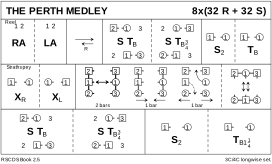
Reel
1-8
1s+2s dance RH across & LH back to places
9-16
1s lead down the middle & back to face 2nd corners
17-24
1s set & turn 2nd corners, set & turn 1st corners to end in lines across (1L between 2s & 1M between 3s)
25-32
2s+1s+3s set twice, 1s turn 2H twice ending between 2s & 3s
Strathspey
1-8
1s change places RH up & down centre, change back LH
9-16
2s+1s+3s Adv+Ret twice (up & down set) 1s turning onto sides, 2s+1s+3s Adv+Ret twice (across dance), 1s end facing 2nd corners
17-24
1s set & turn 2nd corners, set & turn 1st corners to end in lines across (1L between 2s & 1M between 3s)
25-32
2s+1s+3s set twice & 1s turn 2H 1.1/4 times to 2nd place own sides
E-Cribs
Reel
1-8
1c+2c RHA, LHA
9-16
1c down the middle (2c up) and up to face 2cnrs
17-24
Set to and turn 2cnrs ; set to and turn 1cnrs, finish 1W (1M) between 2c (3c) facing P
25-32
1c set twice ; turn BH twice, to finish between the end couples again
Strathspey
33-40
1c change places touching RH and turn R about to face P ; repeat with LH, turning L about
41-48
In lines of 3 across A&R (1+1 step) twice, finish between own corners ; A&R across (1+1 step) twice, finish facing 2cnrs
49-56
Set to and turn 2cnrs ; set to and turn 1cnrs, finish in middle between end couples
57-64
1c set twice, turn 1¼ BH to (2,1,3)

Заметки
The Perth Medley
(See also “Inch of Perth”)
The douce face that the “Fair City” of Perth turns to the world today
gives little indication of its past powerful and often turbulent existence.
Known as Victoria by the Romans and St. John’s-town of Perth by the converted Picts,
the city’s location is both strategic and scenic.
Perth is situated on the banks of the River Tay, at the head of the navigable estuary,
and at a point where the Highlands meet the Lowlands.
Across the Tay, from the top of Kinnoull Hill,
the view is open, over meadow and plain, inches and carse,
to the steel blue ramparts of the Grampians.
Below, the river flows swiftly, a river rich in salmon and rare river pearls.
While it is only by tradition that Perth was once Scotland’s capital,
it is true that the city was for a very long time a centre of government,
a place of supreme importance to early kings.
During the period between the accession of Alexander I in 1107
and the death of Robert III in 1406,
Perth was the scene of many parliaments and council meetings,
conventions both secular and sacred.
If Scottish kings recognised for many centuries
the importance of Perth to the safety of the realm
and made it a favourite residence during their peripatetic lives,
so also did the Church.
In 1120 Alexander I established the monastery of the Canons Regular of St. Augustine
at nearby Scone where kings went to be crowned.
In 1243 David de Bernham, Bishop of St. Andrews, consecrated the Church of St. John the Baptist
in honour of the city’s patron saint.
So great was the power of the Church in Perth
that by the time of the Reformation there were four monasteries within the city:
those of the Blackfriars (Dominican),
Whitefriars (Carmelite),
Greyfriars (Franciscan)
and Carthusians.
Each monastery had its satellite churches, chapels, convents and schools.
Thus it was no wonder that in 1559 John Knox chose Perth
from which to deliver the famous sermon against Roman idolatry
that drove the religious fanatics into a frenzy of destruction
that pulled down the monasteries and desecrated the altars of churches.
And still religion had not finished with Perth
for in 1618 James VI (I),
after an absence of fourteen years from Scotland,
issued the Five Articles of Perth,
an episcopal affront to the Protestants that set new fires blazing.
The city itself suffered from political assaults also.
In 1298 the ancient fortifications were strengthened by the invading Edward I of England
but they were not strong enough to prevent Robert I in 1311
from mounting a night attack that returned the city to the Scots.
Perth then became a prize of war to be wrenched back and forth.
In 1335 it was again captured by the English
and four years later it was retaken for David II, the young son of Robert Bruce.
In the 17th century it was held alternately by James Graham, Marquess of Montrose,
by the army of Oliver Cromwell,
and by John Graham, Viscount Dundee.
In the Risings of 1715 and 1745 Perth was in the hands of the Jacobites.
Two of the best remembered and most dramatic events to take place in Perth involved Scottish kings.
James I (1394–1437) was the prototype of the Stewart kings to follow.
He was brilliant, impetuous, ruthless and luxury-loving,
if indeed life in 14th century Scotland could be said to afford any Sybaritic pleasures.
James was also a poet of better than average talent
and was the author of the long
The Kingis Quair
,
Christis Kirk on the Green
and
Peblis to the Play
.
For some years the northern chiefs had been in open rebellion
but by 1436 order had been restored to some extent in Scotland.
Just before Christmas of that year James, his beloved queen, Joan Beaufort, and the court
travelled to Perth and established themselves in the Blackfriars monastery.
An old Highland spaewife warned the king repeatedly that he would not return from Perth,
dire warnings that he either laughed at or ignored.
There was, however, a conspiracy afoot,
the evil genius behind it the king’s own uncle, Walter Stewart, Earl of Atholl,
who was willing to commit regicide for the crown.
On the night of 20 February, 1437, the royal apartments at the monastery
were attacked by Sir Robert Graham of Kinpont and eight henchmen.
Catherine Douglas, one of Queen Joan’s ladies,
vainly tried to save the king by placing her arm across the door
as a replacement for the stolen bar,
but the door was broken in and the king was murdered in the presence of the queen
who later extracted a fearful retribution from the murderers.
The second event involved James VI (I),
the seventh generation replete with the Stewart talents and characteristics.
This was the Gowrie Conspiracy, one of the unsolved and intriguing Scottish historical mysteries.
It began in 1582 when James was a boy of sixteen.
On 22 August he had been lured to Ruthven Castle, four miles north of Perth,
by William Ruthven, 1st Earl of Gowrie,
who with his father had been one of the murderers of David Rizzio
and who had himself held a knife on Queen Mary during the murder of her secretary.
James was detained against his will at Ruthven Castle for nearly a year
by Gowrie and his faction of extreme Protestants.
He managed to escape and in 1585 Gowrie was beheaded.
Then in August of 1600 revenge was taken,
though whether by James or by John, 3rd Earl of Gowrie, and his brother, Alexander, Master of Ruthven,
is uncertain.
What actually happened will no doubt remain a mystery
and we have only James’ side of the story.
He reported that he had been invited by the young master of Ruthven
to leave Falkland Palace and pay a visit to Gowrie House in Perth.
It was indicated that Ruthven asked the king there to investigate an unexplained pot of gold.
After dinner with the earl, the king said he was locked in a tower room.
Threatened with death,
James said nevertheless that he shouted for help and his attendants rushed to his assistance.
In the resulting fray, both the earl and his brother were killed.
James ordered public rejoicing on his escape and he proscribed the name of Ruthven.
The lands of Ruthven he gave to his friend David Murray of Tullibardine
who changed the name of Ruthven Castle to Huntingtower.
Old Gowrie House is long gone and the spot is covered by the County Buildings,
but the enigma remains.
Did the Ruthven brothers hatch an inept and unwieldy plot to assassinate the king
or did James originate the scheme to murder them?
We shall never know.
From “Scotland Dances”, by Eugenia (Jeannie) Callander Sharp
(Used by permission.)
(See also “Inch of Perth”)
The douce face that the “Fair City” of Perth turns to the world today
gives little indication of its past powerful and often turbulent existence.
Known as Victoria by the Romans and St. John’s-town of Perth by the converted Picts,
the city’s location is both strategic and scenic.
Perth is situated on the banks of the River Tay, at the head of the navigable estuary,
and at a point where the Highlands meet the Lowlands.
Across the Tay, from the top of Kinnoull Hill,
the view is open, over meadow and plain, inches and carse,
to the steel blue ramparts of the Grampians.
Below, the river flows swiftly, a river rich in salmon and rare river pearls.
While it is only by tradition that Perth was once Scotland’s capital,
it is true that the city was for a very long time a centre of government,
a place of supreme importance to early kings.
During the period between the accession of Alexander I in 1107
and the death of Robert III in 1406,
Perth was the scene of many parliaments and council meetings,
conventions both secular and sacred.
If Scottish kings recognised for many centuries
the importance of Perth to the safety of the realm
and made it a favourite residence during their peripatetic lives,
so also did the Church.
In 1120 Alexander I established the monastery of the Canons Regular of St. Augustine
at nearby Scone where kings went to be crowned.
In 1243 David de Bernham, Bishop of St. Andrews, consecrated the Church of St. John the Baptist
in honour of the city’s patron saint.
So great was the power of the Church in Perth
that by the time of the Reformation there were four monasteries within the city:
those of the Blackfriars (Dominican),
Whitefriars (Carmelite),
Greyfriars (Franciscan)
and Carthusians.
Each monastery had its satellite churches, chapels, convents and schools.
Thus it was no wonder that in 1559 John Knox chose Perth
from which to deliver the famous sermon against Roman idolatry
that drove the religious fanatics into a frenzy of destruction
that pulled down the monasteries and desecrated the altars of churches.
And still religion had not finished with Perth
for in 1618 James VI (I),
after an absence of fourteen years from Scotland,
issued the Five Articles of Perth,
an episcopal affront to the Protestants that set new fires blazing.
The city itself suffered from political assaults also.
In 1298 the ancient fortifications were strengthened by the invading Edward I of England
but they were not strong enough to prevent Robert I in 1311
from mounting a night attack that returned the city to the Scots.
Perth then became a prize of war to be wrenched back and forth.
In 1335 it was again captured by the English
and four years later it was retaken for David II, the young son of Robert Bruce.
In the 17th century it was held alternately by James Graham, Marquess of Montrose,
by the army of Oliver Cromwell,
and by John Graham, Viscount Dundee.
In the Risings of 1715 and 1745 Perth was in the hands of the Jacobites.
Two of the best remembered and most dramatic events to take place in Perth involved Scottish kings.
James I (1394–1437) was the prototype of the Stewart kings to follow.
He was brilliant, impetuous, ruthless and luxury-loving,
if indeed life in 14th century Scotland could be said to afford any Sybaritic pleasures.
James was also a poet of better than average talent
and was the author of the long
The Kingis Quair
,
Christis Kirk on the Green
and
Peblis to the Play
.
For some years the northern chiefs had been in open rebellion
but by 1436 order had been restored to some extent in Scotland.
Just before Christmas of that year James, his beloved queen, Joan Beaufort, and the court
travelled to Perth and established themselves in the Blackfriars monastery.
An old Highland spaewife warned the king repeatedly that he would not return from Perth,
dire warnings that he either laughed at or ignored.
There was, however, a conspiracy afoot,
the evil genius behind it the king’s own uncle, Walter Stewart, Earl of Atholl,
who was willing to commit regicide for the crown.
On the night of 20 February, 1437, the royal apartments at the monastery
were attacked by Sir Robert Graham of Kinpont and eight henchmen.
Catherine Douglas, one of Queen Joan’s ladies,
vainly tried to save the king by placing her arm across the door
as a replacement for the stolen bar,
but the door was broken in and the king was murdered in the presence of the queen
who later extracted a fearful retribution from the murderers.
The second event involved James VI (I),
the seventh generation replete with the Stewart talents and characteristics.
This was the Gowrie Conspiracy, one of the unsolved and intriguing Scottish historical mysteries.
It began in 1582 when James was a boy of sixteen.
On 22 August he had been lured to Ruthven Castle, four miles north of Perth,
by William Ruthven, 1st Earl of Gowrie,
who with his father had been one of the murderers of David Rizzio
and who had himself held a knife on Queen Mary during the murder of her secretary.
James was detained against his will at Ruthven Castle for nearly a year
by Gowrie and his faction of extreme Protestants.
He managed to escape and in 1585 Gowrie was beheaded.
Then in August of 1600 revenge was taken,
though whether by James or by John, 3rd Earl of Gowrie, and his brother, Alexander, Master of Ruthven,
is uncertain.
What actually happened will no doubt remain a mystery
and we have only James’ side of the story.
He reported that he had been invited by the young master of Ruthven
to leave Falkland Palace and pay a visit to Gowrie House in Perth.
It was indicated that Ruthven asked the king there to investigate an unexplained pot of gold.
After dinner with the earl, the king said he was locked in a tower room.
Threatened with death,
James said nevertheless that he shouted for help and his attendants rushed to his assistance.
In the resulting fray, both the earl and his brother were killed.
James ordered public rejoicing on his escape and he proscribed the name of Ruthven.
The lands of Ruthven he gave to his friend David Murray of Tullibardine
who changed the name of Ruthven Castle to Huntingtower.
Old Gowrie House is long gone and the spot is covered by the County Buildings,
but the enigma remains.
Did the Ruthven brothers hatch an inept and unwieldy plot to assassinate the king
or did James originate the scheme to murder them?
We shall never know.
From “Scotland Dances”, by Eugenia (Jeannie) Callander Sharp
(Used by permission.)
Видео 1
Social