Perthshire Highlanders
Основная информация
| Автор: | William (18C) Campbell |
|---|---|
| RSCDS: |
 RSCDS HQ publication
|
| Сочинен в России: | Нет |
| Публикация: |
|
| Рекомендуемая музыка: |
|
Параметры
| Тип танца: | Strathspey |
|---|---|
| Тип сета: | Longwise set |
| Размер: | 8x32 |
| Формат сета: | 4 couples |
| Танцующие пары: | 3 |
Источник:
https://my.strathspey.org/dd/dance/5223/
MiniCribs
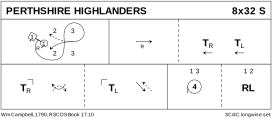
1-8
1s lead & cast down round 2M, cross & cast round 3L, lead up the middle to places
9-16
1s lead down the middle, 1s dancing up turn RH & LH to face 1st corners
17-24
1s turn 1st corners RH, pass by RSh to turn 2nd corners LH & cross to 2nd place own sides
25-32
1s+3s circle 4H round to left, 2s+1s dance R&L
E-Cribs
1-8
1c RHJ, M on L, cast round 2M, cross, cast down round 3W, and up the middle to 1pl
9-16
1c lead down the middle (2c up) ; 1c dance up while turning first RH, then LH to finish facing 1cnr (not quite full turns)
17-24
1c turn 1cnr RH | pass Rsh ; turn 2cnr LH | cross to 2pl
25-32
1c+3c circle4 L ; 2c+1c R&L

Заметки
This Society version of the dance can be traced back to William Campbell’s
11th Book of New and Favorite, Country Dances, & Strathspey Reels
published about 1790.
Perthshire Highlanders
In 1794 Britain was again at war with France,
a revolutionary France whose king, Louis XVI, had been executed the year before
and whose future leader, Napoleon Bonaparte, was an officer in the French army.
Agents of the “new” France were slipping into Ireland with offers of liberty
and the establishment of a republican Ireland.
It was a threatening time.
During that year four volunteer regiments were raised in Scotland
and were disbanded and drafted into other regiments during that same year.
The 97th Strathspey Regiment was raised by Sir James Grant of Grant,
the 132nd Highland Regiment by Colonel Duncan Cameron of Callart
and the 133rd Highland Regiment by Colonel Simon Fraser.
The 116th Perthshire Regiment was raised by Major-General Alexander Campbell of Monzie,
a descendent of the fifth son of Sir Duncan Campbell of Glenorchy, “Black Duncan of the Castles”,
who was the ancestor of the Earls of Breadalbane.
The Perthshire Highlanders served in Ireland during its very short life
and was, as were the other regiments raised in 1794, absorbed into other formations.
From “Scotland Dances”, by Eugenia (Jeannie) Callander Sharp
(Used by permission.)
11th Book of New and Favorite, Country Dances, & Strathspey Reels
published about 1790.
Perthshire Highlanders
In 1794 Britain was again at war with France,
a revolutionary France whose king, Louis XVI, had been executed the year before
and whose future leader, Napoleon Bonaparte, was an officer in the French army.
Agents of the “new” France were slipping into Ireland with offers of liberty
and the establishment of a republican Ireland.
It was a threatening time.
During that year four volunteer regiments were raised in Scotland
and were disbanded and drafted into other regiments during that same year.
The 97th Strathspey Regiment was raised by Sir James Grant of Grant,
the 132nd Highland Regiment by Colonel Duncan Cameron of Callart
and the 133rd Highland Regiment by Colonel Simon Fraser.
The 116th Perthshire Regiment was raised by Major-General Alexander Campbell of Monzie,
a descendent of the fifth son of Sir Duncan Campbell of Glenorchy, “Black Duncan of the Castles”,
who was the ancestor of the Earls of Breadalbane.
The Perthshire Highlanders served in Ireland during its very short life
and was, as were the other regiments raised in 1794, absorbed into other formations.
From “Scotland Dances”, by Eugenia (Jeannie) Callander Sharp
(Used by permission.)
Видео 1
Demonstration quality