The Reivers
Основная информация
| Автор: | Ronald Morton Smith |
|---|---|
| RSCDS: |
 RSCDS HQ publication
|
| Сочинен в России: | Нет |
| Публикация: |
|
| Рекомендуемая музыка: | The Reivers |
Параметры
| Тип танца: | Reel |
|---|---|
| Тип сета: | Longwise set |
| Размер: | 8x32 |
| Формат сета: | 4 couples |
| Танцующие пары: | 2 |
Источник:
https://my.strathspey.org/dd/dance/5543/
MiniCribs
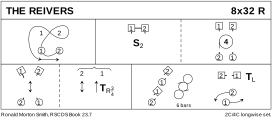
1-8
1M followed by 2M dances a Fig of 8 round 2L & 1L (RSh to 2L) 1M crosses to 2nd place own side & 2M to 1st place
9-16
1L+2L (facing across) set twice & 1s+2s circle 4H round to left to face partner diagonally
17-24
1s+2s Adv+Ret diagonally, 1s+2s Advance, 2s Retire as 1s 3/4 turn RH to end BtoB facing opposite partner
25-32
1s dance diagonal LSh reel of 4 with 2s, 1M ends in 2nd place as 1L turns 2L LH to end in 2nd place
E-Cribs
1-8
1M followed by 2M Fig8 round 2W (Rsh) and 1W, to finish in exchanged places
9-16
1W+2W set twice (1M+2M stand still) ; 1c+2c circle4 to face partners diagonally
17-24
1c+2c advance | retire ; advance again | 2c retire while{2} 1c turn ¾ RH to finish on 2diag for
25-32
1c+2c Lsh Reel4, at end 1W+2W turn LH to finish (2,1).

Заметки
The Reivers
From Gretna on the River Sark at the head of the Solway Firth,
through the lonely Cheviot Hills to and beyond Carter Bar,
meeting the River Tweed near Coldstream,
ever north and east to Berwick on the North Sea
marches the Scottish-English border.
On the map it is a tortuous line,
in history a seemingly palpable demarcation,
a prize to be taken.
Above it and below it the armies of Scotland and England
fought for centuries for the possession of Scotland.
Those who lived on either side of the Border suffered not only from the savaqery of declared war.
Death and destruction, wanton cruelty and lawlessness became a way of life,
for the Border families cherished and indulged their blood feuds,
the vicious raids back and forth across the Border continued
long after the sound of battles had ceased,
and murder was an accepted means to any end.
In those days the law of the Border was as Sir Walter Scott expressed it in
The Black Dwarf
:
“Hout, there’s nae great skill needed;
just put a lighted peat on the end of the spear, or hayfork, or siclike,
and blaw a horn, and cry the gathering word,
and then it’s lawful to follow gear into England, and recover it by the strong hand,
or to take gear frae some other Englishman,
providing ye lift nae mair than’s been lifted frae you.
That’s the auld Border Law, made at Dundrennan in the days of the Black Douglas.
Deil ane need doubt it.
It’s as clear as the sun.”
When the Border itself was no longer a bone of contention,
a people savaged by warfare had been twisted into a mould.
From every Border social level
they turned their energies to freebooting, robbery, cattle lifting and blackmail.
They were the reivers who terrorised the Border
until the time that James VI (I) united the two kingdoms
and ordered the pacification of that barbaric land.
Of all of the terrible crimes against the local inhabitants,
beyond the cattle lifting and the burning,
the worst, the most insidious, was blackmail, the illegal “black rent”,
the protection racket of the strong over the weak.
One of the weak to suffer from extortion was “Jamie Telfer of the Fair Dodhead”
and the strong in this instance were the Scotts and the Elliots.
A few selected verses from the anonymous ballad tell the story.
1.
It fell about the Martinmas tyde,
When our Border steeds get corn and hay,
The Captain of Bewcastle bound him to ryde,
And he’s ower to Tividale to drive a prey.
4.
And when they cam to the fair Dodhead,
Right hastily they clam the peel;
They loosed the kye out, ane and a’,
And ranshackled the house right weel.
5.
Now Jamie Telfer’s heart was sair,
The tear aye rowing in his ee;
He pled wi’ the Captain to hae his gear,
Or else revenged he wad be.
6.
The Captain turned him round and leugh;
Said – “Man, there’s naething in thy house,
But ae auld sword without a sheath,
That hardly now would fell a mouse.
7.
The sun wasna up, but the moon was down,
It was the gryming of a new-fa’n snaw,
Jamie Telfer has run ten myles a-foot,
Between the Bodhead and the Stobs’s Ha’.
8.
And when he cam to the fair tower-yate,
He shouted loud, and cried weel-hie,
Till out bespak auld Gibby Elliot –
“Whae’s this that brings the fraye to me?”
9.
“It’s I, Jamie Telfer of the fair Dodhead,
And a harried man I think I be!
There’s naething left at the fair Dodhead,
But a waefu’ wife and bairnies three.”
10.
“Gae seek your succour at Branksome Ha’,
For succour ye’se get nane frae me!
Gae seek your succour where ye paid black-mail,
For, man, ye ne’er paid money to me.”
11.
Jamie has turned him round about,
I wat the tear blinded his ee –
“I’ll ne’er pay mail to Elliot again,
And the fair Dodhead I’ll never see.”
12.
“My hounds may a’ rin masterless,
My hawks may fly frae tree to tree,
My lord may grip my vassal lands,
For there again I mun never be!”
The ballad continues to a length of forty-nine verses
and in the end the Scotts rise and rout the Captain of Bewcastle in a bloody fray with great loss of life
and Jamie wins back the fair Dodhead.
The reivers, romanticised beyond recognition for what they actually were,
by Sir Walter Scott in the
Minstrelsy of the Scottish Border
,
those ruffians who ruled the land and increased their fortunes through victimisation,
came from the great Border families:
Armstrong, Bell, Burn, Elliot, Johnstone, Kerr and Scott, the ancestors of Sir Walter.
Even the reivers’ nicknames reek of brutality:
“God’s Curse”, “Fire the Braes”, “Nebless”, “Ill Wild Will”, “Halfelugs”, “Fingerless Will”
and “Ill-Drowned Geordie”.
They inspired ballads about anti-heroes:
“Kinmont Willie”, “Dick o’ the Cow”, “Hobie Noble”, “Archie o’ Cawfield” and “Jock o’ the Side”.
The ballads will live on when the deeds of the reivers were best forgotten.
The reivers were not in the tradition and spirit of Robin Hood.
They were the product of a ruthless age and they bring no credit to Scotland.
From “Scotland Dances”, by Eugenia (Jeannie) Callander Sharp
(Used by permission.)
From Gretna on the River Sark at the head of the Solway Firth,
through the lonely Cheviot Hills to and beyond Carter Bar,
meeting the River Tweed near Coldstream,
ever north and east to Berwick on the North Sea
marches the Scottish-English border.
On the map it is a tortuous line,
in history a seemingly palpable demarcation,
a prize to be taken.
Above it and below it the armies of Scotland and England
fought for centuries for the possession of Scotland.
Those who lived on either side of the Border suffered not only from the savaqery of declared war.
Death and destruction, wanton cruelty and lawlessness became a way of life,
for the Border families cherished and indulged their blood feuds,
the vicious raids back and forth across the Border continued
long after the sound of battles had ceased,
and murder was an accepted means to any end.
In those days the law of the Border was as Sir Walter Scott expressed it in
The Black Dwarf
:
“Hout, there’s nae great skill needed;
just put a lighted peat on the end of the spear, or hayfork, or siclike,
and blaw a horn, and cry the gathering word,
and then it’s lawful to follow gear into England, and recover it by the strong hand,
or to take gear frae some other Englishman,
providing ye lift nae mair than’s been lifted frae you.
That’s the auld Border Law, made at Dundrennan in the days of the Black Douglas.
Deil ane need doubt it.
It’s as clear as the sun.”
When the Border itself was no longer a bone of contention,
a people savaged by warfare had been twisted into a mould.
From every Border social level
they turned their energies to freebooting, robbery, cattle lifting and blackmail.
They were the reivers who terrorised the Border
until the time that James VI (I) united the two kingdoms
and ordered the pacification of that barbaric land.
Of all of the terrible crimes against the local inhabitants,
beyond the cattle lifting and the burning,
the worst, the most insidious, was blackmail, the illegal “black rent”,
the protection racket of the strong over the weak.
One of the weak to suffer from extortion was “Jamie Telfer of the Fair Dodhead”
and the strong in this instance were the Scotts and the Elliots.
A few selected verses from the anonymous ballad tell the story.
1.
It fell about the Martinmas tyde,
When our Border steeds get corn and hay,
The Captain of Bewcastle bound him to ryde,
And he’s ower to Tividale to drive a prey.
4.
And when they cam to the fair Dodhead,
Right hastily they clam the peel;
They loosed the kye out, ane and a’,
And ranshackled the house right weel.
5.
Now Jamie Telfer’s heart was sair,
The tear aye rowing in his ee;
He pled wi’ the Captain to hae his gear,
Or else revenged he wad be.
6.
The Captain turned him round and leugh;
Said – “Man, there’s naething in thy house,
But ae auld sword without a sheath,
That hardly now would fell a mouse.
7.
The sun wasna up, but the moon was down,
It was the gryming of a new-fa’n snaw,
Jamie Telfer has run ten myles a-foot,
Between the Bodhead and the Stobs’s Ha’.
8.
And when he cam to the fair tower-yate,
He shouted loud, and cried weel-hie,
Till out bespak auld Gibby Elliot –
“Whae’s this that brings the fraye to me?”
9.
“It’s I, Jamie Telfer of the fair Dodhead,
And a harried man I think I be!
There’s naething left at the fair Dodhead,
But a waefu’ wife and bairnies three.”
10.
“Gae seek your succour at Branksome Ha’,
For succour ye’se get nane frae me!
Gae seek your succour where ye paid black-mail,
For, man, ye ne’er paid money to me.”
11.
Jamie has turned him round about,
I wat the tear blinded his ee –
“I’ll ne’er pay mail to Elliot again,
And the fair Dodhead I’ll never see.”
12.
“My hounds may a’ rin masterless,
My hawks may fly frae tree to tree,
My lord may grip my vassal lands,
For there again I mun never be!”
The ballad continues to a length of forty-nine verses
and in the end the Scotts rise and rout the Captain of Bewcastle in a bloody fray with great loss of life
and Jamie wins back the fair Dodhead.
The reivers, romanticised beyond recognition for what they actually were,
by Sir Walter Scott in the
Minstrelsy of the Scottish Border
,
those ruffians who ruled the land and increased their fortunes through victimisation,
came from the great Border families:
Armstrong, Bell, Burn, Elliot, Johnstone, Kerr and Scott, the ancestors of Sir Walter.
Even the reivers’ nicknames reek of brutality:
“God’s Curse”, “Fire the Braes”, “Nebless”, “Ill Wild Will”, “Halfelugs”, “Fingerless Will”
and “Ill-Drowned Geordie”.
They inspired ballads about anti-heroes:
“Kinmont Willie”, “Dick o’ the Cow”, “Hobie Noble”, “Archie o’ Cawfield” and “Jock o’ the Side”.
The ballads will live on when the deeds of the reivers were best forgotten.
The reivers were not in the tradition and spirit of Robin Hood.
They were the product of a ruthless age and they bring no credit to Scotland.
From “Scotland Dances”, by Eugenia (Jeannie) Callander Sharp
(Used by permission.)
Видео 1
Demonstration quality

Видео 2
Good