Roaring Jelly
Основная информация
| Автор: | Hugh Foss |
|---|---|
| RSCDS: | Не RSCDS |
| Сочинен в России: | Нет |
| Публикация: |
|
| Рекомендуемая музыка: |
|
Параметры
| Тип танца: | Jig |
|---|---|
| Тип сета: | Longwise set |
| Размер: | 8x32 |
| Формат сета: | 4 couples |
| Танцующие пары: | 3 |
Источник:
https://my.strathspey.org/dd/dance/5621/
MiniCribs
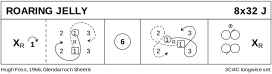
1-8
1s cross RH, cast 1 place, cross RH & cast (Man up & Lady down) into centre, 1M between 2s, 1L between 3s
9-16
1s+2s+3s circle 6H round & back (1s end in centre)
17-24
1s change places RH & dance out of ends to their right, into Figs of 8 (Lady round 2s as 1M dances round 3s)
25-32
1s dance reels of 3 on opposite sides giving RSh to 2nd corners & cross RH to places
E-Cribs
1-8
1c cross RH | cast off (2c up) ; cross RH, 1c casts R round 3cnr to finish in line across between 2cnr and 3cnr
9-16
Circle6 and back
17-24
1c change places up/dn RH | Fig8 round 4cnr and 1cnr, start Rsh), finish on sideline facing 2cnr
25-32
1c Reels3{6} on opposite sides (Rsh to 2cnr) | cross RH

Заметки
“Roaring Jelly”
In WWII, “roaring jelly” was military slang for gelignite or “blasting gelatin”, a plastic explosive invented in 1876 by Alfred Nobel. Gelignite consists of collodion-cotton (a type of nitrocellulose, i.e., cotton that has been treated with nitric and sulfuric acid) that has been dissolved in nitroglycerine and then mixed with saltpetre and wood pulp. Gelignite is more stable than dynamite, has a greater yield, and is one of the cheapest explosives available. It is yellowish-transparent, rubberlike, easy to shape, and can be stored and handled relatively safely because it cannot explode without a detonator. Apart from the military (where it no longer plays an important role today) it is used in mining and quarrying.
So far, so obvious – but the eponymous tune for the dance is found in a collection issued in 1806 by
Nathaniel Gow
(1763–1831), which seems to preclude the explosive connection. The Irish repertoire calls the tune
Smash the Windows
, which would go well with the blasting gelatin, but that title is also on record since the early 19th century. Another explanation points to the fact that pork rinds must be boiled very vigorously to make gelatin, and that could also cause loud noises, right? Perhaps afterwards the gelatin is just “roaring good”? Riddles upon riddles …
From “Anselm's Notes on Dances”, by Anselm Lingnau
(Used by permission.)
In WWII, “roaring jelly” was military slang for gelignite or “blasting gelatin”, a plastic explosive invented in 1876 by Alfred Nobel. Gelignite consists of collodion-cotton (a type of nitrocellulose, i.e., cotton that has been treated with nitric and sulfuric acid) that has been dissolved in nitroglycerine and then mixed with saltpetre and wood pulp. Gelignite is more stable than dynamite, has a greater yield, and is one of the cheapest explosives available. It is yellowish-transparent, rubberlike, easy to shape, and can be stored and handled relatively safely because it cannot explode without a detonator. Apart from the military (where it no longer plays an important role today) it is used in mining and quarrying.
So far, so obvious – but the eponymous tune for the dance is found in a collection issued in 1806 by
Nathaniel Gow
(1763–1831), which seems to preclude the explosive connection. The Irish repertoire calls the tune
Smash the Windows
, which would go well with the blasting gelatin, but that title is also on record since the early 19th century. Another explanation points to the fact that pork rinds must be boiled very vigorously to make gelatin, and that could also cause loud noises, right? Perhaps afterwards the gelatin is just “roaring good”? Riddles upon riddles …
From “Anselm's Notes on Dances”, by Anselm Lingnau
(Used by permission.)
Видео 1
Good

Видео 2
Reasonable
Видео 3
Social
Видео 4
Animation