Saw ye my Wee Thing
Основная информация
| Автор: | Unknown |
|---|---|
| RSCDS: |
 RSCDS HQ publication
|
| Сочинен в России: | Нет |
| Публикация: |
|
| Рекомендуемая музыка: |
|
Параметры
| Тип танца: | Jig |
|---|---|
| Тип сета: | Longwise set |
| Размер: | 8x32 |
| Формат сета: | 4 couples |
| Танцующие пары: | 2 |
Источник:
https://my.strathspey.org/dd/dance/5906/
MiniCribs
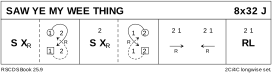
1-8
1s set, cross RH, cast round 2s, lead up & cross to places
9-16
2s set, cross RH, cast up round 1s, lead down & cross to places
17-24
1s followed by 2s lead down the middle & 2s followed by 1s lead back to top
25-32
2s+1s dance R&L
E-Cribs
1-8
1c set | cross RH ; cast off | cross up to 1pl
9-16
2c set | cross RH ; cast up | cross down to 2pl
17-24
1c followed by 2c lead down ; 2c lead up to 1pl, 1c to 2pl
25-32
2c+1c R&L

Заметки
Saw Ye My Wee Thing
O saw ye my wee thing, saw ye mine ain thing?
Saw ye my true love down on yon lea?
Cross’d she the meadow yestreen at the gloamin’?
Sought she the burnie where flow’rs the haw tree?
Her hair it is lint-white, her skin it is milk-white;
Dark is the blue o’ her saft rollin’ e’e.
Red, red her ripe lips, and sweeter than roses;
Whaur could my wee thing wander frae me?
I saw na your wee thing, I saw na your ain thing,
Nor saw I your true love down on yon lea;
But I met my bonnie thing late in the gloamin’,
Down by the burnie whaur flow’rs the haw tree.
Her hair it was lint-white, her skin it was milk-white;
Dark was the blue o’ her saft rollin’ e’e;
Red were her ripe lips, and sweeter than roses,
Sweet were the kisses that she ga’e to me.
It was na my wee thing, it was na my ain thing,
It was na my true love ye met by the tree;
Proud is her leal heart, and modest her nature,
She never lo’ed ony till ance she lo’ed me.
Her name it is Mary, she’s frae Castlecary,
Aft has she sat, when a bairn, on my knee;
Fair as your face is, wer’t fifty times fairer,
Young braggart, she ne’er would gi’e kisses to thee.
It was then your Mary – she’s frae Castlecary;
It was then your true love I met by the tree;
Proud as her heart is, and modest her nature,
Sweet were the kisses that she ga’e to me.
Sair gloom’d his dark brow, blood-red his cheek grew,
Wild flash’d the fire frae his red tollin’ e’e;
Ye’se rue sair this morning your boast and your scorning –
Defend ye, fause traitor, du’ loudly ye lie.
Awa’ wi’ beguiling, cried the youth, smiling;
Aff went the bonnet, the lint-white locks flee,
The belted plaid fa’ing, her white bosom shawing,
Fair stood the loved maid wi’ the dark rollin’ e’e.
Is it my wee thing? is it my ain thing?
Is it my true love here that I see?
O Jamie, forgi’e me, your heart’s constant to me,
I’ll never mair wander, dear laddie, frae thee.
“Saw Ye My Wee Thing” or “The Wee Thing, or Mary of Castlecary” was written by Hector MacNeill
and appeared first in an Edinburgh periodical
The Bee
in May of 1791.
MacNeill was born near Roslin in Midlothian in 1746, the son of an officer of the Black Watch.
Most of his life was spent between the West Indies where he held various posts
and Scotland where he tried, with little early success, to earn a living as a writer.
While he never became one of Scotland’s major poets
he did write some songs that were popular enough to endure:
“Come Under My Plaidie”, “My Luve’s in Germany”, “Dinna Think, Bonnie Lassie”
and the ballad “Scotland’s Scaith, or the History of Will and Jean.”
From “Scotland Dances”, by Eugenia (Jeannie) Callander Sharp
(Used by permission.)
O saw ye my wee thing, saw ye mine ain thing?
Saw ye my true love down on yon lea?
Cross’d she the meadow yestreen at the gloamin’?
Sought she the burnie where flow’rs the haw tree?
Her hair it is lint-white, her skin it is milk-white;
Dark is the blue o’ her saft rollin’ e’e.
Red, red her ripe lips, and sweeter than roses;
Whaur could my wee thing wander frae me?
I saw na your wee thing, I saw na your ain thing,
Nor saw I your true love down on yon lea;
But I met my bonnie thing late in the gloamin’,
Down by the burnie whaur flow’rs the haw tree.
Her hair it was lint-white, her skin it was milk-white;
Dark was the blue o’ her saft rollin’ e’e;
Red were her ripe lips, and sweeter than roses,
Sweet were the kisses that she ga’e to me.
It was na my wee thing, it was na my ain thing,
It was na my true love ye met by the tree;
Proud is her leal heart, and modest her nature,
She never lo’ed ony till ance she lo’ed me.
Her name it is Mary, she’s frae Castlecary,
Aft has she sat, when a bairn, on my knee;
Fair as your face is, wer’t fifty times fairer,
Young braggart, she ne’er would gi’e kisses to thee.
It was then your Mary – she’s frae Castlecary;
It was then your true love I met by the tree;
Proud as her heart is, and modest her nature,
Sweet were the kisses that she ga’e to me.
Sair gloom’d his dark brow, blood-red his cheek grew,
Wild flash’d the fire frae his red tollin’ e’e;
Ye’se rue sair this morning your boast and your scorning –
Defend ye, fause traitor, du’ loudly ye lie.
Awa’ wi’ beguiling, cried the youth, smiling;
Aff went the bonnet, the lint-white locks flee,
The belted plaid fa’ing, her white bosom shawing,
Fair stood the loved maid wi’ the dark rollin’ e’e.
Is it my wee thing? is it my ain thing?
Is it my true love here that I see?
O Jamie, forgi’e me, your heart’s constant to me,
I’ll never mair wander, dear laddie, frae thee.
“Saw Ye My Wee Thing” or “The Wee Thing, or Mary of Castlecary” was written by Hector MacNeill
and appeared first in an Edinburgh periodical
The Bee
in May of 1791.
MacNeill was born near Roslin in Midlothian in 1746, the son of an officer of the Black Watch.
Most of his life was spent between the West Indies where he held various posts
and Scotland where he tried, with little early success, to earn a living as a writer.
While he never became one of Scotland’s major poets
he did write some songs that were popular enough to endure:
“Come Under My Plaidie”, “My Luve’s in Germany”, “Dinna Think, Bonnie Lassie”
and the ballad “Scotland’s Scaith, or the History of Will and Jean.”
From “Scotland Dances”, by Eugenia (Jeannie) Callander Sharp
(Used by permission.)
Видео 1
Good

Видео 2
Reasonable
Видео 3
Reasonable