Seann Triubhas Willichan
Основная информация
| Автор: | Thomas (19C) Wilson |
|---|---|
| RSCDS: |
 RSCDS HQ publication
|
| Сочинен в России: | Нет |
| Публикация: |
|
| Рекомендуемая музыка: |
|
Параметры
| Тип танца: | Strathspey |
|---|---|
| Тип сета: | Longwise set |
| Размер: | 8x32 |
| Формат сета: | 4 couples |
| Танцующие пары: | 2 |
Источник:
https://my.strathspey.org/dd/dance/5982/
MiniCribs
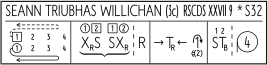
1-8
1s cast & dance down behind own lines, turn outwards & dance back to top
9-16
1L+2M set & change places RH while 1M+2L change places RH & set; repeat
17-24
1s lead down for 2 steps, turn RH, lead up to top & cast to 2nd place
25-32
2s+1s set & turn partner 2H opening out to circle 4H round to left
E-Cribs
1-8
1c cast off behind own lines and cast back
9-16
1W+2M set and change places RH while{4} 1M+2W change places RH and set ; repeat
17-24
1c lead down the middle | turn RH ; lead up and cast off to 2pl (2c up)
25-32
2c+1c set | turn BH ; open into circle4 L.

Заметки
[Editorial note: In Jeannie Sharp’s original manuscript the name of this section is spelled “Truibhas”, not “Triubhas”. There is widespread consensus among our Gaelic-speaking correspondents that “Triubhas” is in fact correct, as per (modern) standardised Gaelic spelling rules, and we have thus taken the liberty to correct this section accordingly. –A.]
In his Illustrations of the Lyric Poetry and Music of Scotland, under the heading “This Is No My Ain House”, William Stenhouse has provided the following information on “Seann Triubhas Willichan”. “There is a set of the tune of ‘Deil stick the Minister,’ inserted in Fraser’s Gaelic airs, under the title of ‘Sean Truid’s Uillachan,’ printed in 1816, and the editor, in a note, informs us, that the tune ‘is the modelling of Mr Campbell of Budyet, and other Nairnshire gentlemen, formerly mentioned. The air is of considerable antiquity, but it was formed by them into this standard.’ Of course we must believe it to be of Gaelic extraction; but the Gaelic title will not do: It is evidently a barbarous translation of Willie’s Shantrews. The word Shan, is a common Scottish adjective, signifying poor or shabby, and shantrews, in the same dialect, literally means shabby or poor-looking trowsers, a name by which the tune has been known in common, with its still more objectionable title, at all our dancing-schools for many generations.
'Of Umquihile John to lie or bann,
Shaws but ill will and looks right shan.
Ye’re never rugget shan nor kittle,
But blythe and gabby.’ – Ramsay’s Poems”
Robert Burns, commenting upon the old song “This is no mine ain House”, stated that the tune to which the verses were set was “an old Highland air, called *Shuan trusih willighan.”
The Royal Scottish Country Dance Society set the dance to the strathspey called “My Dearie”.
In his Illustrations of the Lyric Poetry and Music of Scotland, under the heading “This Is No My Ain House”, William Stenhouse has provided the following information on “Seann Triubhas Willichan”. “There is a set of the tune of ‘Deil stick the Minister,’ inserted in Fraser’s Gaelic airs, under the title of ‘Sean Truid’s Uillachan,’ printed in 1816, and the editor, in a note, informs us, that the tune ‘is the modelling of Mr Campbell of Budyet, and other Nairnshire gentlemen, formerly mentioned. The air is of considerable antiquity, but it was formed by them into this standard.’ Of course we must believe it to be of Gaelic extraction; but the Gaelic title will not do: It is evidently a barbarous translation of Willie’s Shantrews. The word Shan, is a common Scottish adjective, signifying poor or shabby, and shantrews, in the same dialect, literally means shabby or poor-looking trowsers, a name by which the tune has been known in common, with its still more objectionable title, at all our dancing-schools for many generations.
'Of Umquihile John to lie or bann,
Shaws but ill will and looks right shan.
Ye’re never rugget shan nor kittle,
But blythe and gabby.’ – Ramsay’s Poems”
Robert Burns, commenting upon the old song “This is no mine ain House”, stated that the tune to which the verses were set was “an old Highland air, called *Shuan trusih willighan.”
The Royal Scottish Country Dance Society set the dance to the strathspey called “My Dearie”.
Видео 1
Demonstration quality

Видео 2
Demonstration quality
Видео 3
Demonstration quality
Видео 4
Demonstration quality
Видео 5
Demonstration quality
Видео 6
Demonstration quality
Видео 7
Reasonable
Видео 8
Social
Видео 9
Social
Видео 10
Animation