Speed the Plough
Основная информация
| Автор: | Unknown |
|---|---|
| RSCDS: |
 RSCDS HQ publication
|
| Сочинен в России: | Нет |
| Публикация: |
|
| Рекомендуемая музыка: |
|
Параметры
| Тип танца: | Reel |
|---|---|
| Тип сета: | Longwise set |
| Размер: | 8x32 |
| Формат сета: | 4 couples |
| Танцующие пары: | 3 |
Источник:
https://my.strathspey.org/dd/dance/6233/
MiniCribs
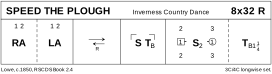
1-8
1s+2s dance RH across & LH back to places
9-16
1s lead down the middle & back to face 1st corners
17-24
1s set & turn 1st corners, set & turn 2nd corners (1s end in lines across Lady between 2s facing down & Man between 3s facing up)
25-32
1s set twice & turn 2H 1.1/4 times to own sides
E-Cribs
1-8
1c+2c RHA, LHA
9-16
1c lead down the middle (2c up) and up, to face 1cnrs
17-24
Set to and turn corners, 1W (1M) finishing between 2c (3c) facing P
25-32
1c set twice ; turn 1¼ BH to 2pl

Заметки
Inverness Country Dance
(or “Speed the Plough”)
In the northeast of Scotland, on the banks of the lovely river Ness,
where the Great Glen opens out flat at the edge of the Inner Moray Firth,
is the Royal Burgh of Inverness, the “Capital of the North”.
From its very beginning until today, Inverness’
raison d’être
has remained unchanged.
It was, and still is, a centre for trade and administration.
When St. Columba visited King Brude MacBile in 565, it was the capital of the Picts
and when it became a chartered burgh in the 12th century it was an active trading community.
For many years the Highlands and Islands have been governed from Inverness.
Inverness’ great value from a commercial and governmental standpoint has been its accessibility.
There has always been the sea.
In 1724 General George Wade (1673–1748) was sent to “open up” the Highlands.
This he did by constructing 250 miles of roads and some forty stone bridges.
Had you seen these roads before they were made,
You would lift your hands and bless General Wade.
Inverness was the terminal point of two of Wade’s great roads,
one running north from Dunkeld in Perthshire
and the other cutting west to east from Fort William on Loch Linnhe.
The Caledonian Canal (1804–1847), whose engineer was Thomas Telford
(See “The Dean Bridge of Edinburgh”),
which connects the Beauly Firth near Inverness with Loch Linnhe, via Loch Ness,
made possible easy water transportation
between Inverness and the western Highlands and the Hebrides.
Very little is left now of Inverness’ antiquity.
The ancient castles are gone.
Macbeth’s castle was destroyed in the 11th century by Malcolm III (Canmore)
in revenge for the murder of his father, Duncan I, at the hands of Macbeth.
Gone too is the old castle of Inverness, built by Malcolm, which surrendered to Queen Mary in 1562.
Today’s Inverness Castle is actually the County Building,
a red sandstone Victorian edifice,
towered and crenellated and perched on Castle Hill high above the River Ness.
Queen Mary’s House, where the queen stayed in 1562, is still there,
as are the early 17th century Abertarff House and Dunbar’s Hospital, which dates from 1668.
The old High Church, from 1772, with its 13th century clock tower and spire,
and the 1791 Tolbooth Steeple remain.
In teh base of the Mercat Cross before the Town Hall is the ancient Clach-na-Cudainn
– the Stone of the Tubs –
where, traditionally, the women of Inverness rested their water pails as they climbed up from the river.
Inverness was the winter residence of many of the Highland gentry,
eager to leave cold castles and lonely mansions for a few months.
In Inverness their children could be educated
and for the adults there were routs and assemblies and balls and supper parties.
Elizabeth Grant of Rothiemurchus (1797–1885),
in her
Memoirs of a Highland Lady
, describes the social life in Inverness in 1814:
“The Northern Meeting was to all of our degree as important a gathering
as was the Badenoch Tryst to our humbler acquaintance.
It had been set agoing soon after my birth by her
who was the life of all circles she entered, the Duchess of Gordon.
She had persuaded all the northern counties to come together once a year about the middle of October,
and spend the better part of a week at Inverness.
There were dinners and balls in the evenings;
the mornings were devoted to visiting neighbouring friends
and the beautiful scenery abounding on all sides.
She had always herself taken a large party there,
and done her utmost to induce her friends to do likewise –
stray English being particularly acceptable,
as supposed admirers of our national beauties! while enacting the part of lion themselves.
No one with equal energy had replaced her;
still, the annual meeting went on,
bringing many together who otherwise might not have become acquainted,
renewing old intimacies, and sometimes obliterating old grudges.”
And: “The mornings had hung heavy to many, but not to me.
Most people lounged about the narrow ill-paved streets, paid each other visits,
or congregated in our northern emporium of fashion, Mr Urquhart the hairdresser’s shop.
My father took my mother, Mrs Cooper, one of the girls, and me
for charming drives in several directions;
it was impossible to turn amiss, the whole surrounding scenery is so enchanting.”
From “Scotland Dances”, by Eugenia (Jeannie) Callander Sharp
(Used by permission.)
(or “Speed the Plough”)
In the northeast of Scotland, on the banks of the lovely river Ness,
where the Great Glen opens out flat at the edge of the Inner Moray Firth,
is the Royal Burgh of Inverness, the “Capital of the North”.
From its very beginning until today, Inverness’
raison d’être
has remained unchanged.
It was, and still is, a centre for trade and administration.
When St. Columba visited King Brude MacBile in 565, it was the capital of the Picts
and when it became a chartered burgh in the 12th century it was an active trading community.
For many years the Highlands and Islands have been governed from Inverness.
Inverness’ great value from a commercial and governmental standpoint has been its accessibility.
There has always been the sea.
In 1724 General George Wade (1673–1748) was sent to “open up” the Highlands.
This he did by constructing 250 miles of roads and some forty stone bridges.
Had you seen these roads before they were made,
You would lift your hands and bless General Wade.
Inverness was the terminal point of two of Wade’s great roads,
one running north from Dunkeld in Perthshire
and the other cutting west to east from Fort William on Loch Linnhe.
The Caledonian Canal (1804–1847), whose engineer was Thomas Telford
(See “The Dean Bridge of Edinburgh”),
which connects the Beauly Firth near Inverness with Loch Linnhe, via Loch Ness,
made possible easy water transportation
between Inverness and the western Highlands and the Hebrides.
Very little is left now of Inverness’ antiquity.
The ancient castles are gone.
Macbeth’s castle was destroyed in the 11th century by Malcolm III (Canmore)
in revenge for the murder of his father, Duncan I, at the hands of Macbeth.
Gone too is the old castle of Inverness, built by Malcolm, which surrendered to Queen Mary in 1562.
Today’s Inverness Castle is actually the County Building,
a red sandstone Victorian edifice,
towered and crenellated and perched on Castle Hill high above the River Ness.
Queen Mary’s House, where the queen stayed in 1562, is still there,
as are the early 17th century Abertarff House and Dunbar’s Hospital, which dates from 1668.
The old High Church, from 1772, with its 13th century clock tower and spire,
and the 1791 Tolbooth Steeple remain.
In teh base of the Mercat Cross before the Town Hall is the ancient Clach-na-Cudainn
– the Stone of the Tubs –
where, traditionally, the women of Inverness rested their water pails as they climbed up from the river.
Inverness was the winter residence of many of the Highland gentry,
eager to leave cold castles and lonely mansions for a few months.
In Inverness their children could be educated
and for the adults there were routs and assemblies and balls and supper parties.
Elizabeth Grant of Rothiemurchus (1797–1885),
in her
Memoirs of a Highland Lady
, describes the social life in Inverness in 1814:
“The Northern Meeting was to all of our degree as important a gathering
as was the Badenoch Tryst to our humbler acquaintance.
It had been set agoing soon after my birth by her
who was the life of all circles she entered, the Duchess of Gordon.
She had persuaded all the northern counties to come together once a year about the middle of October,
and spend the better part of a week at Inverness.
There were dinners and balls in the evenings;
the mornings were devoted to visiting neighbouring friends
and the beautiful scenery abounding on all sides.
She had always herself taken a large party there,
and done her utmost to induce her friends to do likewise –
stray English being particularly acceptable,
as supposed admirers of our national beauties! while enacting the part of lion themselves.
No one with equal energy had replaced her;
still, the annual meeting went on,
bringing many together who otherwise might not have become acquainted,
renewing old intimacies, and sometimes obliterating old grudges.”
And: “The mornings had hung heavy to many, but not to me.
Most people lounged about the narrow ill-paved streets, paid each other visits,
or congregated in our northern emporium of fashion, Mr Urquhart the hairdresser’s shop.
My father took my mother, Mrs Cooper, one of the girls, and me
for charming drives in several directions;
it was impossible to turn amiss, the whole surrounding scenery is so enchanting.”
From “Scotland Dances”, by Eugenia (Jeannie) Callander Sharp
(Used by permission.)
Видео 1
Social