Strathglass House
Основная информация
| Автор: | Robert Bremner |
|---|---|
| RSCDS: |
 RSCDS HQ publication
|
| Сочинен в России: | Нет |
| Публикация: |
|
| Рекомендуемая музыка: |
|
Параметры
| Тип танца: | Strathspey |
|---|---|
| Тип сета: | Longwise set |
| Размер: | 8x32 |
| Формат сета: | 4 couples |
| Танцующие пары: | 3 |
Источник:
https://my.strathspey.org/dd/dance/6349/
MiniCribs
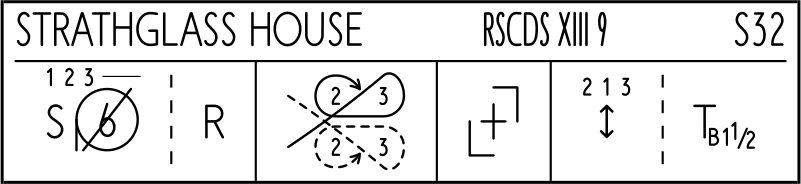
1-8
1s+2s+3s set & circle 6H round 1/2 way, set & continue to circle 6H round back to place
9-16
1s Lead down below 2s, cross & cast down round 3s, lead up between to top & cast 1 place (on opposite sides) to face 1st corners
17-24
Turn 1st corner RH, partner LH, 2nd corner RH & partner LH to end in 2nd place opposite sides
25-32
2s+1s+3s Adv+Ret for 2 steps & 1s turn 2H 1.1/2 times to own sides
E-Cribs
1-8
1c+2c+3c set, ½ circle6 L ; repeat
9-16
1c lead down below 2c, cross and cast round 3c ; lead up to the top, cast to face 1cnrs (2c up)
17-24
1c turn corner, P, corner, P to finish between corners
25-32
2c+1c+3c A&R ; 1c turn BH 1½

Заметки
Strathglass House
Strathglass in Inverness-shire runs parallel to the Great Glen
with twelve-mile long Glen Urquhart connecting the two like the crossing of an H.
At Struy Bridge the Glass is joined by the Farrar to become the River Beauly
that flows into the Beauly Firth.
Near Struy Bridge is Erchless Castle,
the late 16th century tower house that was the seat of The Chisholm
until it was sold in 1887.
The Chisholms were originally a Lowland family of Norman antecedents.
The first Chisholm to settle in the Highlands was Sir Robert de Cheseholm,
Sheriff of Inverness and Constable of Urquhart Castle in the time of David II.
His son Alexander married Margaret, Lady of Erchless,
and from their son Thomas came the Strathglass Chisholms.
The baronies of Erchless and Comer were created in 1538.
The direct line ended with Alexander, 23rd Chief,
and when his half-brother William succeeded him,
the end also came for hundreds of Chisholm clansmen.
Alexander had held out against the Lowland graziers
who wanted to clear the valley and the hills of people and cover the land with sheep.
(See “The Countess of Sutherland’s Reel”)
Hwever, William Chisholm had no such scruples nor sense of loyalty
and the clearance of his clansmen from the land began in 1801.
By 1835 most of the Chisholms were gone from Strathglass.
The last two stanzas of the “Canadian Boat Song” express the sorrow and the sense of betrayal
of the displaced people.
When the bold kindred, in the time long vanish’d,
Conquered the soil and fortified the keep, –
No seer foretold the children would be banish’d
That a degenerate lord might boast his sheep.
Come foreign rage – let Discord burst in slaughter!
O then for clansmen true, and stern claymore –
The hearts that would have given their blood like water,
Beat heavily beyond the Atlantic roar.
And David MacBeth Moir wrote:
Farewell, our fathers’ land,
Valley and fountain!
Farewell, old Scotland’s strand,
Forest and mountain!
Then hush the drum and hush the flute,
And be the stirring bagpipe mute –
Such sounds may not with sorrow suit –
And fare thee well, Lochaber!
This plume and plaid no more will see,
Nor philabeg, nor dirk at knee,
Nor even the broadswords which Dundee
Bade flash at Killiecrankie.
Farewell, our fathers’ land, etc.
Now when of yore, on bank and brae,
Our loyal clansmen marshall’d gay;
Far downward scowls Ben Nevis grey,
On sheep-walks spreading lonely.
Farewell, our fathers’ land, etc.
For now we cross the stormy sea,
Ah! never more to look on thee,
Nor on thy dun der, bounding free,
From Etive glens to Morven.
Farewell, our fathers’ land, etc.
Thy mountain air no more we’ll breathe;
The household sword shall eat the sheath,
While rave the wild winds o’er the heath
Where our grey sires are sleeping.
Then farewell, our fathers’ land etc.
From “Scotland Dances”, by Eugenia (Jeannie) Callander Sharp
(Used by permission.)
Strathglass in Inverness-shire runs parallel to the Great Glen
with twelve-mile long Glen Urquhart connecting the two like the crossing of an H.
At Struy Bridge the Glass is joined by the Farrar to become the River Beauly
that flows into the Beauly Firth.
Near Struy Bridge is Erchless Castle,
the late 16th century tower house that was the seat of The Chisholm
until it was sold in 1887.
The Chisholms were originally a Lowland family of Norman antecedents.
The first Chisholm to settle in the Highlands was Sir Robert de Cheseholm,
Sheriff of Inverness and Constable of Urquhart Castle in the time of David II.
His son Alexander married Margaret, Lady of Erchless,
and from their son Thomas came the Strathglass Chisholms.
The baronies of Erchless and Comer were created in 1538.
The direct line ended with Alexander, 23rd Chief,
and when his half-brother William succeeded him,
the end also came for hundreds of Chisholm clansmen.
Alexander had held out against the Lowland graziers
who wanted to clear the valley and the hills of people and cover the land with sheep.
(See “The Countess of Sutherland’s Reel”)
Hwever, William Chisholm had no such scruples nor sense of loyalty
and the clearance of his clansmen from the land began in 1801.
By 1835 most of the Chisholms were gone from Strathglass.
The last two stanzas of the “Canadian Boat Song” express the sorrow and the sense of betrayal
of the displaced people.
When the bold kindred, in the time long vanish’d,
Conquered the soil and fortified the keep, –
No seer foretold the children would be banish’d
That a degenerate lord might boast his sheep.
Come foreign rage – let Discord burst in slaughter!
O then for clansmen true, and stern claymore –
The hearts that would have given their blood like water,
Beat heavily beyond the Atlantic roar.
And David MacBeth Moir wrote:
Farewell, our fathers’ land,
Valley and fountain!
Farewell, old Scotland’s strand,
Forest and mountain!
Then hush the drum and hush the flute,
And be the stirring bagpipe mute –
Such sounds may not with sorrow suit –
And fare thee well, Lochaber!
This plume and plaid no more will see,
Nor philabeg, nor dirk at knee,
Nor even the broadswords which Dundee
Bade flash at Killiecrankie.
Farewell, our fathers’ land, etc.
Now when of yore, on bank and brae,
Our loyal clansmen marshall’d gay;
Far downward scowls Ben Nevis grey,
On sheep-walks spreading lonely.
Farewell, our fathers’ land, etc.
For now we cross the stormy sea,
Ah! never more to look on thee,
Nor on thy dun der, bounding free,
From Etive glens to Morven.
Farewell, our fathers’ land, etc.
Thy mountain air no more we’ll breathe;
The household sword shall eat the sheath,
While rave the wild winds o’er the heath
Where our grey sires are sleeping.
Then farewell, our fathers’ land etc.
From “Scotland Dances”, by Eugenia (Jeannie) Callander Sharp
(Used by permission.)
Видео 1
Demonstration quality

Видео 2
Demonstration quality
Видео 3
Demonstration quality
Видео 4
Demonstration quality
Видео 5
Good
Видео 6
Animation