The Sutters of Selkirk
Основная информация
| Автор: | Unknown |
|---|---|
| RSCDS: |
 RSCDS HQ publication
|
| Сочинен в России: | Нет |
| Публикация: |
|
| Рекомендуемая музыка: |
|
Параметры
| Тип танца: | Reel |
|---|---|
| Тип сета: | Longwise set |
| Размер: | 8x32 |
| Формат сета: | 4 couples |
| Танцующие пары: | 2 |
Источник:
https://my.strathspey.org/dd/dance/6407/
MiniCribs
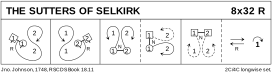
1-8
1s lead round 2M LSh & dance a full Fig of 8 round 2s & end in original places
9-16
2s (Lady on Mans left) lead round 1M RSh & dance a full Fig of 8 round 1s & end in original places
17-24
1M+2M lead between partners, cast round partner back to places, 1s lead down 1 place & cast back to places
25-32
1L+2L lead between partners, cast round partner back to places, 1s lead down 1 step, back to top & cast to 2nd places
E-Cribs
1-8
1c (1M on the L) in promhold cast into Fig8 around 2c (Lsh to 2M), to places
9-16
2c (2W on the L) in promhold cast up into Fig8 around 1c (Rsh to 1M), to places
17-24
1M+2M dance between and around own partner to places ; 1c dance between 2c and cast up to places
25-32
1W+2W dance between and around 1M & 2M ; 1c lead down {1}, up {1} and cast off to 2pl (2c up) Note: Keep the set narrower and longer than usual, and play the music a bit more slowly

Заметки
The Sutters of Selkirk
Up wi’ the souters o’ Selkirk,
And down wi’ the Earl of Hume;
But up wi’ ilka braw callant
That sews the single-soled shoon.
Fy upon yellow and yellow,
And fy upon yellow and green,
But up wi’ the true blue and scarlet,
And up wi’ the single-soled shoon.
Up wi’ the lads o’ the Forest,
That ne’er to the Southron wad yield;
But deil scoup o’ Hume and his menyie,
That stood sae abeigh on the field.
Fy on the green and the yellow,
The craw-hearted loons o’ the Merse;
But here’s to the souters o’ Selkirk,
The elshin, the lingle, and birse.
Then up wi’ the souters o’ Selkirk,
For they are baith trusty and leal;
And up wi’ the lads o’ the Forest,
And down wi’ the Merse to the deil!
Robert Chambers, editor of
The Songs of Scotland Prior to Burns
, commented:
“At some time, probably in the earlier half of the eighteenth century,
the souters or shoemakers of Selkirk – a town noted for the craft –
had a competition at football with certain men of the Merse, retainers of the Earl of Hume.
The souters won, and their victory was celebrated in a boisterous song and air,
the latter of which is sure of permanent preservation.”
There is a theory in regard to this old song that it referred to the battle of Flodden in 1513.
About this Chambers said:
“The allusions made to the brave conduct of the souters of Selkirk,
and the disaffection popularly but unjustly ascribed to the Lord Hume, at the battle of Flodden,
have led to a supposition that this song relates purely to that conflict.
The above account, however,
which is that given by the Rev. Mr. Robertson in his
Statistical Account of Selkirk
,
seems to be the only one entitled to any respect.
In the song, it must be admitted, there is little poetry or common sense;
but the air is one of great merit.”
As Mr Robertson commented in his account there was no Earl of Home at the time of Flodden,
the title not having been created until 1605.
(See “The Earl of Home”)
The Border town of Selkirk on the edge of the Ettrick Forest
was the site of an abbey built in 1113 by David, son of Malcolm III.
Four years after David became king the abbey was moved to Kelso.
Records show that William the Lion held a parliament at Selkirk in 1204
and there was probably a royal castle there.
During Scotland’s interminable war for independence,
Selkirk was in the centre of much of the fighting
and after the battle of Flodden, near Coldstream but across the border,
Selkirk was burned by the victorious English.
The elshin, the lingle and the birse, words which occur in the song, are shoemaking terms.
The elshin is the awl, the lingle is shoemaker’s thread and the birse is the bristle at the end of the lingle.
From “Scotland Dances”, by Eugenia (Jeannie) Callander Sharp
(Used by permission.)
Up wi’ the souters o’ Selkirk,
And down wi’ the Earl of Hume;
But up wi’ ilka braw callant
That sews the single-soled shoon.
Fy upon yellow and yellow,
And fy upon yellow and green,
But up wi’ the true blue and scarlet,
And up wi’ the single-soled shoon.
Up wi’ the lads o’ the Forest,
That ne’er to the Southron wad yield;
But deil scoup o’ Hume and his menyie,
That stood sae abeigh on the field.
Fy on the green and the yellow,
The craw-hearted loons o’ the Merse;
But here’s to the souters o’ Selkirk,
The elshin, the lingle, and birse.
Then up wi’ the souters o’ Selkirk,
For they are baith trusty and leal;
And up wi’ the lads o’ the Forest,
And down wi’ the Merse to the deil!
Robert Chambers, editor of
The Songs of Scotland Prior to Burns
, commented:
“At some time, probably in the earlier half of the eighteenth century,
the souters or shoemakers of Selkirk – a town noted for the craft –
had a competition at football with certain men of the Merse, retainers of the Earl of Hume.
The souters won, and their victory was celebrated in a boisterous song and air,
the latter of which is sure of permanent preservation.”
There is a theory in regard to this old song that it referred to the battle of Flodden in 1513.
About this Chambers said:
“The allusions made to the brave conduct of the souters of Selkirk,
and the disaffection popularly but unjustly ascribed to the Lord Hume, at the battle of Flodden,
have led to a supposition that this song relates purely to that conflict.
The above account, however,
which is that given by the Rev. Mr. Robertson in his
Statistical Account of Selkirk
,
seems to be the only one entitled to any respect.
In the song, it must be admitted, there is little poetry or common sense;
but the air is one of great merit.”
As Mr Robertson commented in his account there was no Earl of Home at the time of Flodden,
the title not having been created until 1605.
(See “The Earl of Home”)
The Border town of Selkirk on the edge of the Ettrick Forest
was the site of an abbey built in 1113 by David, son of Malcolm III.
Four years after David became king the abbey was moved to Kelso.
Records show that William the Lion held a parliament at Selkirk in 1204
and there was probably a royal castle there.
During Scotland’s interminable war for independence,
Selkirk was in the centre of much of the fighting
and after the battle of Flodden, near Coldstream but across the border,
Selkirk was burned by the victorious English.
The elshin, the lingle and the birse, words which occur in the song, are shoemaking terms.
The elshin is the awl, the lingle is shoemaker’s thread and the birse is the bristle at the end of the lingle.
From “Scotland Dances”, by Eugenia (Jeannie) Callander Sharp
(Used by permission.)