Tartan Plaidie
Основная информация
| Автор: | William (18C) Campbell |
|---|---|
| RSCDS: |
 RSCDS HQ publication
|
| Сочинен в России: | Нет |
| Публикация: |
|
| Рекомендуемая музыка: | Tartan Plaidie |
Параметры
| Тип танца: | Strathspey |
|---|---|
| Тип сета: | Longwise set |
| Размер: | 8x32 |
| Формат сета: | 4 couples |
| Танцующие пары: | 2 |
Источник:
https://my.strathspey.org/dd/dance/6477/
MiniCribs
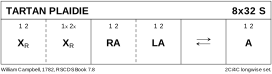
1-8
1s+2s cross RH & cross back RH
9-16
1s+2s dance RH across & LH across back to places
17-24
1s lead down the middle & back to top
25-32
1s+2s dance Allemande
E-Cribs
1-8
1c+2c cross RH ; cross back RH
9-16
1c+2c RHA ; LHA
17-24
1c down the middle and up
25-32
1c+2c Allemande

Заметки
This dance used to carry the alternate title »Highland Plaid« in early RSCDS books but this is no longer being used.
The Highland Plaid
(or “Tartan Plaidie”)
In his time, Robert Tannahill was a popoular song writer.
Among his works were “Gloomy Winter’s Noo Awa’”, “Jessie, the Flower o’ Dunblane”,
“O, Are Ye Sleepin’ Maggie”, and “O, Row Thee in My Highland Plaid”.
“Lowland lassie, wilt thou go
Where the hills are clad with snow;
Where, beneath the icy steep,
The hardy shepherd tends his sheep?
Ill nor wae shall thee betide,
When row’d within my Highland plaid.”
Tannahill was born on 3 June, 1774, the son of a Paisley silk weaver.
At the age of twelve, he was apprenticed to his father’s trade
and, with Robert Burns as his poetic idol,
he began to compose verses while at his loom.
In 1805, he made his first contributions to periodicals in Glasgow
and in 1807 a subscription edition of his poems was published.
On 17 May, 1810, Robert Tannahill committed suicide.
Since this dance appeared in William Campbell’s third collection of country dances,
published in 1788,
Tannahill had no personal connection with the dance,
but it is possible that the old tune, “Tartan Plaidie”, inspired his song.
From “Scotland Dances”, by Eugenia (Jeannie) Callander Sharp
(Used by permission.)
The Highland Plaid
(or “Tartan Plaidie”)
In his time, Robert Tannahill was a popoular song writer.
Among his works were “Gloomy Winter’s Noo Awa’”, “Jessie, the Flower o’ Dunblane”,
“O, Are Ye Sleepin’ Maggie”, and “O, Row Thee in My Highland Plaid”.
“Lowland lassie, wilt thou go
Where the hills are clad with snow;
Where, beneath the icy steep,
The hardy shepherd tends his sheep?
Ill nor wae shall thee betide,
When row’d within my Highland plaid.”
Tannahill was born on 3 June, 1774, the son of a Paisley silk weaver.
At the age of twelve, he was apprenticed to his father’s trade
and, with Robert Burns as his poetic idol,
he began to compose verses while at his loom.
In 1805, he made his first contributions to periodicals in Glasgow
and in 1807 a subscription edition of his poems was published.
On 17 May, 1810, Robert Tannahill committed suicide.
Since this dance appeared in William Campbell’s third collection of country dances,
published in 1788,
Tannahill had no personal connection with the dance,
but it is possible that the old tune, “Tartan Plaidie”, inspired his song.
From “Scotland Dances”, by Eugenia (Jeannie) Callander Sharp
(Used by permission.)