This is no' my ain Hoose
Основная информация
| Автор: | Unknown |
|---|---|
| RSCDS: |
 RSCDS HQ publication
|
| Сочинен в России: | Нет |
| Публикация: |
|
| Рекомендуемая музыка: |
|
Параметры
| Тип танца: | Strathspey |
|---|---|
| Тип сета: | Longwise set |
| Размер: | 8x32 |
| Формат сета: | 4 couples |
| Танцующие пары: | 3 |
Источник:
https://my.strathspey.org/dd/dance/6539/
MiniCribs
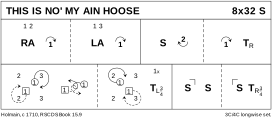
1-8
1s+2s dance RH across & 1s cast to 2nd place, 1s+3s dance LH across & 1s cast to 3rd place
9-16
1s set, lead up to top, cast to 2nd place & turn RH to end facing 1st corners
17-24
1s dance RSh round 1st corner, dance round partner LSh, dance round 2nd corner RSh & turn partner LH to face 1st corner again
25-32
1s dance ‘Hello-Goodbye’ setting turning RH to places
E-Cribs
1-8
1c+2c RHA {3}, 1c cast off as 2c dance to 1pl ; 1c+3c repeat LH (2,3,1)
9-16
1c set, dance NHJ to top (3c down) ; cast off, turn RH to face 1cnr
17-24
1c dance Rsh round 1cnr | Lsh round P ; Rsh round 2cnr | turn P LH to face 1cnr
25-32
1c SetH&G {6} | turn RH to 2pl (2,1,3)

Заметки
This Is No' My Ain Hoose
There are four versions of “This Is No My Ain House” in various collections.
The original was an old nursery song.
O this is no my ain house,
My ain house, my ain house;
O this is no my ain house,
I ken by the biggin o’t;
For bread and cheese are my door cheeks,
Are my door cheeks, are my door cheeks;
For bread and cheese are my door cheeks,
And pancakes the riggin o’t.
O this is no my ain wean,
My ain wean, my ain wean;
O this is no my ain wean,
I ken by the greetie o’t.
I’ll tak the curchie aff my head,
Aff my head, aff my head,
I’ll tak the curchie aff my head,
And row’t about the feetie o’t.
The second was written by Allan Ramsay sometime prior to 1724
and was included in William Thomson’s
Orpheus Caledonius
of 1733.
This is no mine ain House,
I ken by the Rigging o’t;
Since with My Love I’ve changed Vows,
I dinna like the Bigging o’t.
For now that I’m young Robie’s Bride,
And Mistress of his Fire-side,
Mine ain House I’ll like to guide,
And please me with the Trigging o’t.
Then farewell to my Father’s House,
I gang where Love invites me;
The strictest Duty this allows,
When Love with Honour meets me.
When Hymen moulds us into ane,
My Robie’s nearer than my Kin,
And to refuse him were a Sin,
Sae lang’s he kindly treats me.
When I’m in mine ain House,
True Love shall be at hand ay,
To make me still a prudent Spouse,
And let my Man command ay;
Avoiding ilka Cause of Strife,
The common Pest of married Life,
That makes ane wearied of his Wife,
And breaks the kindly Band ay.
In
Scottish Songs Prior to Burns
Robert Chambers provided a third version
and commented:
“When the Scottish Jacobite contemplated the changed conditions of his country
under a parliament-appointed dynasty,
he recalled the refrain of this grandam’s ditty,
and metaphorising the state as his house,
broke out into a political song,
representing the whole of its architectural features as changed for the worse,
and above all the daddy – the auld guidman – driven out of his chair in the hall,
to give place to a foreign intruder.”
O this is no my ain house,
I ken by the biggin’ o’t,
For bow-kail thrave at my door-cheek,
And thristles on the riggin’ o’t.
A carle cam wi’ lack o’ grace,
Wi’ unco gear and unco face,
And sin’ he claimed my daddy’s place,
I downa bide the triggin’ o’t.
Wi’ rowth o’ kin and rowth o’ reek,
My daddy’s door it wadna steek,
But bread and cheese were his door-cheek,
And girdle-cakes the riggin’ o’t.
My daddy bag his housie weel,
By dint o’ head and dint o’ heel,
By dint o’ arm and dint o’ steel,
And muckle weary priggin’ o’t.
Then, was it dink or was it douce,
For ony cringin’ foreign goose,
To claucht my daddy’s wee bit house,
And spoil the hamely triggin’ o’t?
Say, was it foul or was it fair,
To come a hunder miles and mair,
For to ding out my daddy’s heir,
And dash him wi’ the whiggin’ o’t?
Robert Burns wrote yet another version which he called “O, This Is No My Ain Lassie”
of which the chorus is:
O, this is no my ain lassie,
Fair tho’ the lassie be;
Weel ken I may ain lassie –
Kind love is in her e’e.
From “Scotland Dances”, by Eugenia (Jeannie) Callander Sharp
(Used by permission.)
There are four versions of “This Is No My Ain House” in various collections.
The original was an old nursery song.
O this is no my ain house,
My ain house, my ain house;
O this is no my ain house,
I ken by the biggin o’t;
For bread and cheese are my door cheeks,
Are my door cheeks, are my door cheeks;
For bread and cheese are my door cheeks,
And pancakes the riggin o’t.
O this is no my ain wean,
My ain wean, my ain wean;
O this is no my ain wean,
I ken by the greetie o’t.
I’ll tak the curchie aff my head,
Aff my head, aff my head,
I’ll tak the curchie aff my head,
And row’t about the feetie o’t.
The second was written by Allan Ramsay sometime prior to 1724
and was included in William Thomson’s
Orpheus Caledonius
of 1733.
This is no mine ain House,
I ken by the Rigging o’t;
Since with My Love I’ve changed Vows,
I dinna like the Bigging o’t.
For now that I’m young Robie’s Bride,
And Mistress of his Fire-side,
Mine ain House I’ll like to guide,
And please me with the Trigging o’t.
Then farewell to my Father’s House,
I gang where Love invites me;
The strictest Duty this allows,
When Love with Honour meets me.
When Hymen moulds us into ane,
My Robie’s nearer than my Kin,
And to refuse him were a Sin,
Sae lang’s he kindly treats me.
When I’m in mine ain House,
True Love shall be at hand ay,
To make me still a prudent Spouse,
And let my Man command ay;
Avoiding ilka Cause of Strife,
The common Pest of married Life,
That makes ane wearied of his Wife,
And breaks the kindly Band ay.
In
Scottish Songs Prior to Burns
Robert Chambers provided a third version
and commented:
“When the Scottish Jacobite contemplated the changed conditions of his country
under a parliament-appointed dynasty,
he recalled the refrain of this grandam’s ditty,
and metaphorising the state as his house,
broke out into a political song,
representing the whole of its architectural features as changed for the worse,
and above all the daddy – the auld guidman – driven out of his chair in the hall,
to give place to a foreign intruder.”
O this is no my ain house,
I ken by the biggin’ o’t,
For bow-kail thrave at my door-cheek,
And thristles on the riggin’ o’t.
A carle cam wi’ lack o’ grace,
Wi’ unco gear and unco face,
And sin’ he claimed my daddy’s place,
I downa bide the triggin’ o’t.
Wi’ rowth o’ kin and rowth o’ reek,
My daddy’s door it wadna steek,
But bread and cheese were his door-cheek,
And girdle-cakes the riggin’ o’t.
My daddy bag his housie weel,
By dint o’ head and dint o’ heel,
By dint o’ arm and dint o’ steel,
And muckle weary priggin’ o’t.
Then, was it dink or was it douce,
For ony cringin’ foreign goose,
To claucht my daddy’s wee bit house,
And spoil the hamely triggin’ o’t?
Say, was it foul or was it fair,
To come a hunder miles and mair,
For to ding out my daddy’s heir,
And dash him wi’ the whiggin’ o’t?
Robert Burns wrote yet another version which he called “O, This Is No My Ain Lassie”
of which the chorus is:
O, this is no my ain lassie,
Fair tho’ the lassie be;
Weel ken I may ain lassie –
Kind love is in her e’e.
From “Scotland Dances”, by Eugenia (Jeannie) Callander Sharp
(Used by permission.)
Видео 1
Demonstration quality

Видео 2
Demonstration quality
Видео 3
Demonstration quality