The Triumph
Основная информация
| Автор: | Nathaniel Gow |
|---|---|
| RSCDS: |
 RSCDS HQ publication
|
| Сочинен в России: | Нет |
| Публикация: |
|
| Рекомендуемая музыка: |
|
Параметры
| Тип танца: | Reel |
|---|---|
| Тип сета: | Longwise set |
| Размер: | 4x24 |
| Формат сета: | 4 couples |
| Танцующие пары: | 4 |
Источник:
https://my.strathspey.org/dd/dance/6748/
MiniCribs
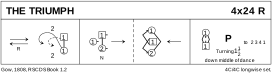
1-8
1s lead down the middle & back to top, 1M presenting 1L to 2M
9-16
1L+2M with nearer hands joined dance down the middle followed by 1M, 1L+2M turn inwards (holding hands) & with crossed arms gives LH to partner, 1M+2M join free hands in arch over Ladies head & all 3 dance up in “Triumph”, 2M returns to place
17-24
1s dance special Poussette (1/4 turn, travel, 1/4 turn, 1/4 turn, travel, 1/4 turn, 1/2 turn) down the middle to 4th place as 2s+3s+4s step up
E-Cribs
1-8
1c lead down the middle and up, 1M presents 1W to 2M
9-16
1W+2M (NHJ), followed by 1M, dance down the middle ; 1W+2M turn inwards and 1M joins (1W hands crossed and joined to outer hands of 1M+2M, their NH making arch above 1W), all three dance up in TRIUMPH to finish 2M in own place and 1c BHJ on opposite sides
17-24
1c Poussette down the middle to bottom pl (¼ R turn, progress, ¼ turn, ¼ turn, progress, progress with ¼ turn, ½ turn to own side, fall back to sides), (all other couples step up on 23-24).

Заметки
The Triumph
“The Triumph” is another dance title about which, from the distance of time, one can only theorise.
There are few clues and even the dates given could be considered suspect.
However, two ideas may be put forward as totally original thinking.
As to the date of the dance itself,
it has been said that “The Triumph” was introduced in 1808 by Nathaniel Gow,
son of the composer-fiddler Niel Gow.
In 1818 it appeared in a Parisian ballroom guide along with four other popular Scottish dances.
This does not mean that the dance was French,
but, rather, that it had been brought to Paris prior to 1818.
J. P. Boulogne, a French dancing master working in Glasgow,
included it in his 1827 collection called
The Ballroom
.
The actual music of the dance is somewhat older,
known perhaps in the latter half of the 18th century,
for the tune was to be found in a collection by James Aird
which was published in Glasgow in six volumes between 1782 and 1803.
This serves to emphasise the fact that, as a rule, the music came before the dances.
The first theory to be advanced is that the dance celebrates an historic event.
Chambers New Compact Dictionary
gives as one definition of “triumph”,
“in ancient Rome, a procession in honour of a victorious general”.
That definition plus the earliest dates of “The Triumph” would seem to indicate
that the dance celebrated a victory or an event during the Napoleonic Wars.
After all, Bars 13–16 of the dance specify that “All three lead up the middle in triumph”,
certainly a triumphal arch having been formed.
The earliest date, 1808, would point to an observance of the battle of Trafalgar on 21 October, 1805,
in which the Right Honourable Lord Viscount Nelson, from his flagship
Victory
,
defeated the French naval force.
It was a great victory, indeed, but unhappily an engagement in which Lord Nelson lost his life.
(See “Admiral Nelson”)
If the later date, 1818, is more acceptable,
the dance would seem to celebrate any triumph of the British and their allies over Napoleon Bonaparte.
This would stretch the period from Trafalgar to the crossing of the Pyrenees in 1813
by Lieutenant General Viscount Wellington at the successful conclusion of the Peninsular War,
to the triumphant entry into Paris by the allies on 30 March, 1814,
and the exile of Napoleon to Elba
or, even, to the terminal defeat of the French at Waterloo on 18 June, 1815,
under the leadership of the then Duke of Wellington
and the Prussian Field Marshal General Prince von Blücher.
The Iron Duke commanded the army of occupation in Paris from 1815 to 1818
and “The Triumph” could indeed have been brought to Paris by the British posted there at the time.
The second theory is based entirely upon a physical aspect of the dance,
a position, chiefly, of the arms of the dancers.
On Bars 13–16 the two men with the lady between them have joined hands with her,
the lady having crossed her arms
to give her left hand to her partner and her right hand to the second man,
both men having raised their free arms to form an arch “as high as possible over the lady’s head”.
They then “lead up the middle in triumph”.
This positioning, the design formed by the dancers, is the same as a head-on view of a “crown steeple”.
In Scotland this feature of Gothic architecture can be seen atop St. Giles’ Church in Edinburgh,
King’s College Chapel in Aberdeen and the Tolbooth in Glasgow.
There was formerly such Gothic ornamentation on the top of St. Michael’s Church at Linlithgow
but it was removed in 1820.
A crown steeple or lantern tower is found in England
only on St. Nicholas’ Church at Newcastle-upon-Tyne
and there it has been referred to as “a triumph”.
From “Scotland Dances”, by Eugenia (Jeannie) Callander Sharp
(Used by permission.)
“The Triumph” is another dance title about which, from the distance of time, one can only theorise.
There are few clues and even the dates given could be considered suspect.
However, two ideas may be put forward as totally original thinking.
As to the date of the dance itself,
it has been said that “The Triumph” was introduced in 1808 by Nathaniel Gow,
son of the composer-fiddler Niel Gow.
In 1818 it appeared in a Parisian ballroom guide along with four other popular Scottish dances.
This does not mean that the dance was French,
but, rather, that it had been brought to Paris prior to 1818.
J. P. Boulogne, a French dancing master working in Glasgow,
included it in his 1827 collection called
The Ballroom
.
The actual music of the dance is somewhat older,
known perhaps in the latter half of the 18th century,
for the tune was to be found in a collection by James Aird
which was published in Glasgow in six volumes between 1782 and 1803.
This serves to emphasise the fact that, as a rule, the music came before the dances.
The first theory to be advanced is that the dance celebrates an historic event.
Chambers New Compact Dictionary
gives as one definition of “triumph”,
“in ancient Rome, a procession in honour of a victorious general”.
That definition plus the earliest dates of “The Triumph” would seem to indicate
that the dance celebrated a victory or an event during the Napoleonic Wars.
After all, Bars 13–16 of the dance specify that “All three lead up the middle in triumph”,
certainly a triumphal arch having been formed.
The earliest date, 1808, would point to an observance of the battle of Trafalgar on 21 October, 1805,
in which the Right Honourable Lord Viscount Nelson, from his flagship
Victory
,
defeated the French naval force.
It was a great victory, indeed, but unhappily an engagement in which Lord Nelson lost his life.
(See “Admiral Nelson”)
If the later date, 1818, is more acceptable,
the dance would seem to celebrate any triumph of the British and their allies over Napoleon Bonaparte.
This would stretch the period from Trafalgar to the crossing of the Pyrenees in 1813
by Lieutenant General Viscount Wellington at the successful conclusion of the Peninsular War,
to the triumphant entry into Paris by the allies on 30 March, 1814,
and the exile of Napoleon to Elba
or, even, to the terminal defeat of the French at Waterloo on 18 June, 1815,
under the leadership of the then Duke of Wellington
and the Prussian Field Marshal General Prince von Blücher.
The Iron Duke commanded the army of occupation in Paris from 1815 to 1818
and “The Triumph” could indeed have been brought to Paris by the British posted there at the time.
The second theory is based entirely upon a physical aspect of the dance,
a position, chiefly, of the arms of the dancers.
On Bars 13–16 the two men with the lady between them have joined hands with her,
the lady having crossed her arms
to give her left hand to her partner and her right hand to the second man,
both men having raised their free arms to form an arch “as high as possible over the lady’s head”.
They then “lead up the middle in triumph”.
This positioning, the design formed by the dancers, is the same as a head-on view of a “crown steeple”.
In Scotland this feature of Gothic architecture can be seen atop St. Giles’ Church in Edinburgh,
King’s College Chapel in Aberdeen and the Tolbooth in Glasgow.
There was formerly such Gothic ornamentation on the top of St. Michael’s Church at Linlithgow
but it was removed in 1820.
A crown steeple or lantern tower is found in England
only on St. Nicholas’ Church at Newcastle-upon-Tyne
and there it has been referred to as “a triumph”.
From “Scotland Dances”, by Eugenia (Jeannie) Callander Sharp
(Used by permission.)
Видео 1
Demonstration quality

Видео 2
Demonstration quality
Видео 3
Demonstration quality
Видео 4
Demonstration quality
Видео 5
Good
Видео 6
Good
Видео 7
Reasonable
Видео 8
Reasonable
Видео 9
Animation