The Trysting Place
Основная информация
| Автор: | Iain Boyd |
|---|---|
| RSCDS: |
 RSCDS HQ publication
|
| Сочинен в России: | Нет |
| Публикация: |
|
| Рекомендуемая музыка: | The Trysting Place |
Параметры
| Тип танца: | Strathspey |
|---|---|
| Тип сета: | Longwise set |
| Размер: | 8x32 |
| Формат сета: | 4 couples |
| Танцующие пары: | 2 |
Источник:
https://my.strathspey.org/dd/dance/6756/
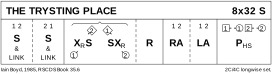
MiniCribs
1-8
1s+2s Set+Link, Set+Link again back to original places
9-16
1M & 2L cross RH & set while 1L & 2M set & cross RH, repeat back to places
17-24
1s+2s dance RH across & LH back to end in line of 4 in middle facing partners (Ladies facing down & Men up)
25-32
1s+2s dance Highland Schottische Poussette: 1s set HS step with both hands joined dancing out to Men’s side while 2s set & dance out to Ladies side ending with a 1/4 turn to right, 1s dance HS down Men’s side & 2s up Ladies side ending with a 1/4 turn to right, 1s+2s dance HS into centre to reform line of 4 in middle with couples having changed places, Men facing down, Ladies facing up, 2s+1s 3/4 turn partners 2H to own sides, 1s ending in 2nd place own side
E-Cribs
1-8
1c+2c S&Link, repeat
9-16
1M+2W change places RH and set while 2W+1M set and change places ; repeat
17-24
1c+2c RHA ; LHA into:
25-32
1c+2c (in centre, women above P) H.Schottische Poussette.

Заметки
Notes from Book 35
The dance was devised by Iain Boyd, New Zealand, in 1985, and inscribed to Mary Murray of Vancouver B.C.
Mary’s former home in Falkirk, and still that of her parents, is in Tryst Road, opposite the traditional site of the Falkirk Tryst where cattle drovers from the Highlands, Lowlands and the north of England met to buy and sell their livestock and produce.
The Highland Schottische poussette was created by Jackie Johnstone of Dumfries and was first used in his dance “S. S. Johnstone” (Loreburn Set Volume II). In that dance, the men start back to back in the middle of the line and so progression been modified for use in “Trysting Place”.
Notes extracted from elsewhere
The “Falkirk Tryst” was one of the largest livestock markets in Scotland with farmers and buyers gathering from all over Scotland and beyond. At its height times as many as 150,000 cattle, sheep and horses were droved there. The tryst was held up to three times a year in August, September and October. With the arrival of the railroad, numbers declined until the late 19th century. Nowadays, you still have the annual Falkirk tryst fun fair here.
For more also historical information on the Falkirk Tryst see
Falkirk Local History Society
,
Our Stories Falkirk
,
Falkirk Herold
and
Wikipedia
.
Pronuncation
The Scots pronuncation of “tryst”, according to the
Dictionaries of the Scots Language
is /trəist/. Don’t let yourself be confused by English dictionaries online which usually specify /trɪst/.
The dance was devised by Iain Boyd, New Zealand, in 1985, and inscribed to Mary Murray of Vancouver B.C.
Mary’s former home in Falkirk, and still that of her parents, is in Tryst Road, opposite the traditional site of the Falkirk Tryst where cattle drovers from the Highlands, Lowlands and the north of England met to buy and sell their livestock and produce.
The Highland Schottische poussette was created by Jackie Johnstone of Dumfries and was first used in his dance “S. S. Johnstone” (Loreburn Set Volume II). In that dance, the men start back to back in the middle of the line and so progression been modified for use in “Trysting Place”.
Notes extracted from elsewhere
The “Falkirk Tryst” was one of the largest livestock markets in Scotland with farmers and buyers gathering from all over Scotland and beyond. At its height times as many as 150,000 cattle, sheep and horses were droved there. The tryst was held up to three times a year in August, September and October. With the arrival of the railroad, numbers declined until the late 19th century. Nowadays, you still have the annual Falkirk tryst fun fair here.
For more also historical information on the Falkirk Tryst see
Falkirk Local History Society
,
Our Stories Falkirk
,
Falkirk Herold
and
Wikipedia
.
Pronuncation
The Scots pronuncation of “tryst”, according to the
Dictionaries of the Scots Language
is /trəist/. Don’t let yourself be confused by English dictionaries online which usually specify /trɪst/.
Видео 1
Demonstration quality

Видео 2
Demonstration quality
Видео 3
Demonstration quality
Видео 4
Good
Видео 5
Good
Видео 6
Reasonable
Видео 7
Animation