Tweedside
Основная информация
| Автор: | Unknown |
|---|---|
| RSCDS: |
 RSCDS HQ publication
|
| Сочинен в России: | Нет |
| Публикация: |
|
| Рекомендуемая музыка: | Tweedside |
Параметры
| Тип танца: | Reel |
|---|---|
| Тип сета: | Longwise set |
| Размер: | 8x36 |
| Формат сета: | 4 couples |
| Танцующие пары: | 3 |
Источник:
https://my.strathspey.org/dd/dance/6797/
MiniCribs
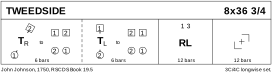
1-12
1M+2L turn RH (1M ends in 2nd place), 1L+2M turn LH (1L ends in 2nd place)
13-24
1s+3s dance R&L (3 steps per hand) 1s end facing 1st corners
25-36
1s turn 1st corner RH, partner LH, 2nd corner RH & partner LH to end in 2nd place
E-Cribs
Throughout this dance a special slow “menuet” PdB (step, step, close) is used.
1-6
1M+2W turn RH, 2W to own place, 1M to 2M place (2M up on [4-6].
7-12
1W+2M turn LH, 2M to 1M place, 1W to 2W place (2W up on [10-12] (2,1,3)
13-24
1c+3c R&L (3 steps per hand), 1c finish facing 1cnrs
25-36
Turn CPCP (3 steps per hand) (2,1,3)

Заметки
6 or 12 bar phrases.
Tweedside
What beauties does Flora disclose!
How sweet are her smiles upon Tweed!
Yet Mary’s, still sweeter than those,
Both nature and fancy exceed.
No daisy, nor sweet blushing rose,
Not all the gay flowers of the field,
Not Tweed gliding gently through those,
Such beauty and pleasure does yield.
The warblers are heard in the grove,
The linnet, the lark and the thrush;
The blackbird, and sweet cooing dove,
With music enchat ev’ry bush.
Come, let us go forth to the mead;
Let us see how the primroses spring;
We’ll lodge in some village on Tweed,
And love while the feather’d folk sing.
How does my love pass the long day?
Does Mary not tend a few sheep?
Do they never carelessly stray
While happily she lies asleep?
Should Tweed’s murmurs lull her to rest,
Kind nature indulgin’ my bliss,
To ease the soft pains of my breast,
I’d steal an ambrosial kiss.
'Tis she does the virgins excell;
No beauty with her may compare;
Love’s graces around her do dwell;
She’s fairest where thousands are fair.
Say, charmer, where do thy flocks stray?
Oh, tell me at morn where they feed?
Shall I seek them on sweet-winding Tay
Or the pleasanter banks of the Tweed?
William Stenhouse said in reference to “Tweedside”:
“This beautiful song, beginning
What beauties does Flora disclose
,
was written prior to 1724, as it was printed in Ramsay’s
Collection
that year,
and again in 1725, with the music, in the
Orpheus Caledonius
.”
There was a good deal of critical argument in regard to the author of the song.
Stenhouse said it was William Crawfurd of Auchinames
and that “According to the testimony of Sir Walter Scott, Bart.
the lady who is celebrated in Crawfurd’s song was a Miss Mary Lillias Scott,
one of the daughters of Walter Scott, Esq. of Harden,
an estate delightfully situated on teh north side of the Tweed, about four miles below Melrose.
This lady was a descendent of another celebrated beauty,
Mary Scott, daughter of Scott of Dryhope, in Selkirkshire,
famous by the traditional name of
The Flower of Yarrow
.”
(See also “The Duke of Hamilton’s Reel”)
Robert Burns was of the opinion that
“He was a Robert Crawford; the Mary he celebrates, was a Mary Stewart, of the Castle-Milk family,
afterwards married to a Mr. John Ritchie.”
Charles Kirkpatrick Sharpe, that early 19th century literary magpie,
offered such a plethora of information on teh subject as to totally confuse the issue.
Burns was undoubtedly correct in stating
that “Tweedside” was written by Robert Crawfurd (1695–1732).
Robert Chambers in
Scottish Songs Prior to Burns
summed up the whole discussion.
“In the reign of George I,
when our national melodies and songs were beginning to make their way into good company,
there was a young gentleman named Robert Crawford,
who manifested a decided gift in pastoral poesy.
There has been some doubt as to his family, and even his Christian name;
but it may now be regarded as settled that he was not William Crawford of the Auchinames family,
in Renfrewshire, as was at one time commonly set forth,
but Robert Crawford, second son of Patrick Crawford of Drumsoy, in that county.”
There was critical agreement though on an older song to the same tune.
Stenhouse stated:
“In the
Muses Delight
, printed at Liverpool in 1754,
this beautiful old Scottish melody is erroneously attributed to Signor David Rizzio,
a musician in the service of Mary, Queen of Scots.
The real name of the composer is unknown.
Prior to the birth of Ramsay, in 1684, it was adapted to the following verses,
which are said to have been written by Lord Yester.”
When Maggie and I were acquaint,
I carried my noddle fu’ hie;
Nae lint-white on all the gay plain,
Nor gowdspink sae bonny as she.
I whistled, I pip’d, and I sang,
I woo’d, but I came nae great speed,
Therefore I maun wander abroad,
And lay my bynes fare frae the Tweed.
To Maggie my love I did tell,
Saut tears did my passion express;
Alas! for I loo’d her o’er well,
And the lasses loe sic a man less;
Her heart it was frozen and cauld,
Her pride had my ruin decreed,
Therefore I will wander abroad,
And lay my banes far frae the Tweed.
Lord Yester was John Hay, ultimately second Marquess of Tweeddale.
The River Tweed meanders for just short of a hundred miles
through the lovely countryisde of Lowland hills on its gentle way to the North Sea.
It rises at Tweedswell, not far from the sources of the Clyde and the Annan,
and, joining company with the Gala, Leader, Yarrow, Ettrick, Teviot, and Till,
drifts past Peebles and Galashiels and Melrose and Kelso to Coldstream and Berwick.
For a dozen miles the Tweed is actually the Border
and for two miles, at Berwick, before it gives itself up to the sea, it flows through England.
The Tweed is a Scottish river, though,
and its valley has been a cradle of Scottish literary genius
from Thomas of Erceldoune, Thomas the Rhymer, the 13th century soothsayer,
to James Hogg, the Ettrich Shepherd,
to Sir Walter Scott and John Buchan, 1st Baron Tweedmuir, author of
The Thirty-Nine Steps
.
From “Scotland Dances”, by Eugenia (Jeannie) Callander Sharp
(Used by permission.)
Tweedside
What beauties does Flora disclose!
How sweet are her smiles upon Tweed!
Yet Mary’s, still sweeter than those,
Both nature and fancy exceed.
No daisy, nor sweet blushing rose,
Not all the gay flowers of the field,
Not Tweed gliding gently through those,
Such beauty and pleasure does yield.
The warblers are heard in the grove,
The linnet, the lark and the thrush;
The blackbird, and sweet cooing dove,
With music enchat ev’ry bush.
Come, let us go forth to the mead;
Let us see how the primroses spring;
We’ll lodge in some village on Tweed,
And love while the feather’d folk sing.
How does my love pass the long day?
Does Mary not tend a few sheep?
Do they never carelessly stray
While happily she lies asleep?
Should Tweed’s murmurs lull her to rest,
Kind nature indulgin’ my bliss,
To ease the soft pains of my breast,
I’d steal an ambrosial kiss.
'Tis she does the virgins excell;
No beauty with her may compare;
Love’s graces around her do dwell;
She’s fairest where thousands are fair.
Say, charmer, where do thy flocks stray?
Oh, tell me at morn where they feed?
Shall I seek them on sweet-winding Tay
Or the pleasanter banks of the Tweed?
William Stenhouse said in reference to “Tweedside”:
“This beautiful song, beginning
What beauties does Flora disclose
,
was written prior to 1724, as it was printed in Ramsay’s
Collection
that year,
and again in 1725, with the music, in the
Orpheus Caledonius
.”
There was a good deal of critical argument in regard to the author of the song.
Stenhouse said it was William Crawfurd of Auchinames
and that “According to the testimony of Sir Walter Scott, Bart.
the lady who is celebrated in Crawfurd’s song was a Miss Mary Lillias Scott,
one of the daughters of Walter Scott, Esq. of Harden,
an estate delightfully situated on teh north side of the Tweed, about four miles below Melrose.
This lady was a descendent of another celebrated beauty,
Mary Scott, daughter of Scott of Dryhope, in Selkirkshire,
famous by the traditional name of
The Flower of Yarrow
.”
(See also “The Duke of Hamilton’s Reel”)
Robert Burns was of the opinion that
“He was a Robert Crawford; the Mary he celebrates, was a Mary Stewart, of the Castle-Milk family,
afterwards married to a Mr. John Ritchie.”
Charles Kirkpatrick Sharpe, that early 19th century literary magpie,
offered such a plethora of information on teh subject as to totally confuse the issue.
Burns was undoubtedly correct in stating
that “Tweedside” was written by Robert Crawfurd (1695–1732).
Robert Chambers in
Scottish Songs Prior to Burns
summed up the whole discussion.
“In the reign of George I,
when our national melodies and songs were beginning to make their way into good company,
there was a young gentleman named Robert Crawford,
who manifested a decided gift in pastoral poesy.
There has been some doubt as to his family, and even his Christian name;
but it may now be regarded as settled that he was not William Crawford of the Auchinames family,
in Renfrewshire, as was at one time commonly set forth,
but Robert Crawford, second son of Patrick Crawford of Drumsoy, in that county.”
There was critical agreement though on an older song to the same tune.
Stenhouse stated:
“In the
Muses Delight
, printed at Liverpool in 1754,
this beautiful old Scottish melody is erroneously attributed to Signor David Rizzio,
a musician in the service of Mary, Queen of Scots.
The real name of the composer is unknown.
Prior to the birth of Ramsay, in 1684, it was adapted to the following verses,
which are said to have been written by Lord Yester.”
When Maggie and I were acquaint,
I carried my noddle fu’ hie;
Nae lint-white on all the gay plain,
Nor gowdspink sae bonny as she.
I whistled, I pip’d, and I sang,
I woo’d, but I came nae great speed,
Therefore I maun wander abroad,
And lay my bynes fare frae the Tweed.
To Maggie my love I did tell,
Saut tears did my passion express;
Alas! for I loo’d her o’er well,
And the lasses loe sic a man less;
Her heart it was frozen and cauld,
Her pride had my ruin decreed,
Therefore I will wander abroad,
And lay my banes far frae the Tweed.
Lord Yester was John Hay, ultimately second Marquess of Tweeddale.
The River Tweed meanders for just short of a hundred miles
through the lovely countryisde of Lowland hills on its gentle way to the North Sea.
It rises at Tweedswell, not far from the sources of the Clyde and the Annan,
and, joining company with the Gala, Leader, Yarrow, Ettrick, Teviot, and Till,
drifts past Peebles and Galashiels and Melrose and Kelso to Coldstream and Berwick.
For a dozen miles the Tweed is actually the Border
and for two miles, at Berwick, before it gives itself up to the sea, it flows through England.
The Tweed is a Scottish river, though,
and its valley has been a cradle of Scottish literary genius
from Thomas of Erceldoune, Thomas the Rhymer, the 13th century soothsayer,
to James Hogg, the Ettrich Shepherd,
to Sir Walter Scott and John Buchan, 1st Baron Tweedmuir, author of
The Thirty-Nine Steps
.
From “Scotland Dances”, by Eugenia (Jeannie) Callander Sharp
(Used by permission.)