The Waratah Weaver
Основная информация
| Автор: | Elma See |
|---|---|
| RSCDS: |
 RSCDS HQ publication
|
| Сочинен в России: | Нет |
| Публикация: |
|
| Рекомендуемая музыка: | The Waratah Weaver |
Параметры
| Тип танца: | Jig |
|---|---|
| Тип сета: | Longwise set |
| Размер: | 4x32 |
| Формат сета: | 4 couples |
| Танцующие пары: | 4 |
Источник:
https://my.strathspey.org/dd/dance/8203/
MiniCribs
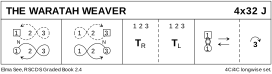
1-8
1s dance Figs of 8 on own sides (dancing in & down to start)
9-16
3s dance Figs of 8 on own sides (dancing in & up to start)
17-24
1s+2s+3s turn RH, turn LH
25-32
1s slip step down for 4 steps & back up to top, 1s cast to bottom as 2s+3s+4s step up
E-Cribs
Can be danced in a 3C, 4C or 5C set
1-8
1c Fig8 on own sides (start in & down)
9-16
Bottom couple Fig8 on own sides (start in & up)
17-24
All turn P RH ; LH
25-32
1c slip down | and up to top ; 1c long cast to bottom (other couples up)

Заметки
The original publication (in
Look, We're Dancing
) says it can be danced in a 3C, 4C or 5C set.
Though the version in the
2nd Graded book
only mentions a 4C set.
The dance intensity is given for the 4C version.
Another existing variation is 8x32 for 3C in a 4C set with the three couples all dancing reels instead of solo figures of 8.
The notes say it was devised “for everyone to dance but especially for new dancers” and also that “the waratah (Telopea speciosissima) is the floral symbol of New South Wales and the name of a suburb of Newcastle, New South Wales.”
Waratah
Waratah is a suburb of Newcastle, New South Wales, Australia, and – perhaps more importantly, the native name of a genus of large shrubs (or small trees) endemic to Australia (
Telopea sp.
). It includes five species, of which
Telopea speciosissima
is the most well-known; it has red flowers and serves as the official flower of the Australian federal state of New South Wales.
The more mature among us may also remember the fictional Waratah National Park, home to
Skippy the Bush Kangaroo
– besides
Flipper
or
Lassie
one of the most popular classic kids’ television series with animal protagonists. There were 91 episodes altogether, which aired from 1968 to 1970. Filming involved between nine and fifteen kangaroos per episode (“like people, some kangaroos are brighter than others”, said producer Dennis Hill), including a stuffed one for scenes that no real kangaroo could be subjected to, plus a large menagerie of other animals such as dingos, emus, opossums, or koalas. There was also a feature film called
Skippy and the Intruders
.
From “Anselm's Notes on Dances”, by Anselm Lingnau
(Used by permission.)
Look, We're Dancing
) says it can be danced in a 3C, 4C or 5C set.
Though the version in the
2nd Graded book
only mentions a 4C set.
The dance intensity is given for the 4C version.
Another existing variation is 8x32 for 3C in a 4C set with the three couples all dancing reels instead of solo figures of 8.
The notes say it was devised “for everyone to dance but especially for new dancers” and also that “the waratah (Telopea speciosissima) is the floral symbol of New South Wales and the name of a suburb of Newcastle, New South Wales.”
Waratah
Waratah is a suburb of Newcastle, New South Wales, Australia, and – perhaps more importantly, the native name of a genus of large shrubs (or small trees) endemic to Australia (
Telopea sp.
). It includes five species, of which
Telopea speciosissima
is the most well-known; it has red flowers and serves as the official flower of the Australian federal state of New South Wales.
The more mature among us may also remember the fictional Waratah National Park, home to
Skippy the Bush Kangaroo
– besides
Flipper
or
Lassie
one of the most popular classic kids’ television series with animal protagonists. There were 91 episodes altogether, which aired from 1968 to 1970. Filming involved between nine and fifteen kangaroos per episode (“like people, some kangaroos are brighter than others”, said producer Dennis Hill), including a stuffed one for scenes that no real kangaroo could be subjected to, plus a large menagerie of other animals such as dingos, emus, opossums, or koalas. There was also a feature film called
Skippy and the Intruders
.
From “Anselm's Notes on Dances”, by Anselm Lingnau
(Used by permission.)
Видео 1
Demonstration quality

Видео 2
Reasonable
Видео 3
Reasonable
Видео 4
Social
Видео 5
Animation