Everything Stops for Tea
Основная информация
| Автор: | Ronald Mackey |
|---|---|
| RSCDS: | Не RSCDS |
| Сочинен в России: | Нет |
| Публикация: | - |
| Рекомендуемая музыка: | - |
Параметры
| Тип танца: | Strathspey |
|---|---|
| Тип сета: | Longwise set |
| Размер: | 8x32 |
| Формат сета: | 4 couples |
| Танцующие пары: | 3 |
Источник:
https://my.strathspey.org/dd/dance/8855/
MiniCribs
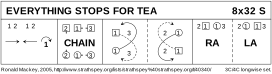
1-8
2s followed by 1s lead down, 1s followed by 2s lead up to top & 1s cast to 2nd place
9-16
2s+1s+3s dance Grand Chain
17-24
1s dance 1/2 Fig of 8 round 3s (giving RH) & 1/2 Fig of 8 round 2s (giving RH)
25-32
1s dance RH across (Lady with 2s & Man with 3s) & dance LH across with other couple
E-Cribs
1-8
2c, 1c following, lead down {3}, and up, 1c leading {3} | 1c cast (to 2,1,3)
9-16
G-Chain (2c cross to start)
17-24
1c ½ Fig8 down (cross RH) , repeat up
25-32
Teapots R and L

Заметки
According to the description in the strathspey threads
40296
and finally
40434
this dance seems to refers to tearoom culture in the 1930es.
The deviser describes it as a dance in four acts.
“The Park” (bars 1-8): The lead down and back and cast represent a pre-tea stroll through the park.
“The Teashop Foyer” (bars 9-16): The rectangle inscribed by the grand chain represents the foyer of the tea shop.
“Finding One’s Table” (bars 17-24): The half figures of eight down and then up represent searching for a free table.
“The Teapots” (bars 25-32): And the “teapots” represent…well, of course…the teapot.
He explicitly also refers to the song “Everything Stops for Tea” as the suggested tune. It was written by Maurice Sigler (tune) and Al Goodheart (lyrics). The song was performed by Jack Buchanan in 1935 and was available on records and featured in Buchanan’s 1935 comedy film, “Come Out Of The Pantry”.
40296
and finally
40434
this dance seems to refers to tearoom culture in the 1930es.
The deviser describes it as a dance in four acts.
“The Park” (bars 1-8): The lead down and back and cast represent a pre-tea stroll through the park.
“The Teashop Foyer” (bars 9-16): The rectangle inscribed by the grand chain represents the foyer of the tea shop.
“Finding One’s Table” (bars 17-24): The half figures of eight down and then up represent searching for a free table.
“The Teapots” (bars 25-32): And the “teapots” represent…well, of course…the teapot.
He explicitly also refers to the song “Everything Stops for Tea” as the suggested tune. It was written by Maurice Sigler (tune) and Al Goodheart (lyrics). The song was performed by Jack Buchanan in 1935 and was available on records and featured in Buchanan’s 1935 comedy film, “Come Out Of The Pantry”.
Видео 1
Good

Видео 2
Social