The Campbells are coming
Основная информация
| Автор: | Unknown |
|---|---|
| RSCDS: |
 RSCDS HQ publication
|
| Сочинен в России: | Нет |
| Публикация: |
|
| Рекомендуемая музыка: |
|
Параметры
| Тип танца: | Jig |
|---|---|
| Тип сета: | Round the room |
| Размер: | 32 тактов |
| Формат сета: | - |
| Танцующие пары: | 2 |
Источник:
https://my.strathspey.org/dd/dance/984/
MiniCribs
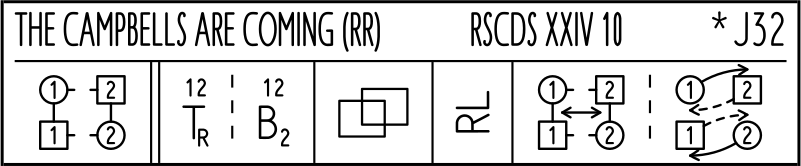
Progressive 2 couple dance, 2 facing 2 round room, Lady on Man’s right
1-8
All turn RH, face partner & set advancing to Bal-in-Line with Ladies in middle giving RH to each other & LH to partners
9-16
Ladies 1/2 turn RH into Ladies’ Chain ending back in original places
17-24
All dance R&L starting by giving RH to other partner
25-32
All Adv+Ret & dance on passing other partner RSh to face oncoming couple
E-Cribs
Couple face couple RR
1-8
All turn P RH ; all set advancing and join LH with P, the W joining RH | BiL
9-16
W turn RH ½ into L-Chain (along line of dance), finish in own places
17-24
R&L, starting RH to opposite couple
25-32
A&R with the other couple ; advance passing Rsh to meet the next couple.

Заметки
The Campbells Are Coming
There are several opinions about the song which most of us have known from childhood
and from which the title of this dance is taken.
It is agreed that the original melody was an old traditional Scots air,
of the lesser pipe music, called “Baile Inneraora” or “The Town of Inverary”.
It is certainly a fact that the tune “The Campbells Are Coming”,
set to the original ancient music,
is the regimental march of the 1st Battalion of the Argyll and Sutherland Highlanders.
Upon the Lomonds I lay, I lay,
Upon the Lomonds I lay, I lay,
I looked down to bonnie Lochleven
And saw three bonnie perches play.
Chorus
The Campbells are comin’, Oho, Oho,
The Campbells are comin’, Oho, Oho,
The Campbells are comin’ to bonnie Lochleven,
The Campbells are comin’, Oho, Oho.
Great Argyle he goes before;
He maks his cannon and guns to roar,
Wi’ sound o’ trumpet, pipe and drum;
The Campbells are comin’, Oho, Oho.
The Campbells they are a’ in arms,
Their loyal faith and truth to show,
Wi’ banners rattling in the wind,
The Campbells are comin’, Oho, Oho.
One source states that the words were wriiten in all probability
by an anonymous hand about 1715
when John Campbell, 2nd Duke of Argyll,
was made Commander-in-Chief of the forces of George I in Scotland
and , in that capacity, crushed the rebellion that would have put James Francis Edward Stuart,
son of James VII and II, on the throne.
The mere mention of the Old Pretender and the “'15” immediately raises the “'45” and, again,
the Campbells were in the forefront of the Hanoverian forces at the battle of Culloden
when Prince Charles Edward Stuart and the majority of the Highland clans were defeated.
In 1794 George III called for four regiments from Scotland
to bolster his army and his orders went to John, 5th Duke of Argyll,
as well as to the Campbell Earl of Breadalbane, the Gordon Marquess of HUntly
and Thomas Graham of Balgowan, later Lord Lynedoch.
The king was in need of staunch Scottish troops in sizeable numbers for an impending war with France.
Since the Duke of Argyll was very ill at the time,
he named Duncan Campbell of Lochnell to carry out the king’s order.
It was thus that the 91st Argyllshire Regiment, then known as the Argyle Regiment,
was raised by Lochnell.
In 1881 the regiment was joined with the Sutherland regiment
to become the 1st and 2nd Battalions of Princess Louise’s Argyll and Sutherland Highlanders.
H.R.H. the Princess Louise, the fourth daughter of Queen Victoria,
was the wife of John Douglas Sutherland Campbell, 9th Duke of Argyll.
But, while one source states that the words were by an anonymous author,
a song entitled “Upon the Lomonds I Lay, I Lay”, to the tune “The Campbells are Comin’”,
is to be found in the collections of the songs and poems of Robert Burns.
This, then, might damp down the implied adulation for the Campbells
for, since Burns was a fiery patriot, Scottish nationalist and sentimental Jacobite
the words would then have a ring of irony and a bite of sarcasm to them.
The power of the Campbells,
which stemmed directly from kingly grace and favour for services rendered,
had long been deeply resented and, as a result,
the participation of so many of the Highland clans in the uprisings of 1715 and 1745
was not so much
for
the Jacobites as
against
the Campbells.
However, an interesting note is found in the index to Volume III (1790)
of James Johnson’s
The Scots Musical Museum
,
to which six volume collection Burns was a prime contributor.
“The Campbells Are Comin – Said to be composed on the imprisonment of Mary Queen of Scots
in Lochleven Castle”
If this story be true, then “Great Argyle” is Archibald Donn Campbell, 5th Earl of Argyll (1530-1573),
the same Argyll who is commemorated in Glasgow’s monument to John Knox.
Archibald Campbell changed his political colours as readily as a chameleon.
First, he became an adherent of John Knox, one of the “Lords of Congregation”
and one of James Stuart’s chief supporters during the regency of Marie de Guise (Mary of Lorraine),
the widowed mother of Mary Stuart.
He was married to Jean Stuart who, like Lord James, was an illegitimate off-spring of James V.
The Countess of Argyll was a great friend of her half-sister, the young queen,
and though the earl and countess detested each other so wholeheartedly
that Lady Jean was afraid for her life if she resided at Inverary when her husband was present,
the earl rallied to the queen’s colours.
In doing so, he separated himself from Knox and the reformers
and eventually from Lord James, who was by that time the Earl of Moray.
It has never been proved whether or not Argyll was an accomplice to both the murder of David Rizzio,
Mary’s secretary, and of Lord Darnley, her husband.
He was, as the song suggests, commander of the queen’s army at Langside in 1568,
the disastrous battle that occurred after Mary’s escape from Lochleven,
a defeat that sent her fleeingto England and another capitvity that ended in her death.
Argyll later made his peace with the Regent Moray and after Moray’s assassination,
in which Argyll may have been implicated,
Archibald Campbell became Lord High Chancellor of Scotland.
The reference to the three “perches” is intriguing.
While a perch could certainly never be confused with a salmon,
the right to wear silver buttons in the shape of salmon is reserved for the Duke of Argyll,
his heir the Marquess of Lorne, and Campbell of Lochnell.
From “Scotland Dances”, by Eugenia (Jeannie) Callander Sharp
(Used by permission.)
There are several opinions about the song which most of us have known from childhood
and from which the title of this dance is taken.
It is agreed that the original melody was an old traditional Scots air,
of the lesser pipe music, called “Baile Inneraora” or “The Town of Inverary”.
It is certainly a fact that the tune “The Campbells Are Coming”,
set to the original ancient music,
is the regimental march of the 1st Battalion of the Argyll and Sutherland Highlanders.
Upon the Lomonds I lay, I lay,
Upon the Lomonds I lay, I lay,
I looked down to bonnie Lochleven
And saw three bonnie perches play.
Chorus
The Campbells are comin’, Oho, Oho,
The Campbells are comin’, Oho, Oho,
The Campbells are comin’ to bonnie Lochleven,
The Campbells are comin’, Oho, Oho.
Great Argyle he goes before;
He maks his cannon and guns to roar,
Wi’ sound o’ trumpet, pipe and drum;
The Campbells are comin’, Oho, Oho.
The Campbells they are a’ in arms,
Their loyal faith and truth to show,
Wi’ banners rattling in the wind,
The Campbells are comin’, Oho, Oho.
One source states that the words were wriiten in all probability
by an anonymous hand about 1715
when John Campbell, 2nd Duke of Argyll,
was made Commander-in-Chief of the forces of George I in Scotland
and , in that capacity, crushed the rebellion that would have put James Francis Edward Stuart,
son of James VII and II, on the throne.
The mere mention of the Old Pretender and the “'15” immediately raises the “'45” and, again,
the Campbells were in the forefront of the Hanoverian forces at the battle of Culloden
when Prince Charles Edward Stuart and the majority of the Highland clans were defeated.
In 1794 George III called for four regiments from Scotland
to bolster his army and his orders went to John, 5th Duke of Argyll,
as well as to the Campbell Earl of Breadalbane, the Gordon Marquess of HUntly
and Thomas Graham of Balgowan, later Lord Lynedoch.
The king was in need of staunch Scottish troops in sizeable numbers for an impending war with France.
Since the Duke of Argyll was very ill at the time,
he named Duncan Campbell of Lochnell to carry out the king’s order.
It was thus that the 91st Argyllshire Regiment, then known as the Argyle Regiment,
was raised by Lochnell.
In 1881 the regiment was joined with the Sutherland regiment
to become the 1st and 2nd Battalions of Princess Louise’s Argyll and Sutherland Highlanders.
H.R.H. the Princess Louise, the fourth daughter of Queen Victoria,
was the wife of John Douglas Sutherland Campbell, 9th Duke of Argyll.
But, while one source states that the words were by an anonymous author,
a song entitled “Upon the Lomonds I Lay, I Lay”, to the tune “The Campbells are Comin’”,
is to be found in the collections of the songs and poems of Robert Burns.
This, then, might damp down the implied adulation for the Campbells
for, since Burns was a fiery patriot, Scottish nationalist and sentimental Jacobite
the words would then have a ring of irony and a bite of sarcasm to them.
The power of the Campbells,
which stemmed directly from kingly grace and favour for services rendered,
had long been deeply resented and, as a result,
the participation of so many of the Highland clans in the uprisings of 1715 and 1745
was not so much
for
the Jacobites as
against
the Campbells.
However, an interesting note is found in the index to Volume III (1790)
of James Johnson’s
The Scots Musical Museum
,
to which six volume collection Burns was a prime contributor.
“The Campbells Are Comin – Said to be composed on the imprisonment of Mary Queen of Scots
in Lochleven Castle”
If this story be true, then “Great Argyle” is Archibald Donn Campbell, 5th Earl of Argyll (1530-1573),
the same Argyll who is commemorated in Glasgow’s monument to John Knox.
Archibald Campbell changed his political colours as readily as a chameleon.
First, he became an adherent of John Knox, one of the “Lords of Congregation”
and one of James Stuart’s chief supporters during the regency of Marie de Guise (Mary of Lorraine),
the widowed mother of Mary Stuart.
He was married to Jean Stuart who, like Lord James, was an illegitimate off-spring of James V.
The Countess of Argyll was a great friend of her half-sister, the young queen,
and though the earl and countess detested each other so wholeheartedly
that Lady Jean was afraid for her life if she resided at Inverary when her husband was present,
the earl rallied to the queen’s colours.
In doing so, he separated himself from Knox and the reformers
and eventually from Lord James, who was by that time the Earl of Moray.
It has never been proved whether or not Argyll was an accomplice to both the murder of David Rizzio,
Mary’s secretary, and of Lord Darnley, her husband.
He was, as the song suggests, commander of the queen’s army at Langside in 1568,
the disastrous battle that occurred after Mary’s escape from Lochleven,
a defeat that sent her fleeingto England and another capitvity that ended in her death.
Argyll later made his peace with the Regent Moray and after Moray’s assassination,
in which Argyll may have been implicated,
Archibald Campbell became Lord High Chancellor of Scotland.
The reference to the three “perches” is intriguing.
While a perch could certainly never be confused with a salmon,
the right to wear silver buttons in the shape of salmon is reserved for the Duke of Argyll,
his heir the Marquess of Lorne, and Campbell of Lochnell.
From “Scotland Dances”, by Eugenia (Jeannie) Callander Sharp
(Used by permission.)
Видео 1
Good

Видео 2
Good
Видео 3
Social
Видео 4
Social